
Sir James Dashwood (1715–1779)
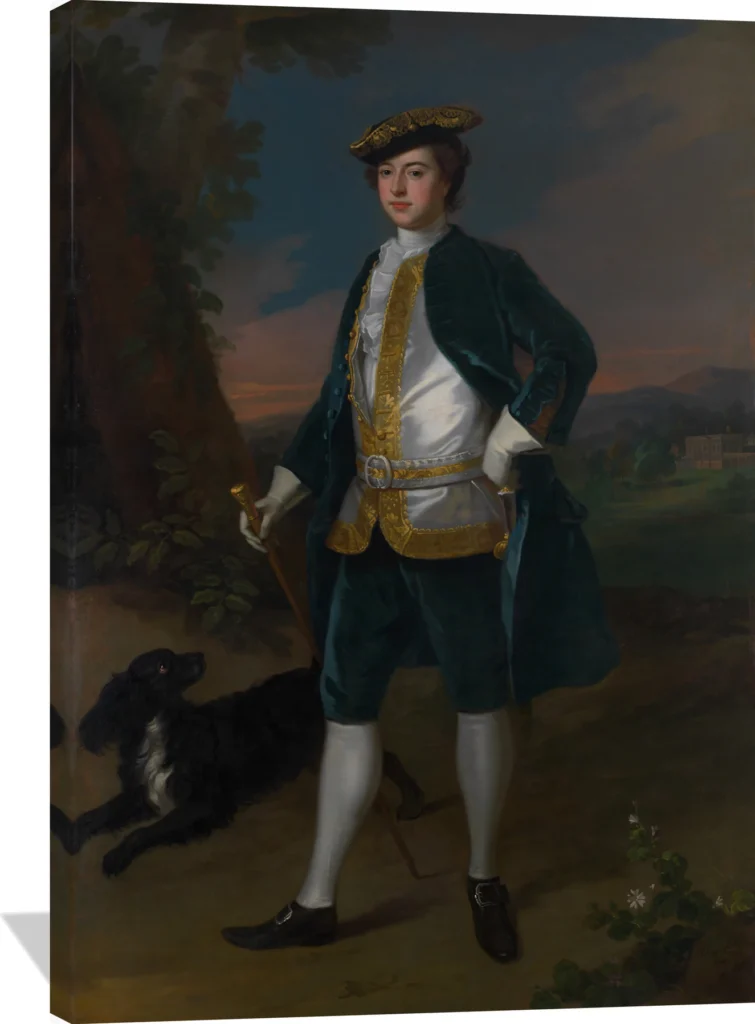
The Enoch Seeman the Younger Sir James Dashwood (1715–1779) canvas captures the refined elegance of 18th-century portraiture. Set against a serene dusk landscape, the young gentleman stands confidently in rich teal and gold attire, accompanied by his loyal dog. The composition’s deep greens, warm browns, and soft sky tones evoke a mood of aristocratic poise and timeless grace.
This exquisite canvas print brings a touch of heritage and sophistication to any space. Ideal for a study, library, or classic living room, it celebrates the artistry of Seeman’s German-English tradition while adding a stately focal point to modern interiors.
Enoch Seeman the Younger (German, Danzig ca. 1690–1744 London) was a distinguished portrait painter whose career flourished in early eighteenth‑century England. Renowned for his refined technique and perceptive character studies, he became a sought‑after artist among Britain’s aristocracy and rising professional class.
Artistic Style
Seeman’s work is defined by its elegant balance of realism and subtle idealization. His portraits display disciplined draftsmanship, smooth brushwork, and a quiet luminosity that highlights the sitter’s presence without excess ornamentation. He favored richly textured fabrics and carefully modulated flesh tones, integrating them into compositions that exude poise and understated sophistication.
Typical Subjects
Known primarily for his portraits, Seeman captured members of the English gentry, nobility, and prominent cultural figures. His sitters are often portrayed with a calm self-assurance, emphasizing dignity and social stature. Beyond likeness, he conveyed psychological nuance, offering viewers a sense of the personality behind each refined façade.
Notable Contributions
Seeman played a significant role in shaping Britain’s portrait tradition during a period of cultural expansion and shifting tastes. Working in London at a time when demand for personal and dynastic representation surged, he contributed to the visual language that defined Georgian society. His ability to combine technical clarity with a perceptive, humanizing touch made him a valued contemporary and a respected figure in the evolution of eighteenth‑century portraiture.
Cultural Significance
As an artist who bridged continental training with English artistic expectations, Seeman brought a distinctive blend of Northern European precision and British elegance to his work. His paintings offer a window into the aspirations, identities, and social rituals of early Georgian England, making them historically rich as well as visually compelling. Today, his portraits are appreciated for their enduring refinement and their contribution to the development of the British portrait tradition.
Trust & policies
- 🚚 Free tracked shipping to 45+ countries. Local import duties or taxes may apply in some destinations.
- 🎨 Made-to-order, printed close to your delivery location
- 🛡️ If damaged, defective, or misprinted: free replacement or refund
- 🌍 Printed in US/CA/EU/UK/AU based on delivery location
- 💎 Acid-free, fade-resistant canvas with solid wood stretcher bars
- 🖼️ Optional pine floating frames in white, black, or brown
- 🪝 Ready to hang — hardware pre-installed