
Interior with a Young Couple
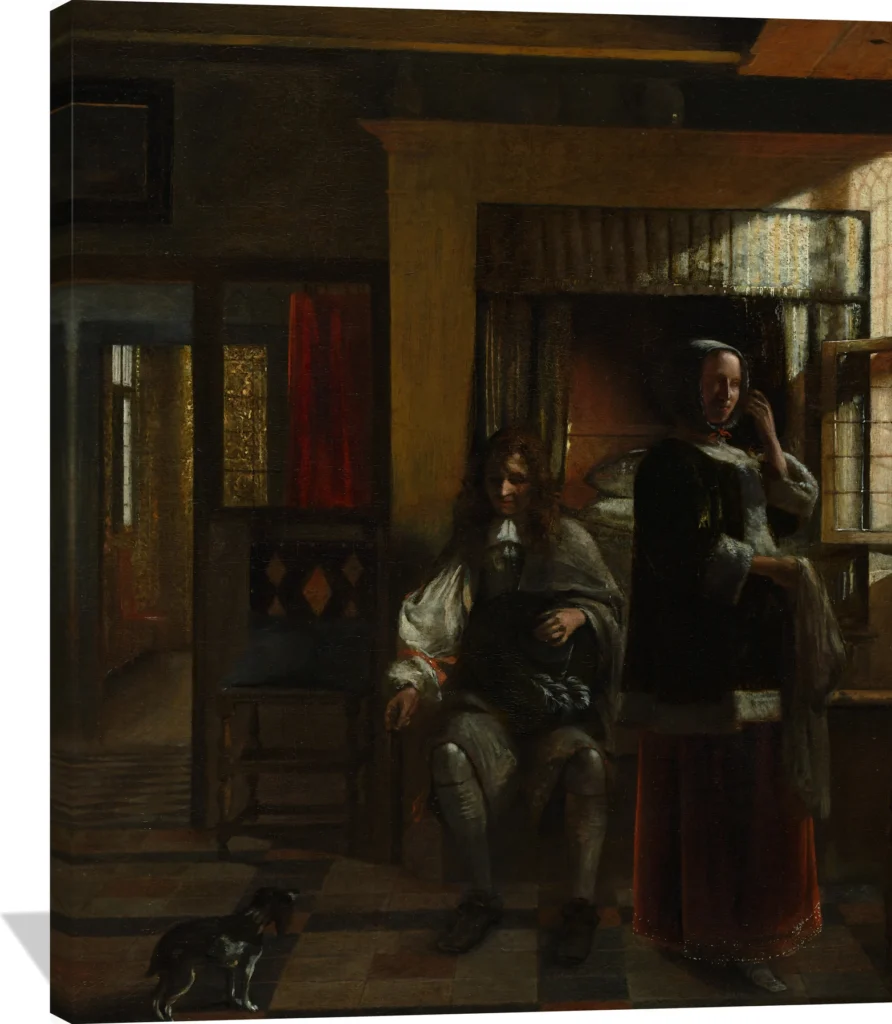
The Pieter de Hooch Interior with a Young Couple canvas captures a quiet moment of domestic intimacy bathed in soft, golden light. De Hooch’s masterful use of perspective and shadow draws the eye through a warmly lit room where a seated man, a standing woman, and a small dog evoke a timeless sense of calm. Earthy browns, muted golds, and deep reds create a refined palette that complements both classic and modern interiors.
This museum-quality canvas print brings the serene elegance of 17th-century Dutch life into your home. Ideal for a living room, study, or entryway, it adds depth, warmth, and a touch of historic sophistication to any wall.
Pieter de Hooch (Dutch, Rotterdam 1629–1684 Amsterdam) is celebrated as one of the foremost painters of the Dutch Golden Age, renowned for his serene, meticulously structured domestic interiors and luminous courtyard scenes.
Artistic Style
De Hooch’s work is distinguished by its masterful command of light and perspective. His compositional clarity, nuanced color harmonies, and gentle illumination define a style that brings quiet moments of daily life into poetic focus. Often compared to the works of his contemporary Vermeer, de Hooch’s paintings are marked by a remarkable sense of spatial order and a deep understanding of how sunlight transforms interior architecture.
Subjects and Themes
His paintings typically portray intimate household scenes, women engaged in domestic tasks, and welcoming courtyards that open onto sunlit passageways. These settings reflect the social values of the Dutch Republic, celebrating cleanliness, family life, and civic pride. Works such as The Courtyard of a House in Delft exemplify this dedication to capturing everyday tranquility with exceptional precision.
Legacy and Significance
Pieter de Hooch’s contribution to genre painting lies in his ability to elevate ordinary moments into enduring visual poetry. His keen observation of space and atmosphere has influenced generations of artists and continues to resonate with viewers seeking beauty in simplicity. Today, de Hooch is regarded as a master of intimate realism, offering an enduring window into the refined domestic culture of the 17th‑century Netherlands.
Trust & policies
- 🚚 Free tracked shipping to 45+ countries. Local import duties or taxes may apply in some destinations.
- 🎨 Made-to-order, printed close to your delivery location
- 🛡️ If damaged, defective, or misprinted: free replacement or refund
- 🌍 Printed in US/CA/EU/UK/AU based on delivery location
- 💎 Acid-free, fade-resistant canvas with solid wood stretcher bars
- 🖼️ Optional pine floating frames in white, black, or brown
- 🪝 Ready to hang — hardware pre-installed