
Titmouse with Pomegranate Flowers
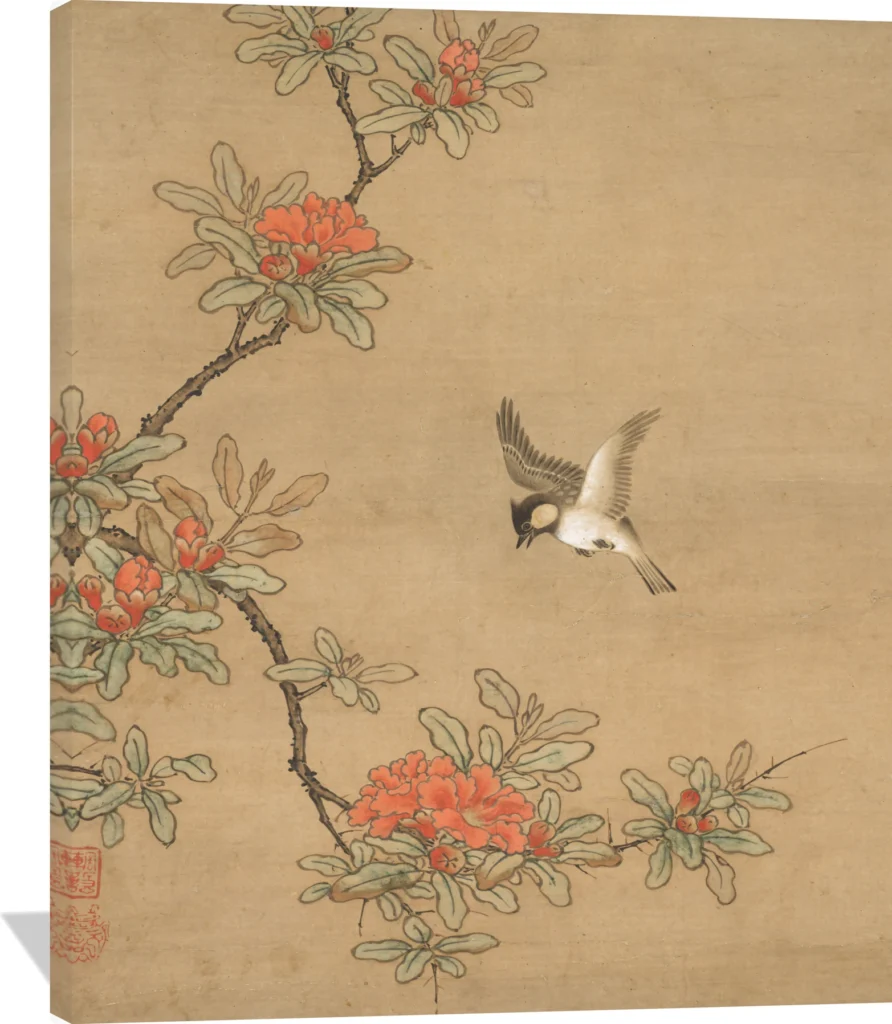
The Kano Yukinobu Titmouse with Pomegranate Flowers canvas captures a moment of serene grace, where a delicate bird hovers among blooming branches. Soft beige tones frame the vivid coral-red blossoms and muted green leaves, creating a balanced harmony that feels both tranquil and alive. The composition’s airy vertical flow draws the eye upward, evoking the quiet beauty of nature in motion.
This refined wall art brings timeless Japanese elegance to any space. Ideal for a living room, study, or entryway, this canvas print invites calm reflection and subtle sophistication through its masterful brushwork and gentle palette.
Kano Yukinobu (ca. 1513–1575) was a distinguished painter of the Kano school, the leading force in Japanese painting from the Muromachi through the Edo period. Active during a transformative era, he contributed to shaping the visual identity of courtly, religious, and elite cultural spaces.
Artistic Style
Yukinobu’s work reflects the hallmark synthesis of Chinese ink traditions with Japanese aesthetics that defined the Kano lineage. His paintings often balance expressive brushwork with controlled clarity, creating compositions that feel both dynamic and disciplined. He favored bold ink lines, nuanced tonal gradations, and carefully ordered spatial arrangements that convey a sense of poised elegance.
Subjects and Themes
He is associated with subjects central to the Kano repertoire, including landscapes, auspicious motifs, historical and literary figures, and Zen-inspired imagery. These themes allowed him to demonstrate technical fluency while engaging with cultural references deeply valued by his patrons. Whether depicting serene mountain vistas or scenes of courtly refinement, his work evokes an atmosphere of cultivated restraint.
Notable Contributions
As a member of the prominent Kano family, Yukinobu helped solidify the school’s reputation as the preferred artistic institution for the shogunate and major temples. His role in transmitting stylistic principles and workshop practices contributed to the Kano school’s continuity and lasting influence. Through his training, collaborations, and commissions, he participated in the development of a style that would dominate Japanese official painting for centuries.
Cultural Significance
Yukinobu’s paintings embody the visual ideals of his time, merging imported ink-painting techniques with Japanese narrative sensibilities. His legacy lies not only in individual works but also in his position within a dynastic atelier that shaped the aesthetics of screens, sliding doors, and large-scale interiors. Collectors and admirers value his art for its refined balance of strength and subtlety, a hallmark of the Kano school during its formative peak.
Trust & policies
- 🚚 Free tracked shipping to 45+ countries. Local import duties or taxes may apply in some destinations.
- 🎨 Made-to-order, printed close to your delivery location
- 🛡️ If damaged, defective, or misprinted: free replacement or refund
- 🌍 Printed in US/CA/EU/UK/AU based on delivery location
- 💎 Acid-free, fade-resistant canvas with solid wood stretcher bars
- 🖼️ Optional pine floating frames in white, black, or brown
- 🪝 Ready to hang — hardware pre-installed