
Hanuman Revives Rama and Lakshmana with Medicinal Herbs: Illustrated folio from a dispersed Ramayana series
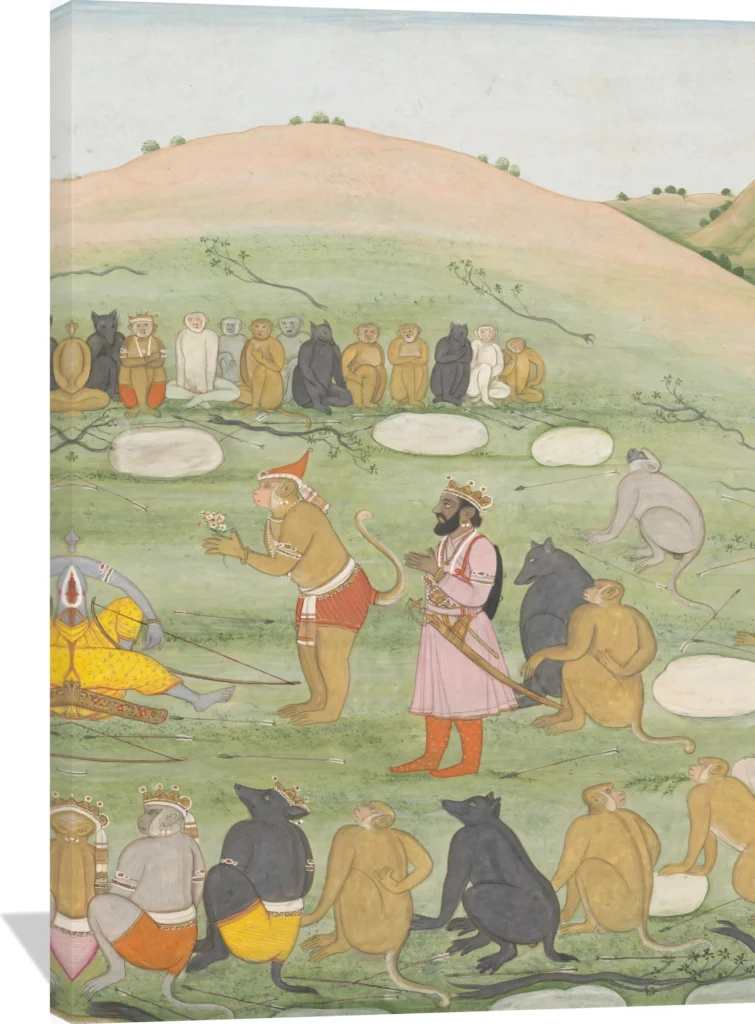
The Nainsukh Hanuman Revives Rama and Lakshmana with Medicinal Herbs canvas captures a luminous moment from the Ramayana, rendered with delicate brushwork and serene balance. Soft greens, muted golds, and gentle rose tones create a tranquil landscape where divine figures and devoted allies gather in harmony. The horizontal composition draws the eye across the sacred scene, evoking both devotion and vitality.
This exquisite wall art brings the grace of 18th-century Indian miniature painting into a modern space. Ideal for a living room, study, or entryway, this canvas print radiates cultural depth and timeless artistry, celebrating Nainsukh’s refined storytelling and spiritual beauty.
Nainsukh (active ca. 1735–78) stands as one of the most influential figures of the Pahari painting tradition, celebrated for his refined naturalism, emotional sensitivity, and innovative approach to portraiture. Working primarily in the court of the rulers of Guler and later Jasrota in the Himalayan foothills, he transformed North Indian miniature painting through an unprecedented commitment to realism and psychological depth.
Artistic Style
Nainsukh’s style is defined by delicate linework, subtle shading, and a gentle luminosity that brought a new lifelike quality to court painting. He incorporated elements of Mughal naturalism, blending them seamlessly with Pahari aesthetics. His compositions often reveal carefully observed gestures, intricate textiles, and finely rendered expressions, providing a sense of immediacy rare in his era.
Subjects and Themes
He is best known for intimate portraits of his patron Raja Balwant Singh, capturing everyday activities such as reading, praying, or receiving visitors. These scenes, along with his depictions of court ceremonies, devotional moments, and poetic narratives, reveal his gift for portraying the subtle interplay of character and setting.
Legacy and Significance
Nainsukh’s work marked a turning point in Pahari painting. His humanizing approach and his attention to individuality paved the way for future generations of artists in the region. Today, he is recognized as a master whose paintings offer both artistic beauty and a vivid historical record of 18th‑century courtly life.
Trust & policies
- 🚚 Free tracked shipping to 45+ countries. Local import duties or taxes may apply in some destinations.
- 🎨 Made-to-order, printed close to your delivery location
- 🛡️ If damaged, defective, or misprinted: free replacement or refund
- 🌍 Printed in US/CA/EU/UK/AU based on delivery location
- 💎 Acid-free, fade-resistant canvas with solid wood stretcher bars
- 🖼️ Optional pine floating frames in white, black, or brown
- 🪝 Ready to hang — hardware pre-installed