
Uvedale Tomkyns Price (1685–1764) and Members of His Family
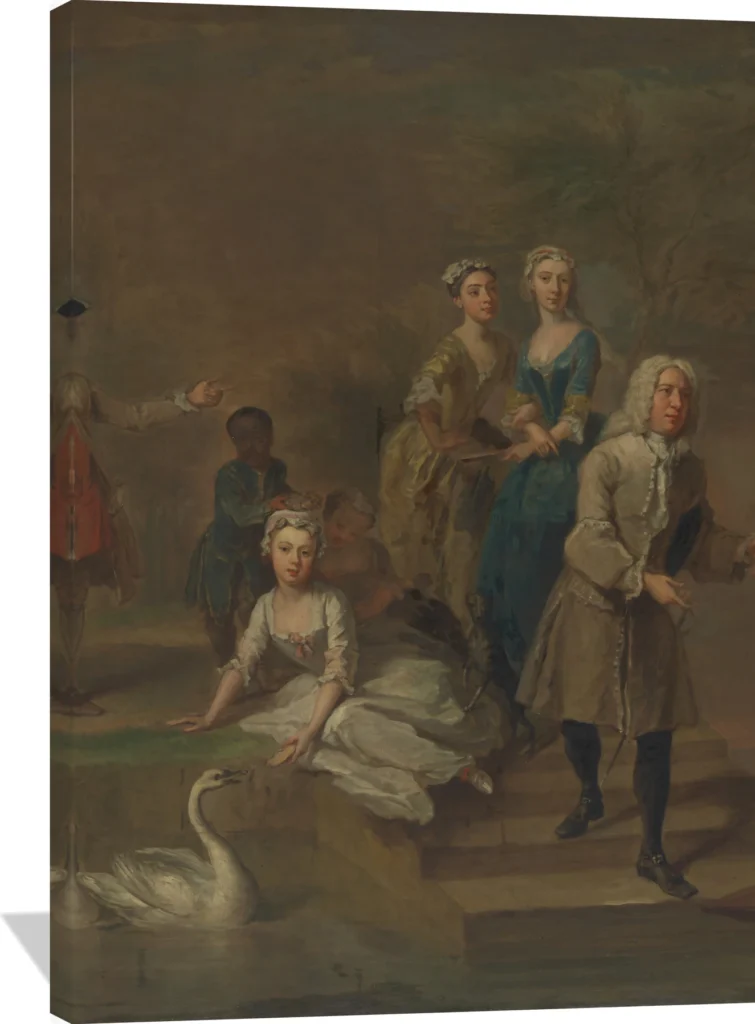
The Bartholomew Dandridge Uvedale Tomkyns Price (1685–1764) and Members of His Family canvas captures the grace and refinement of 18th‑century British portraiture. Set in a tranquil garden scene, elegantly dressed figures gather near a reflective pond with swans, rendered in warm earth tones, soft pinks, deep blues, and muted greens. Dandridge’s delicate brushwork and balanced composition evoke harmony, lineage, and genteel leisure.
This exquisite wall art brings timeless sophistication to any interior. Ideal for a living room, study, or entryway, this museum‑inspired canvas print infuses your space with the poise and charm of Georgian elegance.
Bartholomew Dandridge (1691–in or after 1754) was a distinguished British painter whose career helped shape the development of eighteenth‑century portraiture. Active throughout his life in London, he earned recognition for his refined ability to capture likeness, character, and social stature during a period when portraiture served as a key marker of identity and status.
Artistic Style
Dandridge’s work reflects the transition from the Baroque’s formality to the more natural elegance that defined early Georgian portraiture. His paintings often feature carefully modulated lighting, graceful compositions, and a balanced interplay between sitter and setting. He was particularly adept at rendering fabrics and textures, adding richness and depth without overwhelming the human presence at the center of his work.
Subjects and Themes
Best known for his portraits of London’s rising professional and mercantile classes, Dandridge portrayed merchants, politicians, cultural figures, and families seeking to assert their place within Britain’s increasingly dynamic social landscape. His group portraits are especially notable for their fluid arrangement and subtle narrative quality, offering a glimpse into the domestic confidence of the era.
Notable Contributions
Dandridge is recognized for helping establish the genteel, polished portrait aesthetic that would later flourish in the hands of artists such as Gainsborough and Reynolds. His ability to blend psychological presence with elegant form made his works appealing to a society invested in self‑representation. As one of the early occupants of Covent Garden’s fashionable studio district, he contributed to London’s emergence as a major artistic center.
Cultural Significance
Operating during a time of expanding print culture and growing public interest in the arts, Dandridge played a meaningful role in shaping Britain’s visual identity. His portraits provide a valuable record of early Georgian fashion, interiors, and social aspiration. Today, his work remains admired for its quiet sophistication and its ability to evoke the texture of eighteenth‑century life.
Bartholomew Dandridge’s paintings endure as refined expressions of character and as important examples of Britain’s early modern portrait tradition, offering viewers both aesthetic pleasure and historical insight.
Trust & policies
- 🚚 Free tracked shipping to 45+ countries. Local import duties or taxes may apply in some destinations.
- 🎨 Made-to-order, printed close to your delivery location
- 🛡️ If damaged, defective, or misprinted: free replacement or refund
- 🌍 Printed in US/CA/EU/UK/AU based on delivery location
- 💎 Acid-free, fade-resistant canvas with solid wood stretcher bars
- 🖼️ Optional pine floating frames in white, black, or brown
- 🪝 Ready to hang — hardware pre-installed