
The Dispatch-Bearer
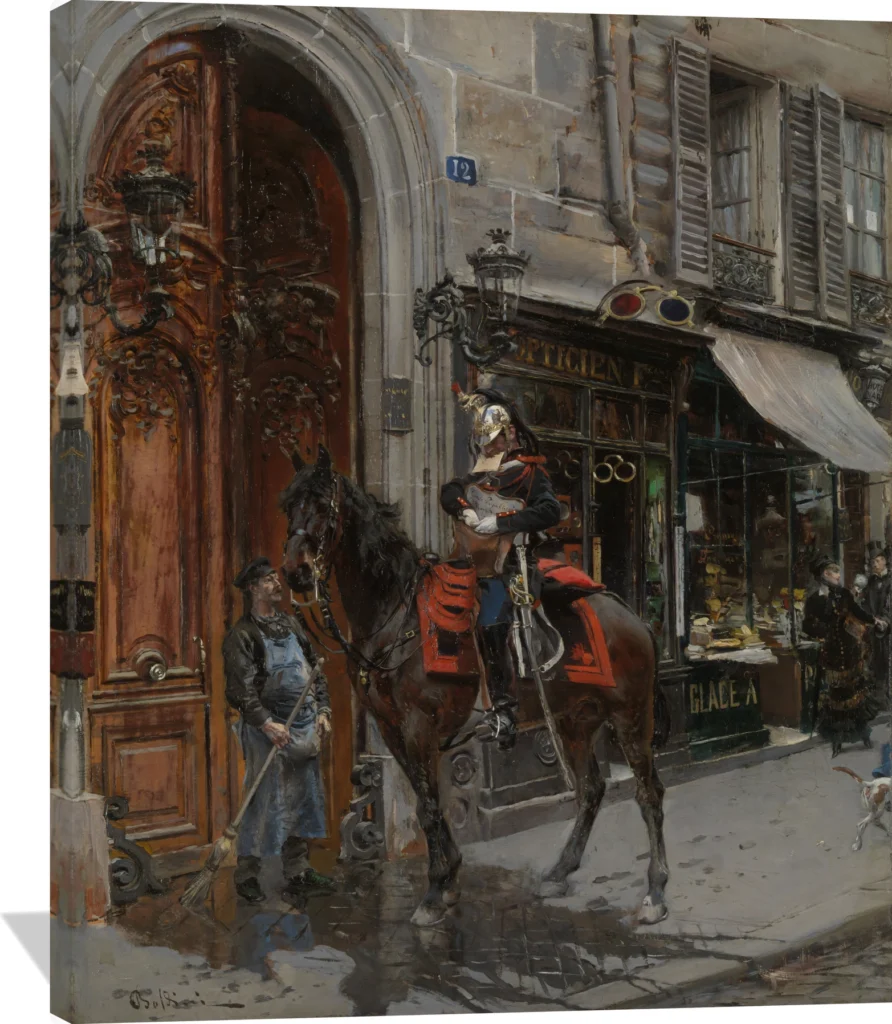
Giovanni Boldini’s The Dispatch-Bearer canvas captures a moment of poised elegance amid the bustle of a Parisian street. A mounted officer in gleaming armor commands attention before a richly carved doorway, rendered in Boldini’s fluid brushwork and refined palette of deep browns, muted grays, and flashes of crimson. The artist’s signature energy and precision bring the 19th-century scene vividly to life.
This premium canvas print offers timeless sophistication for any living room, study, or entryway. With its blend of urban realism and romantic detail, The Dispatch-Bearer adds a distinguished European charm to contemporary interiors, celebrating the artistry of Italian master Giovanni Boldini (Ferrara 1842–1931 Paris).
Giovanni Boldini (Italian, Ferrara 1842–1931 Paris) was a master portraitist celebrated for his dazzling brushwork and refined visual flair. Active primarily in Paris, he became one of the most sought‑after interpreters of high society at the turn of the twentieth century.
Artistic Style
Boldini’s work is distinguished by its fluid, sweeping strokes and a sense of motion that brings each figure vividly to life. His paintings balance precision with spontaneity, creating portraits that feel both elegant and dynamic. This signature style, often described as virtuosic and atmospheric, set him apart within the international art scene.
Notable Subjects
Renowned for his portrayals of fashionable women, writers, and aristocrats, Boldini captured the glamour and sophistication of Belle Époque Paris. His subjects appear animated and confident, their silhouettes elongated and draped in luminous textures. Works such as Portrait of the Countess de Martel de Janville showcase his ability to convey personality through gesture and light.
Cultural Significance
Boldini played a defining role in shaping the visual identity of his era. His portraits not only documented the cultural elite but also contributed to the broader evolution of modern portraiture. Revered for his expressive technique and acute psychological insight, he remains a key figure in the transition from nineteenth‑century realism to the more atmospheric sensibilities of early modern art.
Trust & policies
- 🚚 Free tracked shipping to 45+ countries. Local import duties or taxes may apply in some destinations.
- 🎨 Made-to-order, printed close to your delivery location
- 🛡️ If damaged, defective, or misprinted: free replacement or refund
- 🌍 Printed in US/CA/EU/UK/AU based on delivery location
- 💎 Acid-free, fade-resistant canvas with solid wood stretcher bars
- 🖼️ Optional pine floating frames in white, black, or brown
- 🪝 Ready to hang — hardware pre-installed