
Saint Peter Martyr Healing the Leg of a Young Man
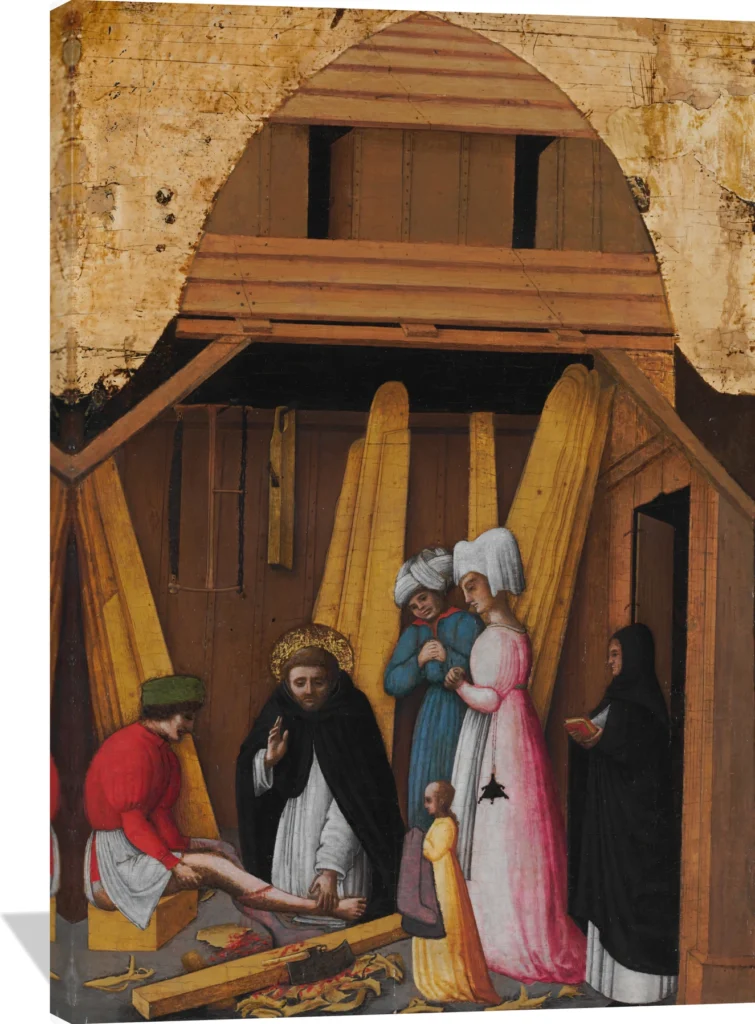
The Antonio Vivarini Saint Peter Martyr Healing the Leg of a Young Man canvas captures a moment of divine compassion rendered in luminous tempera tones. Warm ochres, deep blacks, and rose hues draw the eye to the saint’s gentle gesture, framed within a rustic architectural setting that exudes quiet reverence. Vivarini’s Venetian mastery infuses this sacred scene with both human tenderness and spiritual grace.
This museum-quality canvas print brings a sense of calm devotion and historical depth to any space. Ideal for a living room, study, or entryway, this timeless wall art evokes the serene beauty of early Renaissance faith and artistry.
Antonio Vivarini was an Italian painter active in Venice from the early 1440s until his death between 1476 and 1484. A pivotal figure in the transition from Gothic elegance to the early Venetian Renaissance, he helped shape the visual language that would influence Venetian painting for generations.
Artistic Style
Vivarini’s style blends the ornamental refinement of the late Gothic tradition with emerging Renaissance ideals. His works often feature graceful figures, luminous color harmonies, and finely detailed drapery. While rooted in the spiritual sensibilities of medieval art, his paintings reveal a growing interest in naturalism and spatial coherence, marking him as a bridge between eras.
Notable Contributions
A central member of the influential Vivarini workshop, Antonio collaborated frequently with family members, most notably his brother-in-law Giovanni d’Alemagna and later his son Bartolomeo. Their workshop became known for richly painted altarpieces that brought Venetian art into closer dialogue with the innovations happening in Florence and Padua. Antonio’s contribution to this evolution was the introduction of more sculptural figures and a heightened attention to emotional expression.
Typical Subjects
Religious imagery dominates Vivarini’s oeuvre. He is best known for altarpieces depicting the Virgin and Child, saints, and scenes from Christian narratives, often set within elaborately gilded architectural frames. These compositions carry a serene devotional mood, enhanced by his delicate use of color and his sensitivity to gesture. Works such as Madonna and Child and Saints in Glory exemplify his ability to balance spiritual solemnity with decorative richness.
Cultural and Historical Significance
Antonio Vivarini stands among the early architects of Venice’s distinct Renaissance identity. His workshop helped establish the city as a major center of artistic production, blending Byzantine heritage with contemporary European currents. Through his refined technique and evolving stylistic approach, he contributed to the foundations upon which later Venetian masters would build.
Today, Vivarini is recognized for his role in shaping the visual and cultural fabric of 15th‑century Venice, offering timeless examples of the transition from medieval piety to the humanistic sensibilities of the Renaissance. His work remains valued for its elegant craftsmanship and its place within the unfolding story of Venetian art.
Trust & policies
- 🚚 Free tracked shipping to 45+ countries. Local import duties or taxes may apply in some destinations.
- 🎨 Made-to-order, printed close to your delivery location
- 🛡️ If damaged, defective, or misprinted: free replacement or refund
- 🌍 Printed in US/CA/EU/UK/AU based on delivery location
- 💎 Acid-free, fade-resistant canvas with solid wood stretcher bars
- 🖼️ Optional pine floating frames in white, black, or brown
- 🪝 Ready to hang — hardware pre-installed