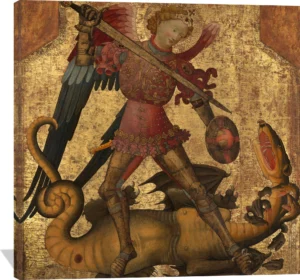
Artistic Style
His work is distinguished by a delicate linearity, luminous color, and meticulous attention to ornamental detail, hallmarks of the International Gothic style that defined much of early fifteenth‑century European painting. Yet exposure to Italian workshops enriched his approach, introducing greater spatial coherence and a heightened sensitivity to naturalistic form. The resulting blend of influences created a visual signature both elegant and quietly innovative.
Subjects and Themes
Devotional imagery forms the core of his surviving oeuvre, especially altarpiece panels depicting the Virgin, Christ, and the saints. Figures are typically rendered with a serene, introspective presence, set against richly textured backgrounds that reveal his Valencian roots while acknowledging contemporary Italian advancements in depth and composition. Narrative scenes, when present, are composed with clarity and subtle emotional resonance.
Historical Significance
As an artist working between cultural spheres, he contributed to the dissemination of Mediterranean artistic ideas at a pivotal moment of stylistic transition. His practice exemplifies how Valencian painters helped shape visual culture beyond their homeland, bringing Iberian refinement to Italian courts and, in turn, carrying home new approaches to space, light, and human presence. Though details of his life remain limited, his legacy endures through work that reflects both the cosmopolitan networks of his time and the enduring beauty of the International Gothic aesthetic.