
Saint Michael and the Dragon
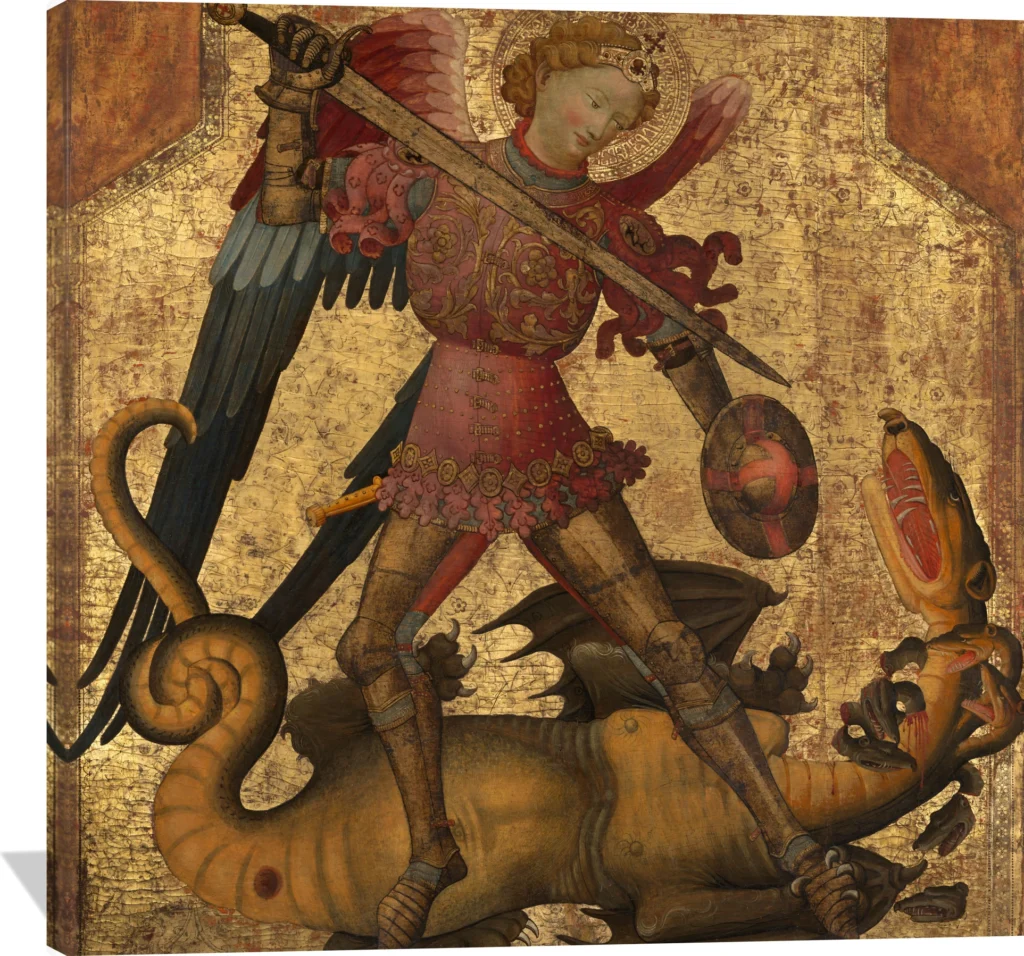
The Spanish (Valencian) Painter Saint Michael and the Dragon canvas captures a timeless moment of triumph and divine strength. Bathed in radiant gold tones with accents of crimson, emerald, and deep blue, this early 15th-century masterpiece reveals the archangel’s poised grace as he conquers the dragon beneath his feet. The intricate detailing and luminous background evoke the grandeur of Gothic devotion and Italian influence.
This museum-quality canvas print brings a sense of courage and reverence to any interior. Perfect for a living room, study, or entryway, it transforms your space with the enduring power and elegance of sacred art.
A Valencian painter active in Italy during the early fifteenth century, this artist represents the dynamic exchange between the Crown of Aragon and the Italian courts at a moment of profound artistic transformation. Working at the crossroads of Gothic tradition and emerging Renaissance sensibilities, he helped carry the refined visual language of the Iberian Levant into the flourishing cultural centers of the Italian peninsula.
Artistic Style
His work is distinguished by a delicate linearity, luminous color, and meticulous attention to ornamental detail, hallmarks of the International Gothic style that defined much of early fifteenth‑century European painting. Yet exposure to Italian workshops enriched his approach, introducing greater spatial coherence and a heightened sensitivity to naturalistic form. The resulting blend of influences created a visual signature both elegant and quietly innovative.
Subjects and Themes
Devotional imagery forms the core of his surviving oeuvre, especially altarpiece panels depicting the Virgin, Christ, and the saints. Figures are typically rendered with a serene, introspective presence, set against richly textured backgrounds that reveal his Valencian roots while acknowledging contemporary Italian advancements in depth and composition. Narrative scenes, when present, are composed with clarity and subtle emotional resonance.
Historical Significance
As an artist working between cultural spheres, he contributed to the dissemination of Mediterranean artistic ideas at a pivotal moment of stylistic transition. His practice exemplifies how Valencian painters helped shape visual culture beyond their homeland, bringing Iberian refinement to Italian courts and, in turn, carrying home new approaches to space, light, and human presence. Though details of his life remain limited, his legacy endures through work that reflects both the cosmopolitan networks of his time and the enduring beauty of the International Gothic aesthetic.
Trust & policies
- 🚚 Free tracked shipping to 45+ countries. Local import duties or taxes may apply in some destinations.
- 🎨 Made-to-order, printed close to your delivery location
- 🛡️ If damaged, defective, or misprinted: free replacement or refund
- 🌍 Printed in US/CA/EU/UK/AU based on delivery location
- 💎 Acid-free, fade-resistant canvas with solid wood stretcher bars
- 🖼️ Optional pine floating frames in white, black, or brown
- 🪝 Ready to hang — hardware pre-installed