
Bacchus and Nymphs in a Landscape
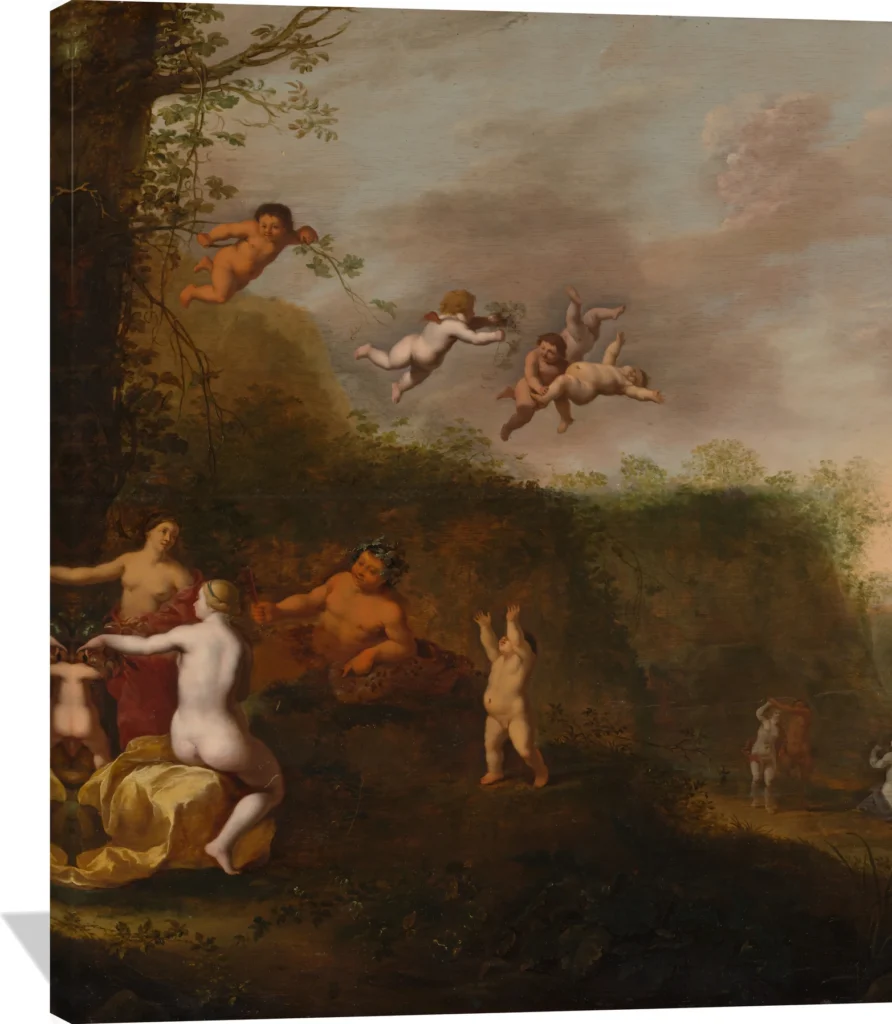
The Abraham van Cuylenborch Bacchus and Nymphs in a Landscape canvas captures a mythological celebration bathed in golden light. Set against a lush, wooded hillside and an expansive sky, the scene glows with warm earth tones, soft greens, and gentle rose hues. Van Cuylenborch’s masterful use of light and texture brings a sense of movement and divine serenity to this Baroque composition.
This exquisite Bacchus and Nymphs in a Landscape wall art adds a touch of classical elegance to any interior. Ideal for a living room, study, or entryway, this canvas print evokes timeless beauty and the joy of nature’s abundance, making it a captivating centerpiece for refined spaces.
Abraham van Cuylenborch (Utrecht, ca. 1620–1658) was a Dutch painter celebrated for his imaginative landscapes and refined treatment of mythological and religious themes. Active during the Dutch Golden Age, he developed a distinctive visual language that blended Northern naturalism with the atmospheric allure of Italianate art.
Artistic Style
Cuylenborch is best known for his meticulously crafted grotto and cavern scenes, where dramatic light and shadow create a sense of mystery and quiet grandeur. His work often features delicately modeled figures set against luminous rock formations, revealing his gift for integrating human narratives within evocative, otherworldly settings. This poetic interplay of light, architecture, and landscape became his signature approach and remains a hallmark of his artistry.
Subjects and Themes
Drawing inspiration from classical literature and biblical narratives, Cuylenborch frequently depicted episodes involving mythological deities, heroic travelers, and contemplative wanderers. Whether illustrating a moment of divine encounter or a tranquil pastoral pause, he infused each composition with a serene theatricality, encouraging the viewer to linger within the scene’s carefully constructed atmosphere.
Legacy and Significance
Though his career was relatively brief, Cuylenborch made a lasting impact through his innovative fusion of fantasy and realism. His paintings stand out for their polished technique and their ability to evoke a world both imagined and grounded in natural observation. Collectors and historians value his work for its distinctive mood, its graceful architectural forms, and its role in expanding the expressive possibilities of Dutch landscape painting. A master of the grotto scene and a subtle storyteller, he remains a compelling figure within the heritage of Dutch Golden Age art.
Trust & policies
- 🚚 Free tracked shipping to 45+ countries. Local import duties or taxes may apply in some destinations.
- 🎨 Made-to-order, printed close to your delivery location
- 🛡️ If damaged, defective, or misprinted: free replacement or refund
- 🌍 Printed in US/CA/EU/UK/AU based on delivery location
- 💎 Acid-free, fade-resistant canvas with solid wood stretcher bars
- 🖼️ Optional pine floating frames in white, black, or brown
- 🪝 Ready to hang — hardware pre-installed