Artistic Style
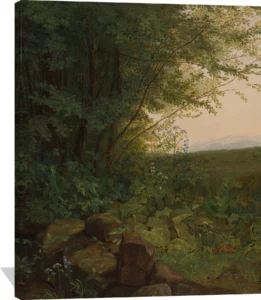
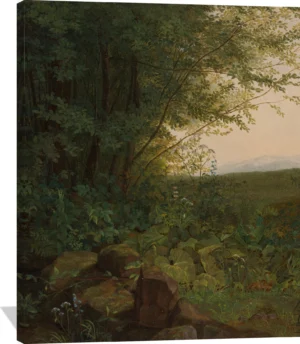
Heinrich’s paintings are characterized by a poetic approach to landscape, balancing careful natural observation with a Romantic search for mood and meaning. His compositions often feature sweeping valleys, rugged mountain ranges, and delicately rendered skies, all treated with a luminous clarity that hints at the emerging Biedermeier sensibility. Subtle tonal transitions and finely layered brushwork give his scenes a quiet, contemplative intensity.
Subjects and Themes
Heinrich focused primarily on landscapes inspired by Saxon and Alpine environments, reflecting both his Dresden upbringing and his later years in Innsbruck. His work frequently explores the relationship between humans and nature, portraying humble rural structures, winding paths, or distant travelers within vast, dramatic settings. These small narrative elements serve to heighten the grandeur of the natural world while maintaining an intimate, almost lyrical touch.
Legacy and Significance
Although his life was brief, Heinrich contributed meaningfully to the evolving aesthetic of early German Romantic landscape painting. His ability to merge detailed topographical accuracy with an evocative, atmospheric style marks him as a distinctive voice among his contemporaries. Today, his work is appreciated for its quiet refinement, its sense of place, and its embodiment of a moment in European art when nature became a source of profound emotional and artistic exploration. His paintings remain valued for their delicate luminosity and their expressive serenity, qualities that continue to resonate with modern collectors.