
Jean-Baptiste Colbert (1619–1683)
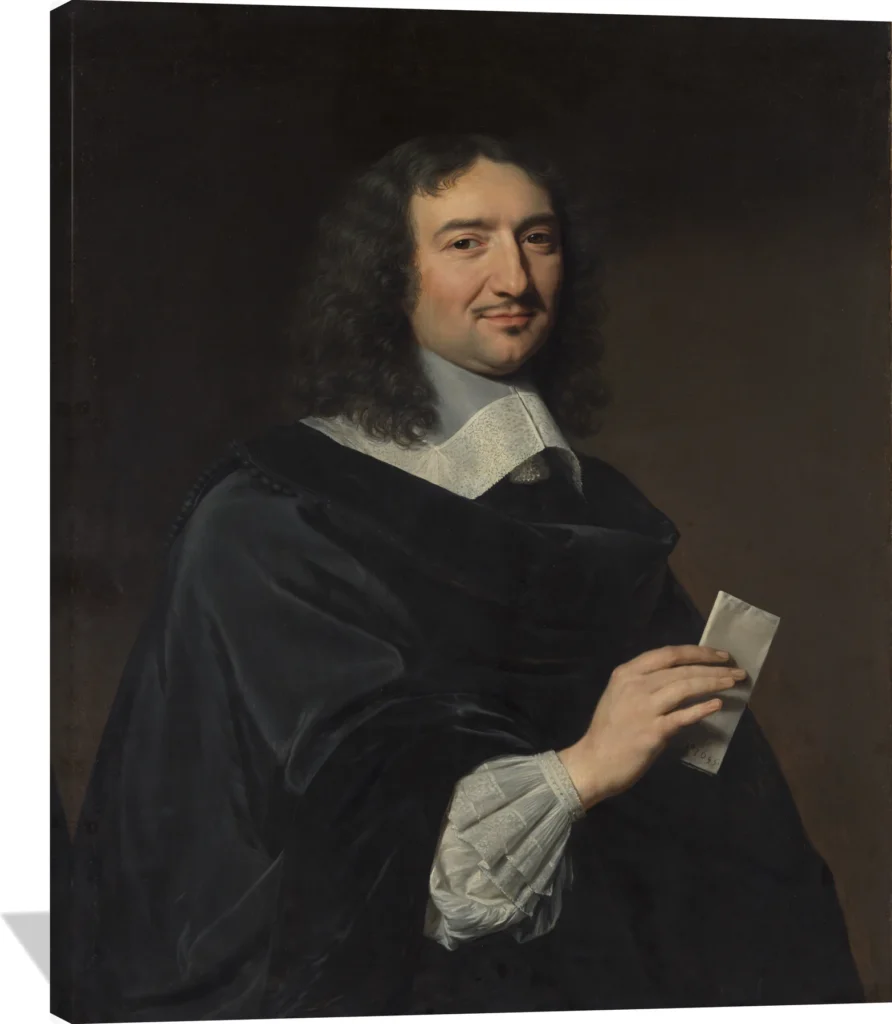
The Philippe de Champaigne Jean-Baptiste Colbert (1619–1683) canvas captures the refined dignity of a 17th-century statesman through masterful realism and luminous detail. Deep blacks, soft ivory, and warm flesh tones create a striking contrast that draws the eye to the sitter’s poised expression and elegant gesture. The subtle play of light across velvet and lace evokes timeless sophistication.
This exquisite wall art brings classical grandeur to contemporary interiors. Ideal for a study, library, or formal living room, this canvas print celebrates the artistry of Philippe de Champaigne—French painter of quiet power and precision, Brussels 1602–1674 Paris.
Philippe de Champaigne (French, Brussels 1602–1674 Paris) was one of the foremost painters of the French Baroque, celebrated for his precise realism, masterful use of light, and penetrating psychological insight. Working at the heart of 17th‑century Paris, he became a defining artistic voice of the era, admired for both his technical discipline and his restrained emotional power.
Artistic Style
Champaigne’s style is characterized by clarity, exacting detail, and a controlled palette that heightens the contemplative quality of his work. His compositions reveal a profound commitment to naturalism, achieving a sense of quiet intensity that made his portraits and religious scenes especially compelling. His disciplined approach and unembellished elegance remain hallmarks of his artistic identity.
Notable Contributions
As a leading painter associated with the French court and the Jansenist movement, Champaigne produced some of the era’s most memorable devotional works, including the deeply moving Ex-Voto de 1662. In portraiture, he set new standards for psychological depth, depicting statesmen, clergy, and scholars with an honesty that emphasized moral presence over ornamentation. His subtle realism and thoughtful restraint have earned him enduring recognition as a master of 17th-century European painting.
Subjects and Significance
Champaigne is best known for his portraits, religious images, and occasional allegorical works. His ability to convey inner life through measured expression and meticulous draftsmanship made him an essential figure in French Baroque art. Closely connected to intellectual and religious circles in Paris, he brought a unique blend of spiritual intensity and visual precision to his paintings.
Legacy
Today, Philippe de Champaigne is esteemed for his unwavering commitment to truthfulness in representation and for his role in shaping a distinctly French form of sober, reflective Baroque painting. His work continues to resonate for its balance of emotional depth and compositional discipline, a combination that cements his standing as a pivotal figure in European art history.
Trust & policies
- 🚚 Free tracked shipping to 45+ countries. Local import duties or taxes may apply in some destinations.
- 🎨 Made-to-order, printed close to your delivery location
- 🛡️ If damaged, defective, or misprinted: free replacement or refund
- 🌍 Printed in US/CA/EU/UK/AU based on delivery location
- 💎 Acid-free, fade-resistant canvas with solid wood stretcher bars
- 🖼️ Optional pine floating frames in white, black, or brown
- 🪝 Ready to hang — hardware pre-installed