
Girl in a Courtyard, Algiers (formerly Courtyard in Tangier)
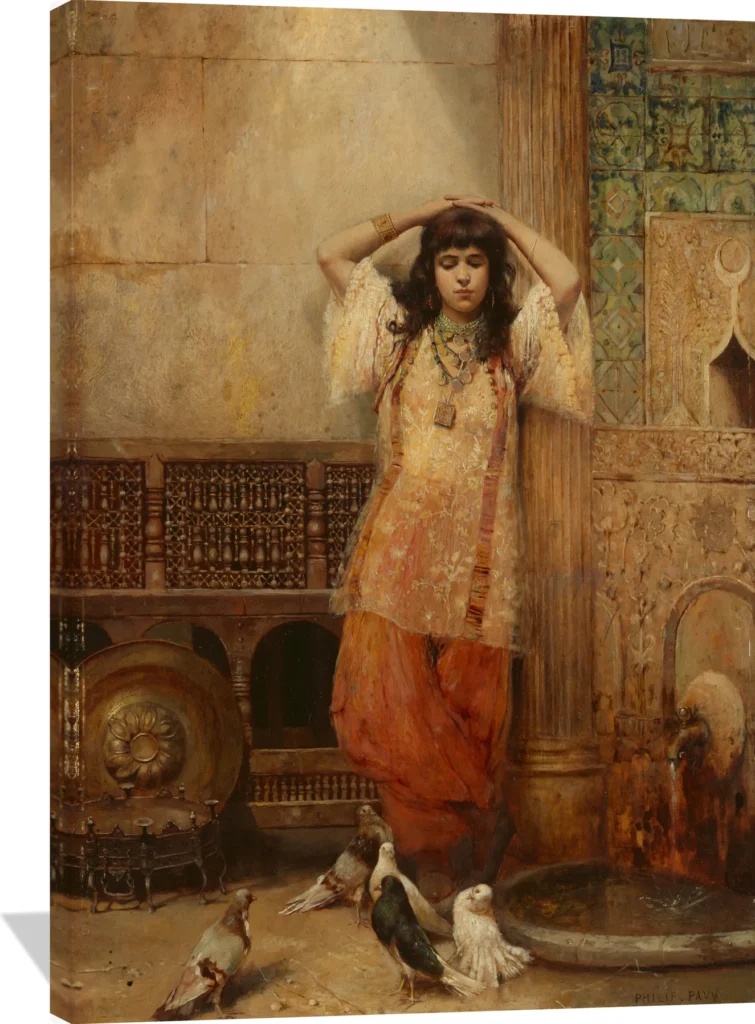
The Philippe Pavy Girl in a Courtyard, Algiers canvas captures a tranquil moment bathed in warm light and intricate detail. A young woman stands gracefully beside a tiled fountain, surrounded by doves, her flowing garments rendered in soft ochres, terracotta, and muted greens. The composition’s vertical orientation and delicate brushwork evoke the quiet elegance of North African courtyards and the timeless allure of Orientalist art.
This museum-quality canvas print brings depth and serenity to any space. Ideal for a living room, study, or entryway, it infuses interiors with a sense of stillness and refined cultural beauty—an exquisite statement piece for collectors and admirers of 19th-century artistry.
Philippe Pavy was a French painter active in the late nineteenth century, known for a brief yet compelling career that unfolded during a transformative era in European art. Born around 1856/57 or 1860 and passing away in Menton in 1891, he worked at the intersection of tradition and emerging modern sensibilities, contributing to the visual culture of a period marked by rapid aesthetic evolution.
Artistic Style
Pavy’s work reflects the refined naturalism favored in France during the late 1800s, often characterized by attentive rendering, balanced compositions, and a nuanced approach to light. While aligned with academic techniques, his paintings show a sensitivity to atmosphere, hinting at the broader artistic shift toward more personal and expressive interpretations of everyday scenes.
Subjects and Themes
Although few of his works survive, Pavy is associated with subjects common among painters of his generation: intimate figure studies, quiet domestic moments, and landscapes capturing the gentle luminosity of the Mediterranean region. His choice of motifs highlights an interest in subtle emotional resonance rather than grand narratives, elevating the ordinary through careful observation and measured elegance.
Legacy and Significance
Pavy’s early death limited the development of his career, yet the works attributed to him demonstrate a disciplined technique and a perceptive eye. He contributed to the rich tapestry of nineteenth‑century French painting, standing among the artists who helped bridge classical conventions and the more exploratory approaches that would soon flourish. Today, collectors value his art for its quiet sophistication and its ability to convey atmosphere with restrained yet evocative detail.
Trust & policies
- 🚚 Free tracked shipping to 45+ countries. Local import duties or taxes may apply in some destinations.
- 🎨 Made-to-order, printed close to your delivery location
- 🛡️ If damaged, defective, or misprinted: free replacement or refund
- 🌍 Printed in US/CA/EU/UK/AU based on delivery location
- 💎 Acid-free, fade-resistant canvas with solid wood stretcher bars
- 🖼️ Optional pine floating frames in white, black, or brown
- 🪝 Ready to hang — hardware pre-installed