
A Peasant Family
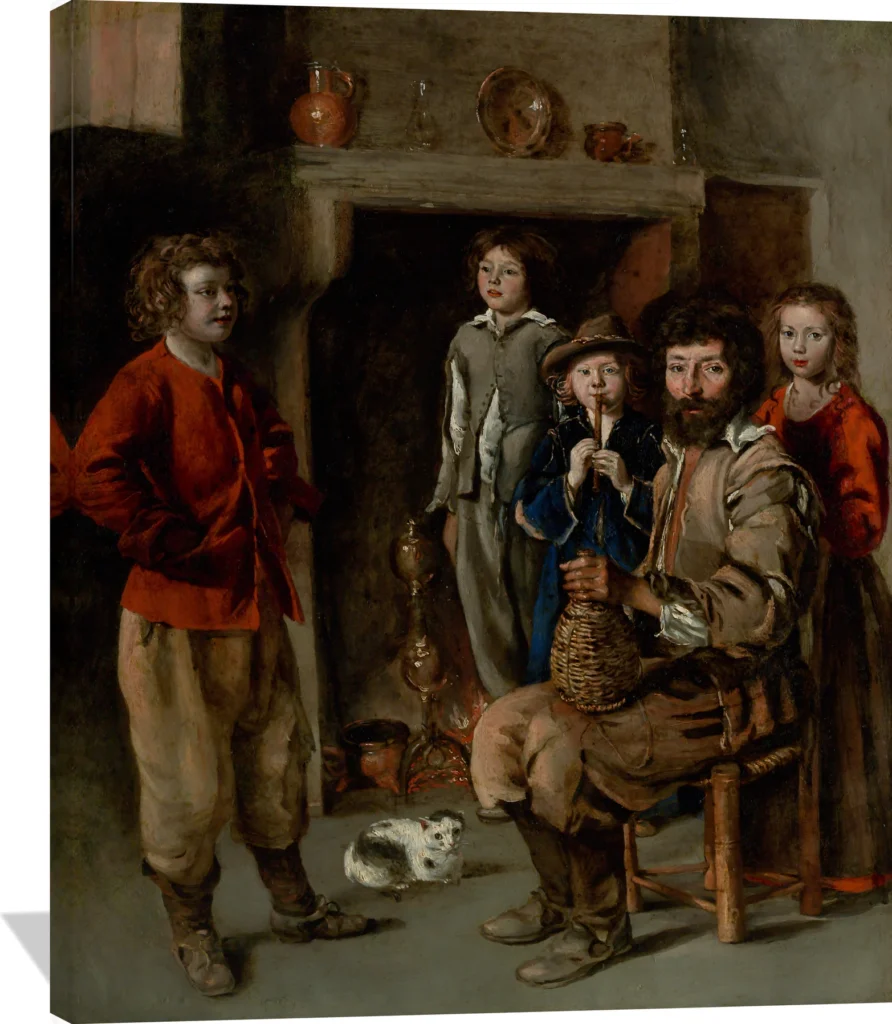
The Antoine Le Nain A Peasant Family canvas captures a quiet moment of rustic life with remarkable warmth and dignity. Set before a hearth, the composition glows with earthy browns, soft grays, deep reds, and muted blues, evoking the intimacy of 17th-century French domestic life. Each figure is rendered with Le Nain’s signature realism and compassion, creating a timeless portrayal of family unity.
This museum-quality A Peasant Family wall art brings depth and character to any interior. Ideal for a living room, study, or entryway, this canvas print adds a touch of historical elegance and contemplative charm to modern spaces.
Antoine Le Nain was a French painter born in Laon around 1600 and active in Paris until his death in 1648. Working alongside his brothers Louis and Mathieu, he became a central figure in early seventeenth‑century French genre painting, celebrated for his intimate depictions of everyday life.
Artistic Style
Le Nain’s work is distinguished by its quiet realism, balanced compositions, and a muted, silvery palette that lends his scenes a contemplative atmosphere. His figures possess a calm gravity, rendered with a sensitive treatment of light that reflects influences from both Flemish naturalism and the developing French Baroque. This blend of restraint and emotional depth remains a hallmark of his style.
Subjects and Themes
He is best known for portraying humble rural families, musicians, soldiers, and domestic interiors, elevating ordinary moments with a sense of dignity and humanity. Works such as Peasant Family exemplify his ability to capture subtle psychological nuance while maintaining a composition of striking simplicity. His occasional portraits and small devotional scenes also reveal a refined approach to character and mood.
Legacy and Significance
Antoine Le Nain played a vital role in shaping French genre painting, offering a sincere portrayal of social reality at a time when grand historical subjects dominated artistic circles. His paintings, marked by their quiet authenticity and emotional clarity, paved the way for later artists who sought truth in everyday subjects. Today, his works remain admired for their timeless humanity and the understated elegance that makes the Le Nain brothers emblematic figures of seventeenth‑century French art.
Trust & policies
- 🚚 Free tracked shipping to 45+ countries. Local import duties or taxes may apply in some destinations.
- 🎨 Made-to-order, printed close to your delivery location
- 🛡️ If damaged, defective, or misprinted: free replacement or refund
- 🌍 Printed in US/CA/EU/UK/AU based on delivery location
- 💎 Acid-free, fade-resistant canvas with solid wood stretcher bars
- 🖼️ Optional pine floating frames in white, black, or brown
- 🪝 Ready to hang — hardware pre-installed