
Abraham Dismissing Hagar and Ishmael
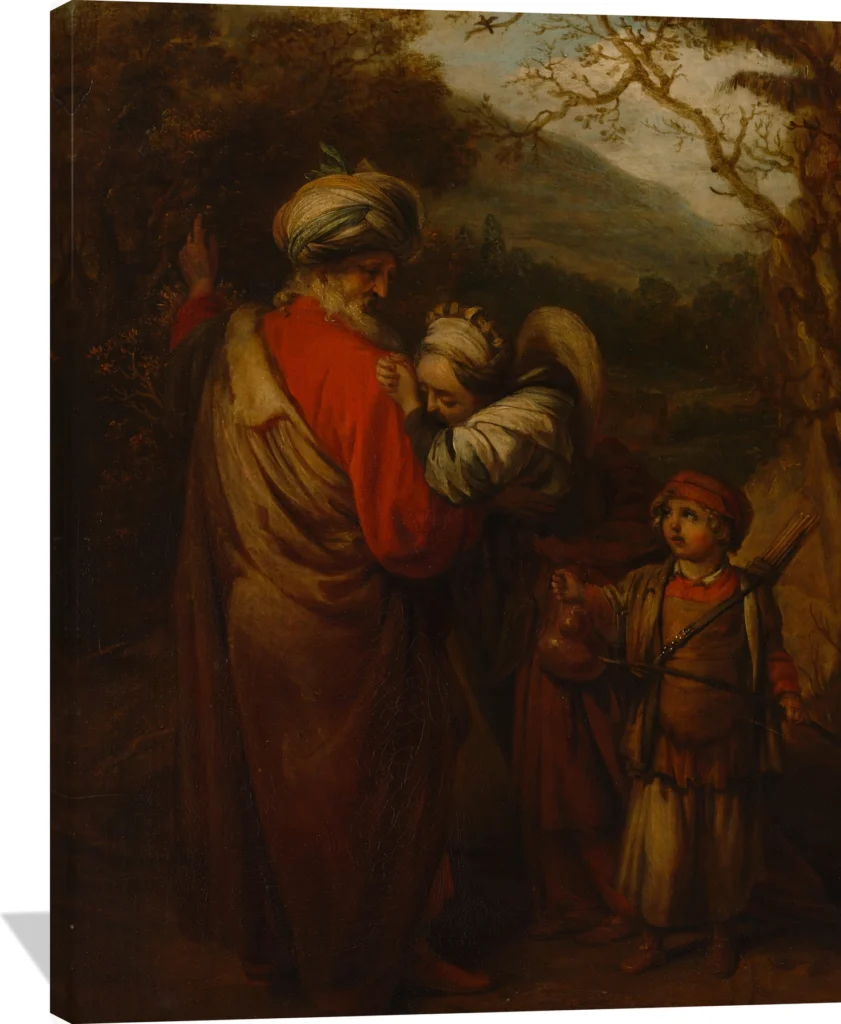
The Barent Fabritius Abraham Dismissing Hagar and Ishmael canvas captures a moment of deep emotion and human tenderness, rendered in warm earth tones of amber, sienna, and soft gold. Fabritius’s masterful use of light and shadow draws the viewer into the intimate farewell, set against a tranquil landscape that heightens the painting’s spiritual depth.
This museum-quality canvas print brings timeless Dutch artistry into your home, offering a refined focal point for a living room, study, or entryway. The Abraham Dismissing Hagar and Ishmael wall art evokes both drama and grace—an exquisite statement for collectors who appreciate classical storytelling through luminous brushwork.
Barent Fabritius (Dutch, Middenbeemster 1624–1673 Amsterdam) was a gifted painter of the Dutch Golden Age, known for his sensitive handling of biblical themes and finely observed genre scenes. Trained within a family of artists and influenced by his brother Carel Fabritius, he developed a distinctive approach that balanced expressive character studies with a nuanced command of light.
Artistic Style
Fabritius’s paintings are recognized for their warm tonalities, softly diffused illumination, and intimate focus on the human figure. His style reflects the broader Amsterdam school yet carries a personal subtlety, marked by gentle psychological depth and careful attention to gesture. His brushwork often conveys a quiet immediacy, allowing viewers to feel closely connected to his subjects.
Subjects and Themes
Religious narratives formed the core of Fabritius’s oeuvre, depicted with empathy rather than drama. He excelled at portraying moments of contemplation, humility, and devotion, often set within modest interiors. His secular works, which include portraits and genre scenes, reveal the same interest in character and atmosphere. Figures appear thoughtfully modeled, illuminated by a soft radiance that enhances their emotional presence.
Legacy and Significance
Though overshadowed historically by some contemporaries, Fabritius contributed meaningfully to the evolution of Dutch narrative painting. His ability to blend realism with introspective mood makes his work especially resonant today. Collectors value his paintings for their refined execution, human warmth, and the quiet strength that defines the Dutch Golden Age at its most contemplative.
Trust & policies
- 🚚 Free tracked shipping to 45+ countries. Local import duties or taxes may apply in some destinations.
- 🎨 Made-to-order, printed close to your delivery location
- 🛡️ If damaged, defective, or misprinted: free replacement or refund
- 🌍 Printed in US/CA/EU/UK/AU based on delivery location
- 💎 Acid-free, fade-resistant canvas with solid wood stretcher bars
- 🖼️ Optional pine floating frames in white, black, or brown
- 🪝 Ready to hang — hardware pre-installed