
Scene at Napanoch
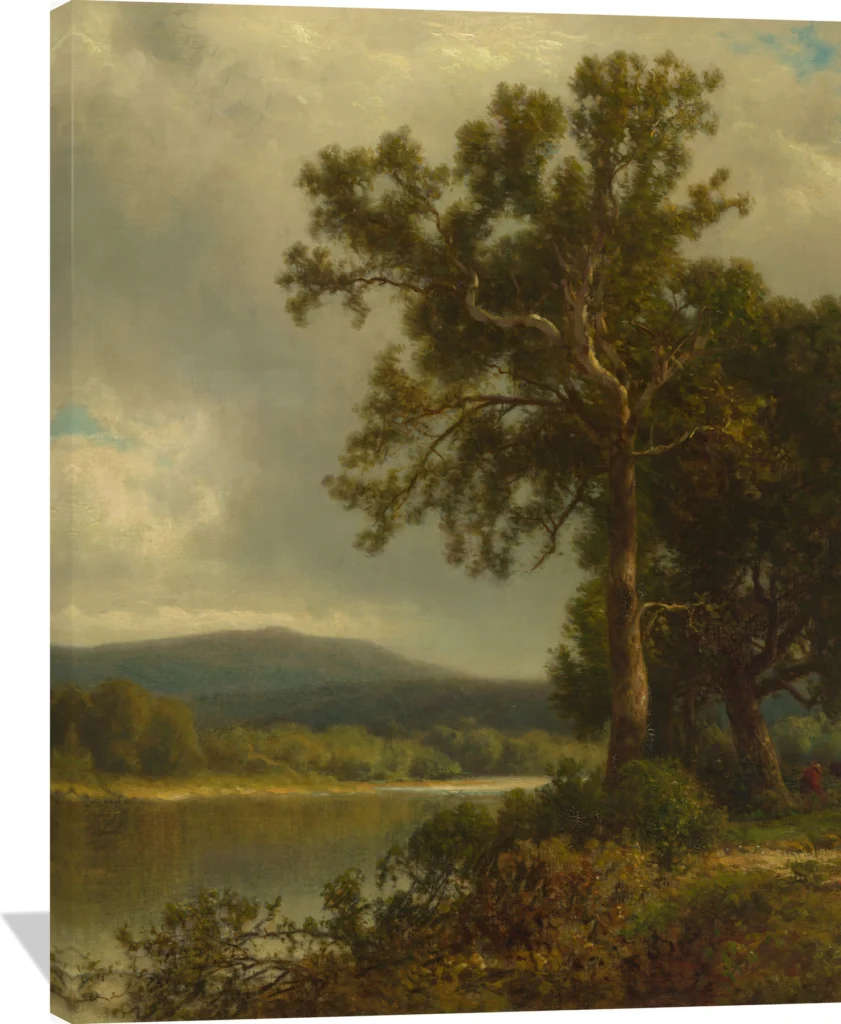
The William Hart Scene at Napanoch canvas captures the tranquil beauty of the American landscape with luminous realism. A serene river reflects the soft light of a cloud-streaked sky, while tall trees and grazing cattle evoke a timeless pastoral calm. Dominated by earthy greens, warm browns, and gentle blues, this horizontal composition invites a sense of peace and natural harmony.
This premium wall art brings a refined touch to any living room, study, or entryway. As a canvas print, it highlights Hart’s mastery of light and atmosphere, offering a window into the quiet grandeur of 19th-century American scenery.
William Hart (1823–1894) was a Scottish-born American painter whose lyrical landscapes placed him among the notable figures of the Hudson River School. After emigrating to the United States as a child, Hart developed a deep connection to the natural world, shaping his mature style and securing his place within nineteenth‑century American art.
Artistic Style and Approach
Hart’s work is distinguished by its serene atmospheres, delicate light, and finely observed detail. His landscapes often merge realism with a gentle poeticism, creating scenes that feel both truthful and idealized. He favored warm tonalities and soft transitions, capturing the quiet harmony of the American countryside.
Typical Subjects
Pastoral vistas, wooded glens, and reflective waterways were central to Hart’s oeuvre. He frequently painted cattle in open meadows, using their presence to convey scale, tranquility, and a sense of rural life. His compositions often guide the viewer’s eye through a carefully balanced interplay of foreground foliage, distant hills, and luminous skies.
Notable Contributions
As a leading landscape painter of his generation, Hart contributed significantly to shaping the visual identity of American nature in the nineteenth century. He helped popularize a refined, atmospheric mode of landscape painting and played a prominent role in artistic communities through his exhibitions and mentorship. His dedication to portraying the American landscape with both sensitivity and structure made him a respected figure within the movement.
Cultural and Historical Significance
Hart’s paintings reflect a moment in American history when the landscape was celebrated as a source of national pride and spiritual renewal. His ability to transform everyday rural scenes into evocative, luminous compositions solidified his legacy as an influential interpreter of the natural world. Today, his works remain admired for their grace, craftsmanship, and enduring sense of peace.
Trust & policies
- 🚚 Free tracked shipping to 45+ countries. Local import duties or taxes may apply in some destinations.
- 🎨 Made-to-order, printed close to your delivery location
- 🛡️ If damaged, defective, or misprinted: free replacement or refund
- 🌍 Printed in US/CA/EU/UK/AU based on delivery location
- 💎 Acid-free, fade-resistant canvas with solid wood stretcher bars
- 🖼️ Optional pine floating frames in white, black, or brown
- 🪝 Ready to hang — hardware pre-installed