Artistic Style
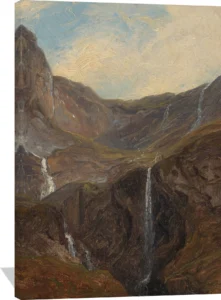
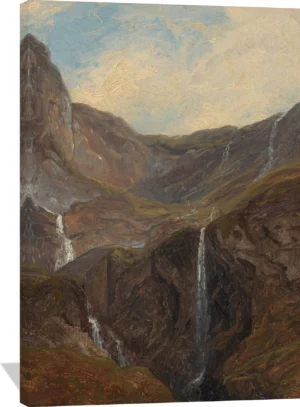
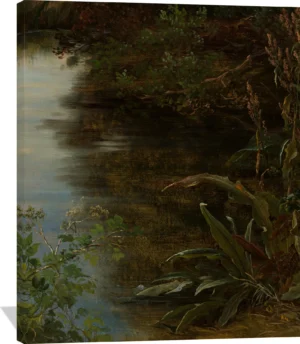
Fearnley’s style is defined by its luminous naturalism, sweeping compositions, and meticulous attention to atmospheric detail. Influenced by the Romantic movement, he embraced plein‑air techniques early in his career, allowing him to observe and convey shifting light and weather with remarkable immediacy. His brushwork balances precision with expressive energy, giving his landscapes both emotional depth and visual vitality.
Subjects and Themes
Nature was Fearnley’s great subject. He traveled extensively through Norway, Germany, Switzerland, and Italy, capturing dramatic fjords, towering alpine peaks, waterfalls, and forest interiors. His paintings often center on the relationship between humans and the sublime forces of nature, emphasizing scale and grandeur without losing intimacy. Works such as Labrofossen and Grimelund Farm exemplify his ability to transform everyday scenery into something profoundly evocative.
Contributions and Significance
Fearnley’s dedication to working outdoors and his keen observational sensibilities helped lay foundational principles for Scandinavian landscape painting. His sketches and oil studies became essential references for later artists, demonstrating how fieldwork could inform ambitious studio compositions. Though his life was brief, his influence on the Norwegian Romantic tradition was enduring, bridging the poetic sensibility of earlier Romanticism with the emerging precision of naturalist approaches.
Today, Thomas Fearnley is recognized as a painter whose landscapes embody both national identity and universal emotion. His ability to portray the Nordic environment with such authenticity and grandeur remains one of his most distinctive artistic achievements, securing his place in the cultural heritage of Norway and European Romantic art.