
Cavalier and Shepherd
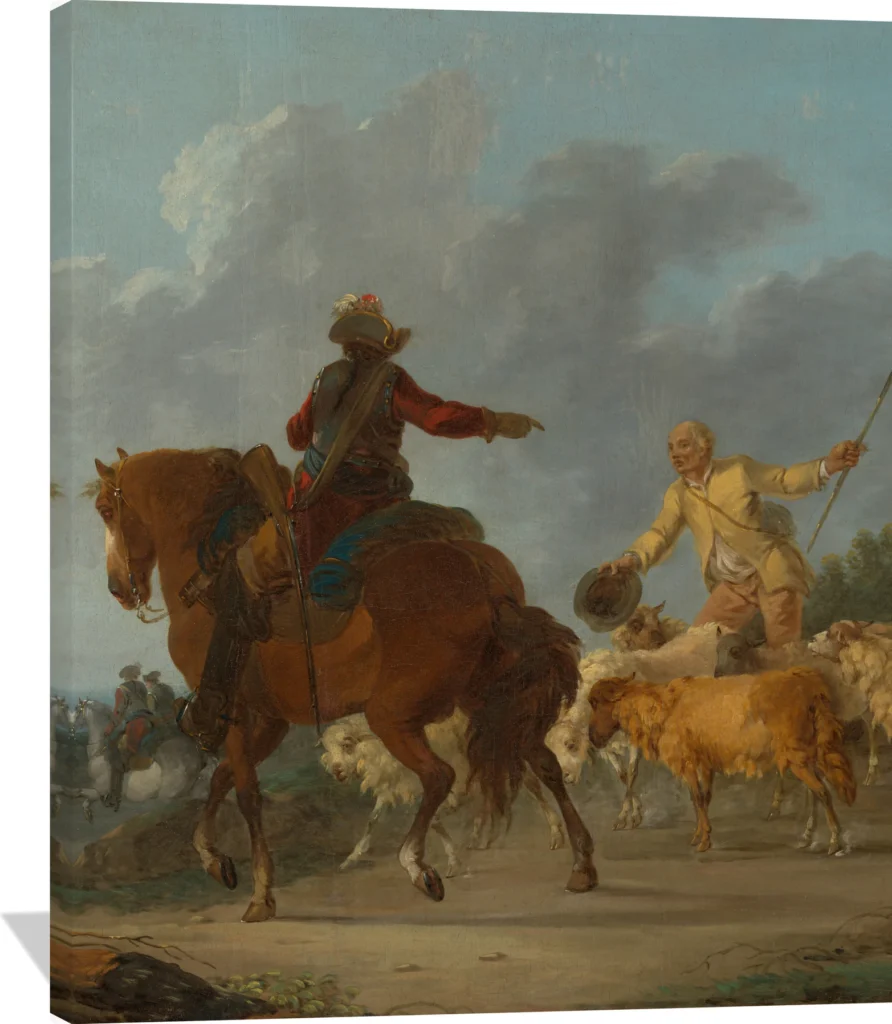
The Francesco Casanova Cavalier and Shepherd canvas captures a vivid encounter between a mounted nobleman and a humble shepherd beneath a vast, cloud-filled sky. Rendered in warm earth tones, soft blues, and muted greens, this pastoral scene blends movement and atmosphere with masterful light. Casanova’s dynamic brushwork evokes both drama and serenity, creating a timeless balance between power and simplicity.
This elegant canvas print brings classical sophistication to any space. Ideal for a living room, study, or entryway, the Cavalier and Shepherd wall art invites reflection on human connection and the beauty of rural life through the lens of 18th-century Italian artistry.
Francesco Casanova (Italian, London 1727–1803 Brühl) was an accomplished painter celebrated for his dynamic battle scenes and refined command of movement and atmosphere. Active across major European artistic centers, he became renowned for transforming military subjects into vivid, emotionally charged tableaux.
Artistic Style
Casanova’s work is distinguished by sweeping compositions, dramatic lighting, and an exceptional ability to convey tension and motion. His paintings often juxtapose the tumult of combat with carefully observed detail, creating a compelling blend of energy and precision. Drawing on the influence of Venetian colorism, he employed rich tonal contrasts that heightened the immediacy of his scenes and distinguished his approach within eighteenth‑century European painting.
Typical Subjects
Best known for his portrayals of cavalry charges, battlefield encounters, and military encampments, Casanova elevated martial themes into powerful visual narratives. Horses, soldiers, and atmospheric landscapes interact in his canvases with striking realism, revealing his deep study of anatomy and his talent for depicting nuanced human expression amidst conflict. Works such as The Cavalry Battle showcase his ability to orchestrate complex arrangements without sacrificing clarity or emotional resonance.
Contributions and Significance
Casanova’s mastery of battle painting earned him recognition among European courts and positioned him as one of the era’s foremost specialists in the genre. His ability to infuse large-scale scenes with meticulous detail and palpable drama contributed to the period’s evolving taste for expressive, immersive compositions. As the brother of the famed writer Giacomo Casanova, he was connected to the broader cultural currents of the Enlightenment, yet his own legacy rests firmly on his artistic achievements.
Today, his works are valued for their technical brilliance and their distinctive blend of narrative intensity and painterly elegance, marking Francesco Casanova as a significant figure in eighteenth-century European art whose vision continues to capture the imagination of collectors and admirers.
Trust & policies
- 🚚 Free tracked shipping to 45+ countries. Local import duties or taxes may apply in some destinations.
- 🎨 Made-to-order, printed close to your delivery location
- 🛡️ If damaged, defective, or misprinted: free replacement or refund
- 🌍 Printed in US/CA/EU/UK/AU based on delivery location
- 💎 Acid-free, fade-resistant canvas with solid wood stretcher bars
- 🖼️ Optional pine floating frames in white, black, or brown
- 🪝 Ready to hang — hardware pre-installed