
Seventh Regiment on Review, Washington Square, New York
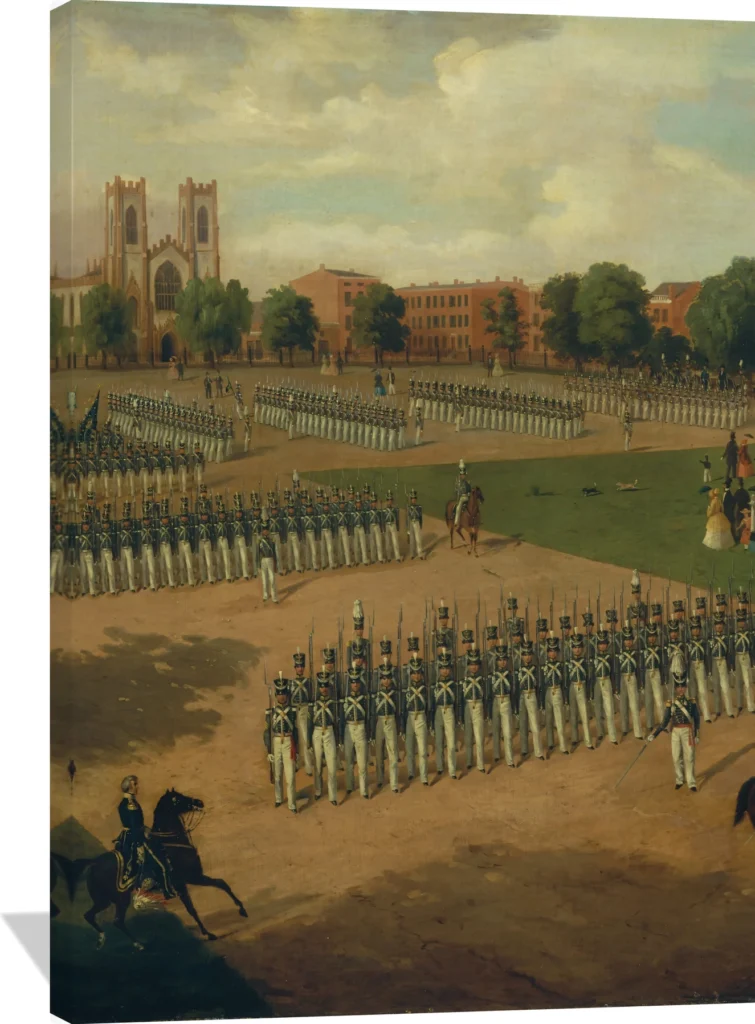
The Otto Boetticher Seventh Regiment on Review, Washington Square, New York canvas captures a grand military parade set against the stately architecture and leafy expanse of 19th-century Manhattan. With disciplined ranks of soldiers, elegant spectators, and soft afternoon light, Boetticher’s composition blends precision and pageantry in warm earth tones, muted greens, and sky blues.
This historic wall art brings a sense of order and heritage to any space. Perfect for a study, library, or refined living room, this canvas print evokes the pride and ceremony of a bygone New York with timeless elegance and quiet strength.
Otto Boetticher (ca. 1816–after 1864) was a German-born illustrator and lithographer whose career in the United States left a distinctive imprint on mid‑19th‑century visual culture. Known for his precise draftsmanship and observational clarity, he created images that captured everyday life, military experience, and emerging American pastimes with uncommon immediacy.
Artistic Style
Boetticher’s work is defined by clean linearity, balanced compositions, and a documentary sensibility that reflects his background in commercial lithography. His scenes often read as carefully arranged windows into lived experience, combining technical accuracy with a quiet emotional resonance.
Notable Contributions
Boetticher is best remembered for his Civil War–era lithographs, including his celebrated depiction of Union prisoners engaging in leisure activities within a Confederate camp, an image notable for containing one of the earliest published portrayals of baseball. Works such as Union Prisoners at Salisbury, North Carolina reveal his ability to merge reportage with an emerging American visual identity.
Subjects and Themes
His subjects ranged from military encampments and uniformed figures to moments of daily routine and recreation. Boetticher’s attentive rendering of gesture and posture gives his scenes a sense of presence, inviting viewers to observe the era’s social interactions and evolving cultural norms. His lithographs frequently highlight human resilience, making his compositions feel quietly narrative despite their straightforward presentation.
Cultural Significance
As a German immigrant contributing to the visual record of the United States during a pivotal period, Boetticher occupies a meaningful place in the history of American printmaking. His work provides valuable insight into mid‑19th‑century life, and pieces associated with the early visual history of baseball carry particular historical weight. Today, his prints are appreciated not only for their aesthetic clarity but also for their role in illuminating the cultural fabric of the era.
Trust & policies
- 🚚 Free tracked shipping to 45+ countries. Local import duties or taxes may apply in some destinations.
- 🎨 Made-to-order, printed close to your delivery location
- 🛡️ If damaged, defective, or misprinted: free replacement or refund
- 🌍 Printed in US/CA/EU/UK/AU based on delivery location
- 💎 Acid-free, fade-resistant canvas with solid wood stretcher bars
- 🖼️ Optional pine floating frames in white, black, or brown
- 🪝 Ready to hang — hardware pre-installed