
View from the Quai d’Orsay
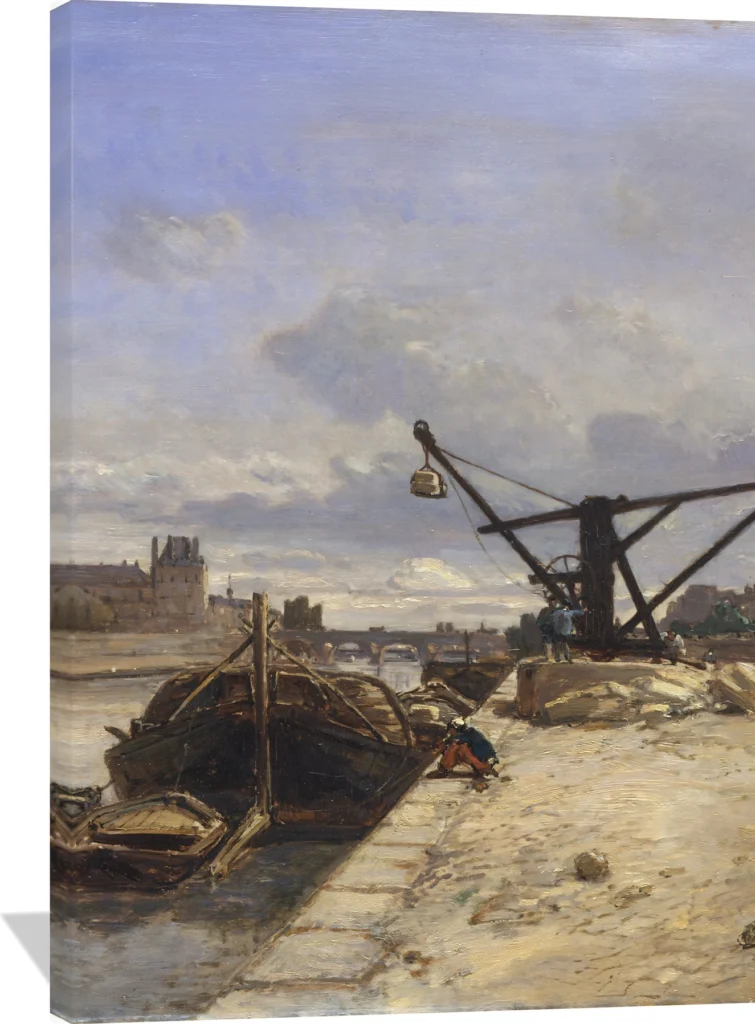
The Johan Barthold Jongkind View from the Quai d’Orsay canvas captures a tranquil moment along the Seine, where soft light meets industrious calm. Gentle blues, sandy beiges, and muted grays blend seamlessly to evoke the serene rhythm of 19th-century Paris. Jongkind’s expressive brushwork and atmospheric depth make this piece a timeless study in light and reflection.
This elegant wall art brings a refined sense of history and quiet sophistication to any space. Perfect for a living room, study, or entryway, this canvas print invites viewers to pause and appreciate the harmony between city, river, and sky.
Johan Barthold Jongkind (1819–1891), born in Latrop in the Netherlands and active in France until his death in La Côte-Saint-André, was a pivotal Dutch painter whose luminous landscapes played a formative role in the evolution of modern French painting. His work, admired by contemporaries and later generations, bridged the atmospheric qualities of Romanticism with the fresh, perceptive vision that would help shape Impressionism.
Artistic Style
Jongkind is renowned for his masterful handling of light, subtle tonal shifts, and expressive yet controlled brushwork. His approach favored spontaneity and direct observation, capturing transient effects of weather and atmosphere. This ability to evoke mood with restrained detail made him a vital precursor to the Impressionist movement, influencing artists such as Claude Monet. His landscapes often feel both intimate and expansive, marked by a refined sensibility and a quietly innovative manner of seeing.
Subjects and Techniques
Harbors, rivers, and coastal vistas dominate Jongkind’s oeuvre. Scenes along the Seine, the ports of Normandy, and the Dutch waterways reveal his fascination with reflections, shifting skies, and the elegant geometry of ships and quays. Watercolor and oil were his principal media, each used to enhance the immediacy of his observations. His watercolors, in particular, are noted for their clarity and poetic restraint, often serving as studies that informed his more polished oil compositions.
Legacy and Cultural Significance
Jongkind’s contribution lies not only in the beauty of his works but also in his role as an artistic catalyst. His fresh approach to landscape painting and his keen attention to natural light helped lay the groundwork for what would become the Impressionist vision. Through his influence on younger artists and his dedication to painting directly from nature, he provided an essential bridge between traditional landscape conventions and the bold visual language of the late nineteenth century.
Today, Jongkind is celebrated for his innovative atmospheric landscapes and for his quiet yet significant impact on the trajectory of modern art. His paintings remain admired for their clarity of perception and their enduring sensitivity to place, weather, and light.
Trust & policies
- 🚚 Free tracked shipping to 45+ countries. Local import duties or taxes may apply in some destinations.
- 🎨 Made-to-order, printed close to your delivery location
- 🛡️ If damaged, defective, or misprinted: free replacement or refund
- 🌍 Printed in US/CA/EU/UK/AU based on delivery location
- 💎 Acid-free, fade-resistant canvas with solid wood stretcher bars
- 🖼️ Optional pine floating frames in white, black, or brown
- 🪝 Ready to hang — hardware pre-installed