
The Marriage Feast at Cana
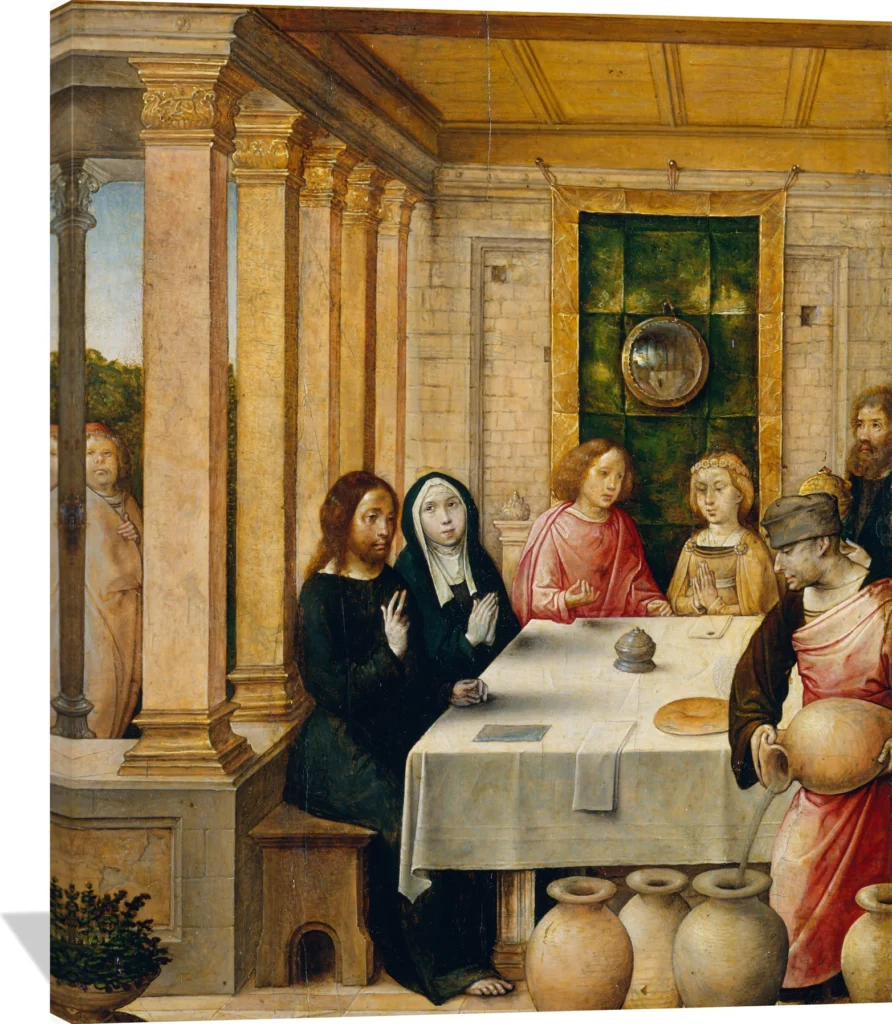
The Juan de Flandes The Marriage Feast at Cana canvas captures a moment of quiet divinity and intricate storytelling. Rendered in warm golds, soft creams, and deep greens, this Renaissance masterpiece depicts the biblical feast with refined architectural detail and luminous color. The balanced composition and serene expressions draw the viewer into a scene of transformation and grace.
This museum-quality wall art adds timeless sophistication to any living room, study, or entryway. A canvas print of The Marriage Feast at Cana brings the elegance of Netherlandish artistry and the contemplative beauty of the 16th century into your modern space.
Juan de Flandes was a Netherlandish painter active by 1496 until his death in 1519 in Palencia, celebrated for bringing the precision of Northern European painting to the courts of Spain. His work reflects the refined detail, luminous color, and delicate modeling characteristic of the Flemish tradition, yet adapted to the spiritual and cultural currents of the Iberian Peninsula.
Artistic Style
Known for his meticulous brushwork and subtle handling of light, Juan de Flandes created compositions distinguished by serene expression and intimate psychological presence. His figures display a gentle naturalism, while his backgrounds often reveal intricate landscapes rendered with exceptional clarity. This fusion of Flemish detail with emerging Spanish sensibilities made his style both distinctive and influential.
Notable Contributions
Juan de Flandes served as a court painter to Queen Isabella of Castile, producing a celebrated series of small devotional panels, including works such as The Resurrection and The Temptation of Christ. These panels exemplify his ability to convey complex narratives within a compact format, balancing emotional depth with technical precision. His contributions helped shape the development of Renaissance art in Spain, introducing Northern techniques that enriched local artistic practice.
Subjects and Significance
His oeuvre centers on religious themes, with particular sensitivity toward the human aspects of sacred stories. Close attention to gesture, expression, and atmosphere allowed him to create scenes that feel intimate yet spiritually resonant. As a bridge between Northern and Spanish Renaissance traditions, Juan de Flandes holds a place of enduring importance in European art history.
Trust & policies
- 🚚 Free tracked shipping to 45+ countries. Local import duties or taxes may apply in some destinations.
- 🎨 Made-to-order, printed close to your delivery location
- 🛡️ If damaged, defective, or misprinted: free replacement or refund
- 🌍 Printed in US/CA/EU/UK/AU based on delivery location
- 💎 Acid-free, fade-resistant canvas with solid wood stretcher bars
- 🖼️ Optional pine floating frames in white, black, or brown
- 🪝 Ready to hang — hardware pre-installed