
Spring Blossoms, Montclair, New Jersey
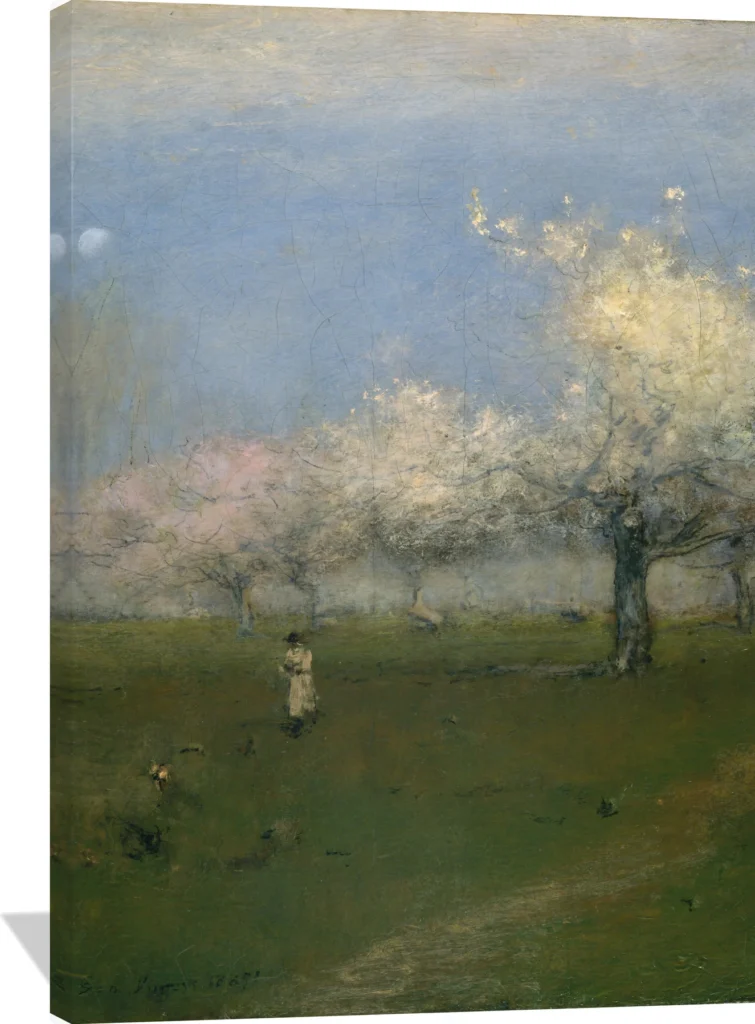
The George Inness Spring Blossoms, Montclair, New Jersey canvas captures a serene moment of renewal in soft, atmospheric light. Gentle hues of sky blue, moss green, and pale blossom pink blend seamlessly to evoke the quiet beauty of spring awakening. A lone figure beneath flowering trees adds a sense of calm reflection and timeless grace.
This exquisite wall art brings a tranquil, painterly charm to any space. Ideal for a living room, study, or entryway, this canvas print infuses your decor with the poetic stillness and natural harmony that define Inness’s celebrated American landscapes.
George Inness (1825–1894) was an American landscape painter whose career bridged the pastoral spirit of the Hudson River School with the atmospheric subtleties of Tonalism. Born in Newburgh, New York, and later active across the northeastern United States and Europe, he became one of the 19th century’s most influential interpreters of the American landscape.
Artistic Style and Vision
Inness’s mature style is defined by soft harmonies of light, nuanced color, and a contemplative sense of mood. Rather than focusing on meticulous detail, he pursued an expressive naturalism shaped by his engagement with Swedenborgian philosophy. This spiritual lens led him to create landscapes that feel inward, poetic, and suffused with atmosphere, often emphasizing unity between nature and the human spirit.
Notable Contributions
Regarded as a central figure in the rise of Tonalism, Inness helped shift American art toward more intimate, emotionally resonant interpretations of the land. His paintings moved beyond straightforward representation, embracing a more suggestive and interpretive approach that influenced a generation of artists. Works such as The Home of the Heron and Early Autumn, Montclair exemplify his mastery in rendering subtle transitions of light and creating scenes that feel both grounded and transcendent.
Typical Subjects
Inness frequently depicted rural fields, quiet farmsteads, forest interiors, and mist-laden horizons. Though drawn to American locales, he also painted extensively in Europe, especially Italy and France, capturing pastoral scenes that balanced structure with a luminous, atmospheric veil. His compositions often incorporate small human elements figures, paths, or dwellings that guide the eye gently through the landscape without overpowering its serenity.
Cultural and Historical Significance
Today, Inness is celebrated for his role in transforming American landscape painting from the grand, heroic vistas of the mid-19th century to a more introspective and modern sensibility. His work embodies a refined balance of observation and emotion, making him a key bridge between artistic traditions. His subtle handling of light and tone continues to resonate in contemporary discussions of landscape art, securing his place as a pivotal innovator whose vision helped redefine American aesthetics.
Trust & policies
- 🚚 Free tracked shipping to 45+ countries. Local import duties or taxes may apply in some destinations.
- 🎨 Made-to-order, printed close to your delivery location
- 🛡️ If damaged, defective, or misprinted: free replacement or refund
- 🌍 Printed in US/CA/EU/UK/AU based on delivery location
- 💎 Acid-free, fade-resistant canvas with solid wood stretcher bars
- 🖼️ Optional pine floating frames in white, black, or brown
- 🪝 Ready to hang — hardware pre-installed