Artistic Style
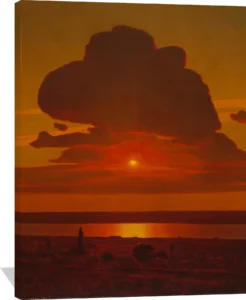
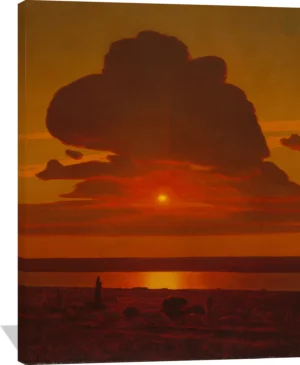
Kuindzhi is best known for his luminous landscapes, where carefully orchestrated contrasts create a sense of drama and quiet mystery. His approach blended realism with a near‑symbolic intensity, often pushing the boundaries of naturalism to heighten emotional impact. Areas of deep shadow set against radiant skies became a signature device, revealing his mastery of color modulation and his innovative use of light.
Subjects and Themes
Nature was Kuindzhi’s central subject. He painted sweeping plains, moonlit nights, and vast horizons that evoke both solitude and transcendence. Works such as Moonlit Night on the Dnieper demonstrate his ability to transform familiar scenery into something almost visionary, using simplified forms and glowing tonalities to immerse viewers in a contemplative atmosphere. His scenes often carry a sense of quiet grandeur, reflecting the spiritual resonance he found in the Ukrainian and Russian landscape.
Contributions and Significance
Kuindzhi held a unique place within the artistic circles of his time. Associated with the Peredvizhniki (The Wanderers) before pursuing his own independent path, he became known for bold exhibition practices, including presenting single works dramatically lit in darkened rooms to emphasize their radiance. His influence reached far beyond his own canvases; as a teacher at the Imperial Academy of Arts, he supported young painters and encouraged experimentation, helping shape a new generation of artists.
Legacy
Today, Kuindzhi is admired for his ability to merge realism with a heightened atmospheric vision, creating landscapes that feel both grounded and otherworldly. His work continues to resonate for its emotional depth, technical refinement, and the way it captures the expansive spirit of the natural world. Through his art, Kuindzhi secured his place as a pivotal figure in the evolution of modern landscape painting.