
Moses and Aaron before Pharaoh: An Allegory of the Dinteville Family
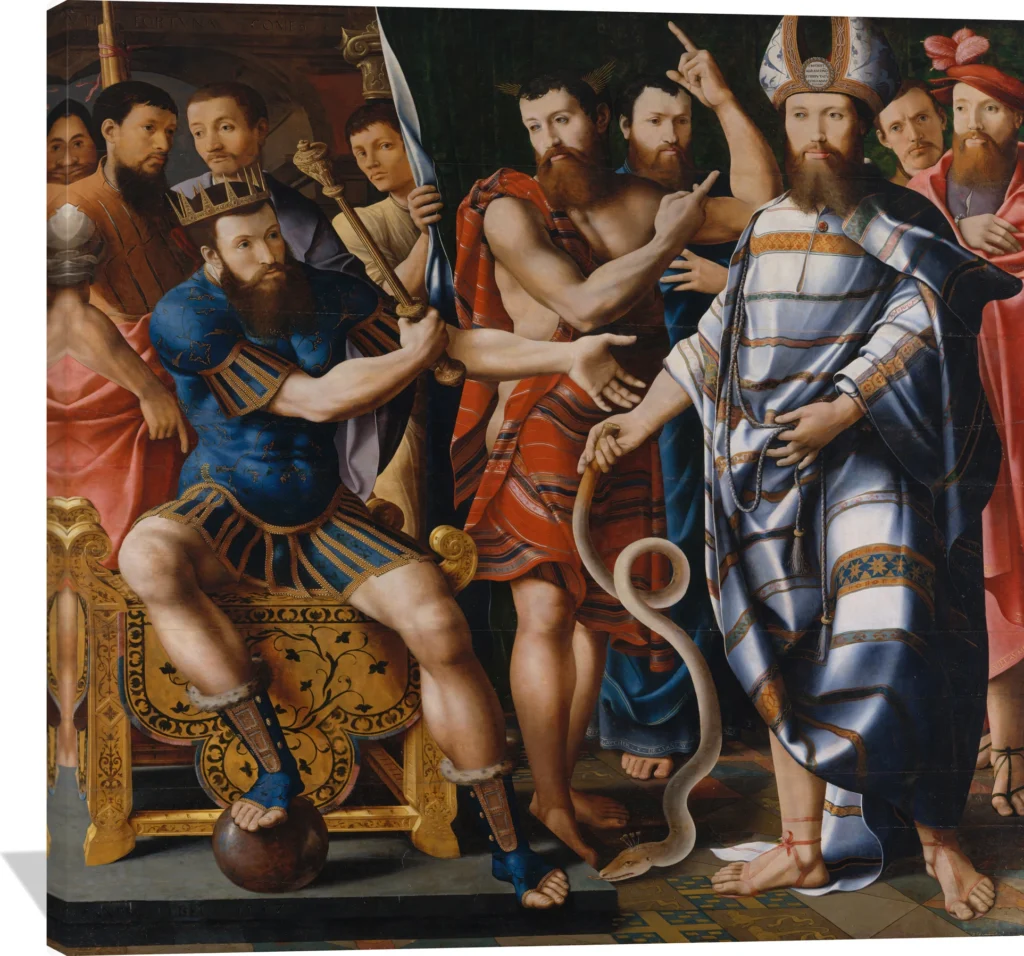
The Master of the Dinteville Allegory captures divine confrontation and human drama in Moses and Aaron before Pharaoh: An Allegory of the Dinteville Family. This striking canvas print showcases luminous blues, deep reds, and warm golds in a masterful balance of power and faith, rendered with the refined precision of mid-16th-century Netherlandish art. The scene’s rich symbolism and lifelike figures bring timeless narrative depth to any space.
Perfect for a living room, study, or entryway, this Master of the Dinteville Allegory canvas transforms walls into a gallery of Renaissance storytelling. Its bold composition and regal tones invite reflection, making it an exceptional centerpiece for collectors of historical or religious wall art.
The Master of the Dinteville Allegory was a Netherlandish or French painter active in the mid-sixteenth century, known for a refined artistic voice that blended Northern European precision with emerging Renaissance humanism. Though anonymous, the artist is identified by a distinctive allegorical painting associated with the Dinteville family, whose intellectual milieu shaped the artist’s thematic focus.
Artistic Style
The artist’s work is marked by meticulous detail, cool tonal harmonies, and an incisive rendering of textures characteristic of Northern tradition. Yet the compositions reveal an awareness of contemporary French courtly aesthetics, creating a subtle fusion of realism and symbolic sophistication. This synthesis gives the artist’s surviving works an unmistakable visual identity anchored in clarity, balance, and intellectual nuance.
Typical Subjects
The Master of the Dinteville Allegory is best known for allegorical and moralizing imagery featuring elegantly posed figures, emblems, and coded motifs. These subjects often explore themes of mortality, virtue, and worldly ambition. Symbolic elements are integrated with precision, encouraging viewers to read the imagery as a layered narrative rather than a straightforward scene.
Cultural Significance
The artist occupies a compelling position within mid-sixteenth‑century Northern art, bridging local traditions with broader Renaissance currents. By merging courtly taste with learned symbolism, the Master contributed to the evolving visual language of humanist allegory. The enduring appeal of works attributed to this painter lies in their quiet complexity, refined technique, and enduring symbolic resonance, making them prized examples of early modern European allegorical painting.
Trust & policies
- 🚚 Free tracked shipping to 45+ countries. Local import duties or taxes may apply in some destinations.
- 🎨 Made-to-order, printed close to your delivery location
- 🛡️ If damaged, defective, or misprinted: free replacement or refund
- 🌍 Printed in US/CA/EU/UK/AU based on delivery location
- 💎 Acid-free, fade-resistant canvas with solid wood stretcher bars
- 🖼️ Optional pine floating frames in white, black, or brown
- 🪝 Ready to hang — hardware pre-installed