
The Love Song
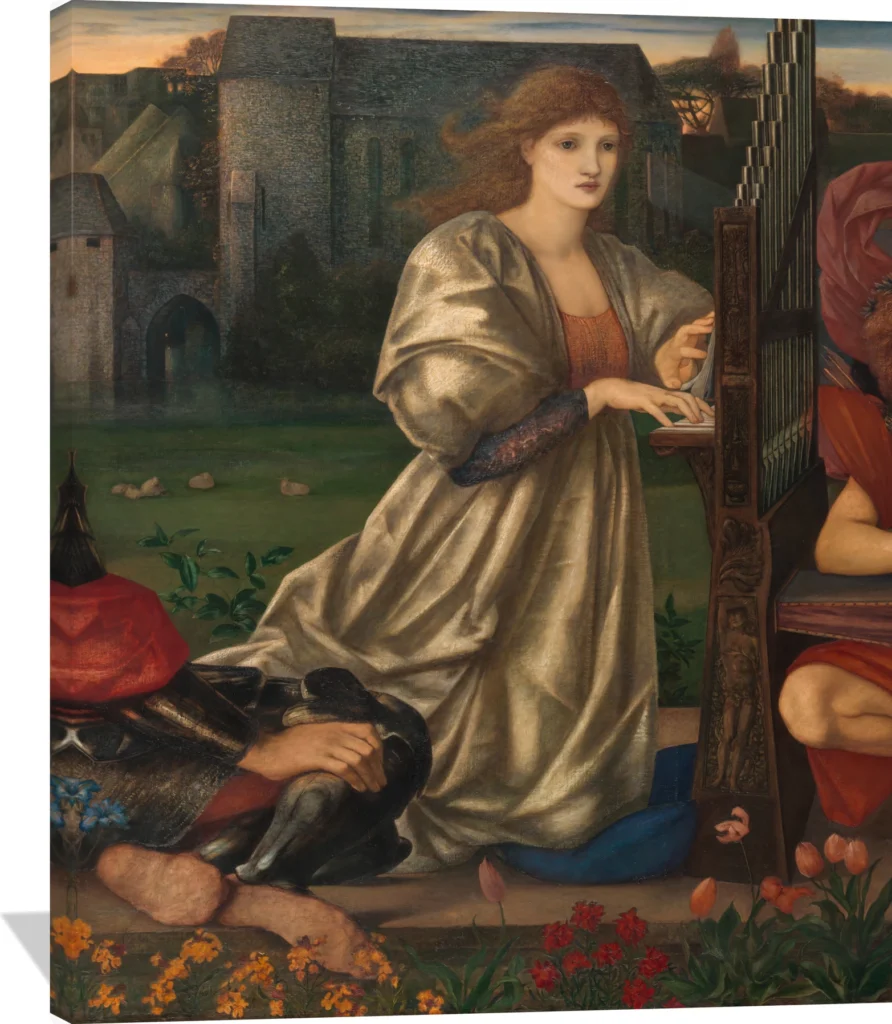
The Sir Edward Burne-Jones The Love Song canvas captures a moment of quiet harmony and romantic reverie. Rendered in soft golds, deep reds, and muted greens, this Pre-Raphaelite masterpiece evokes a timeless sense of beauty and introspection. Three figures gathered around an organ in a medieval garden create an atmosphere both intimate and ethereal, perfect for those who appreciate art steeped in symbolism and grace.
This exquisite wall art brings a refined elegance to any living room, study, or entryway. A canvas print of The Love Song offers a serene focal point that celebrates music, devotion, and the poetic spirit of Burne-Jones’s vision.
Sir Edward Burne-Jones (1833–1898) was a British artist whose poetic vision helped define the later phase of the Pre-Raphaelite movement and shape the aesthetics of the Aesthetic and Arts and Crafts movements. Born in Birmingham and active primarily in London, he became one of the most influential figures of nineteenth-century British art, celebrated for his dreamlike narratives and meticulous craftsmanship.
Artistic Style
Burne-Jones developed a distinctive visual language marked by elongated forms, ethereal figures, and a deliberate revival of medieval and Renaissance ideals. His palette often embraced subdued, harmonious tones, enhancing the sense of otherworldly beauty that permeates his work. Through a fusion of poetic symbolism and refined technique, he created a world where myth and imagination intertwine with emotional depth.
Subjects and Themes
Much of Burne-Jones’s oeuvre centers on mythological, literary, and legendary subjects, particularly from Arthurian lore, Greek mythology, and medieval romance. Works such as The Beguiling of Merlin and The Golden Stairs exemplify his fascination with heroic quests, spiritual longing, and the mysteries of fate. His compositions often feature contemplative heroes, enigmatic heroines, and richly patterned settings that invite viewers into a realm of symbolic storytelling.
Legacy and Significance
A central figure in the circle of William Morris, Burne-Jones contributed significantly to the ideals of the Arts and Crafts movement, advocating for the unity of fine and decorative arts. His designs for stained glass, tapestries, and book illustration expanded his influence beyond painting and helped inspire a generation of artists and designers across Europe. His ability to transform traditional narratives into visually compelling, emotionally resonant images remains a hallmark of his enduring legacy.
Celebrated for his lyrical imagination and for reshaping Victorian art’s relationship with myth and beauty, Burne-Jones continues to captivate viewers with works that transcend time and speak to the enduring power of visual storytelling.
Trust & policies
- 🚚 Free tracked shipping to 45+ countries. Local import duties or taxes may apply in some destinations.
- 🎨 Made-to-order, printed close to your delivery location
- 🛡️ If damaged, defective, or misprinted: free replacement or refund
- 🌍 Printed in US/CA/EU/UK/AU based on delivery location
- 💎 Acid-free, fade-resistant canvas with solid wood stretcher bars
- 🖼️ Optional pine floating frames in white, black, or brown
- 🪝 Ready to hang — hardware pre-installed