Artistic Style
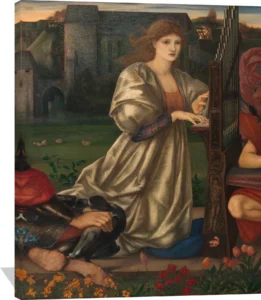
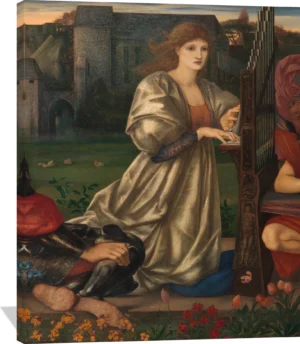
Burne-Jones developed a distinctive visual language marked by elongated forms, ethereal figures, and a deliberate revival of medieval and Renaissance ideals. His palette often embraced subdued, harmonious tones, enhancing the sense of otherworldly beauty that permeates his work. Through a fusion of poetic symbolism and refined technique, he created a world where myth and imagination intertwine with emotional depth.
Subjects and Themes
Much of Burne-Jones’s oeuvre centers on mythological, literary, and legendary subjects, particularly from Arthurian lore, Greek mythology, and medieval romance. Works such as The Beguiling of Merlin and The Golden Stairs exemplify his fascination with heroic quests, spiritual longing, and the mysteries of fate. His compositions often feature contemplative heroes, enigmatic heroines, and richly patterned settings that invite viewers into a realm of symbolic storytelling.
Legacy and Significance
A central figure in the circle of William Morris, Burne-Jones contributed significantly to the ideals of the Arts and Crafts movement, advocating for the unity of fine and decorative arts. His designs for stained glass, tapestries, and book illustration expanded his influence beyond painting and helped inspire a generation of artists and designers across Europe. His ability to transform traditional narratives into visually compelling, emotionally resonant images remains a hallmark of his enduring legacy.
Celebrated for his lyrical imagination and for reshaping Victorian art’s relationship with myth and beauty, Burne-Jones continues to captivate viewers with works that transcend time and speak to the enduring power of visual storytelling.