
Madonna and Child with the Young Saint John the Baptist
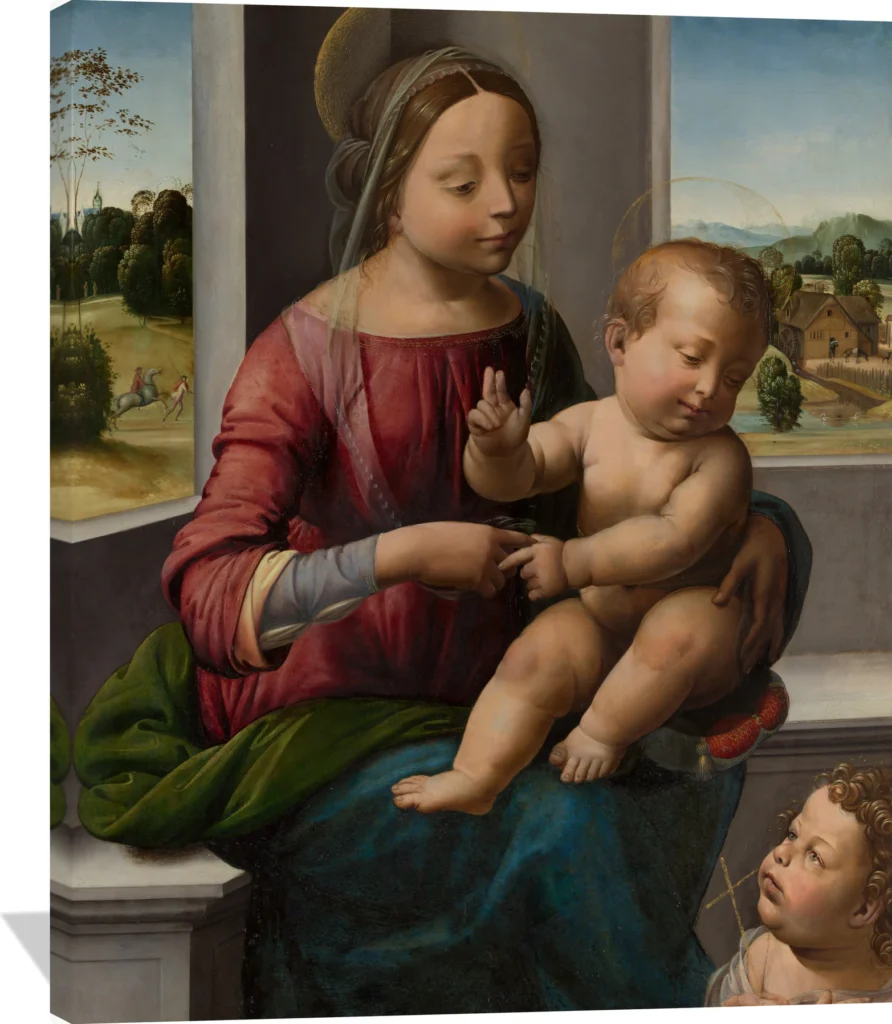
The Fra Bartolomeo Madonna and Child with the Young Saint John the Baptist canvas captures serene devotion and tender humanity in rich Renaissance color. Deep crimson, soft gold, and tranquil blue tones illuminate the sacred figures, framed by a peaceful Tuscan landscape. The artist’s masterful balance of light and composition evokes both intimacy and grace, making this canvas print a timeless focal point for any refined space.
Ideal for a living room, study, or entryway, this exquisite wall art brings classical harmony and spiritual warmth to modern interiors. A museum-quality canvas print that celebrates the enduring beauty of Italian artistry.
Fra Bartolomeo (Bartolomeo di Paolo del Fattorino, 1473–1517) was an influential Florentine painter whose serene yet powerful religious imagery helped shape the High Renaissance. A Dominican friar of the convent of San Marco, he united spiritual devotion with refined artistic innovation, becoming a central figure in the transition from Quattrocento clarity to the harmonious ideals of the early sixteenth century.
Artistic Style
Fra Bartolomeo is celebrated for his balanced compositions, luminous color harmonies, and graceful modeling of the human form. His work reveals a masterful understanding of proportion and perspective, enriched by a soft, atmospheric handling of light. Influenced by the teachings of Fra Angelico and later by Raphael, he developed a style marked by calm monumentality and an elegant sense of order. His ability to evoke spiritual depth through subtle expression and refined contour remains one of his most distinctive contributions.
Subjects and Themes
Devotional imagery was at the heart of Bartolomeo’s practice. He produced altarpieces, grand church commissions, and intimate paintings of the Madonna and Child, saints, and scenes from the life of Christ. His figures often exude a quiet dignity, embodying the Dominican ideal of contemplative piety. Works such as The Vision of St. Bernard and The Madonna della Misericordia demonstrate his gift for infusing sacred narratives with emotional resonance while maintaining impeccable compositional structure.
Notable Contributions
Bartolomeo played a key role in restoring the significance of monumental, large-scale religious painting in Florence after the upheavals of the late fifteenth century. His pioneering use of the modello carefully crafted preparatory drawings helped professionalize studio practice. He also forged a meaningful artistic exchange with Raphael, influencing and being influenced by one of the Renaissance’s greatest masters. His confident use of drapery, color modulation, and spatial unity exemplifies the High Renaissance’s pursuit of aesthetic harmony.
Cultural and Historical Significance
As both friar and painter, Fra Bartolomeo embodied the profound link between art and spirituality that characterized Renaissance Florence. His works served not only as visual anchors for worship but also as testaments to the evolving language of Italian painting. His serene, architecturally balanced compositions became a touchstone for later artists, and his commitment to integrating devotion with artistic excellence contributed to his enduring reputation as a master of sacred art.
Today, Fra Bartolomeo is remembered for his harmonious visual poetry and for shaping a moment in art history when faith, humanism, and painterly refinement converged with exceptional grace.
Trust & policies
- 🚚 Free tracked shipping to 45+ countries. Local import duties or taxes may apply in some destinations.
- 🎨 Made-to-order, printed close to your delivery location
- 🛡️ If damaged, defective, or misprinted: free replacement or refund
- 🌍 Printed in US/CA/EU/UK/AU based on delivery location
- 💎 Acid-free, fade-resistant canvas with solid wood stretcher bars
- 🖼️ Optional pine floating frames in white, black, or brown
- 🪝 Ready to hang — hardware pre-installed