
The Forest in Winter at Sunset
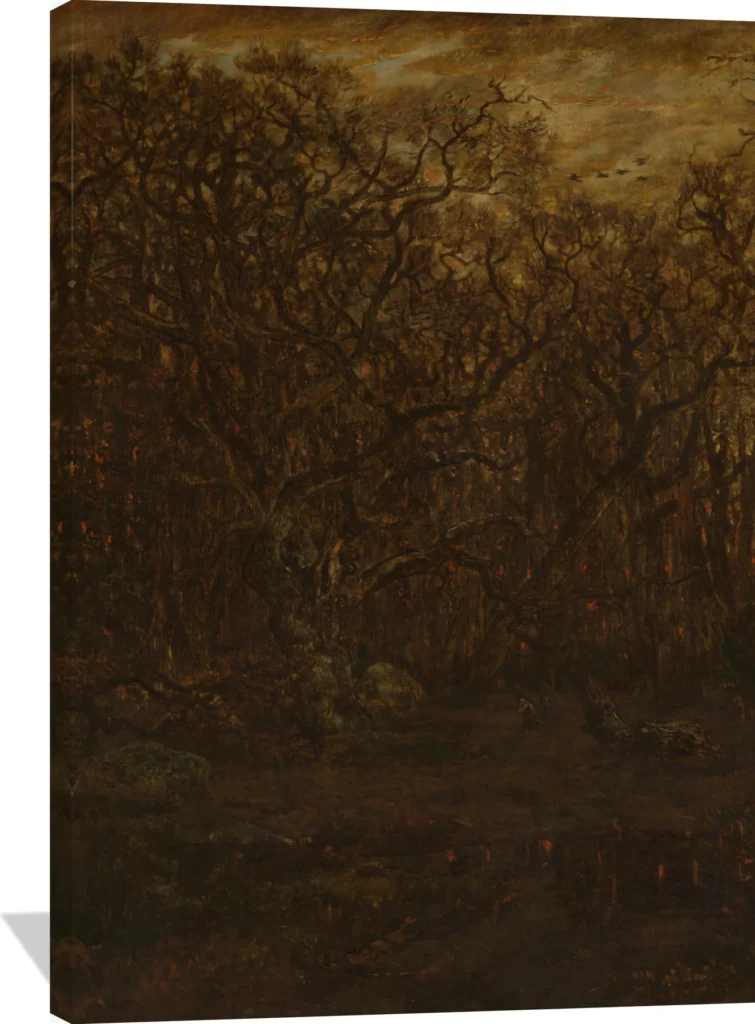
The Théodore Rousseau The Forest in Winter at Sunset canvas captures the haunting beauty of a quiet woodland bathed in the final glow of day. Deep browns, muted golds, and dusky grays evoke the stillness of nature at rest, while the intricate silhouettes of bare trees draw the eye toward a distant, fading light. Rousseau’s masterful brushwork and tonal harmony create a contemplative atmosphere that feels both timeless and intimate.
This elegant wall art brings a sense of depth and serenity to any space—ideal for a living room, study, or entryway seeking a touch of natural majesty and quiet reflection. A striking canvas print for those who appreciate the poetic power of landscape art.
Théodore Rousseau (French, Paris 1812–1867 Barbizon) was a central figure of the Barbizon School, renowned for his profound devotion to depicting the natural world with emotional depth and exceptional sensitivity. His work marked a pivotal shift in nineteenth‑century French painting, moving away from academic conventions toward direct engagement with the landscape.
Artistic Style
Rousseau’s style is characterized by richly textured brushwork, atmospheric tonalities, and a deep reverence for nature. He often painted en plein air, allowing changing light and weather to shape his compositions. His canvases balance careful observation with a poetic mood, creating landscapes that feel both grounded and contemplative.
Typical Subjects
Forests, ancient oaks, rural clearings, and the expansive woodlands surrounding Barbizon were Rousseau’s favored motifs. Rather than idealizing the countryside, he portrayed it with honesty and emotional resonance, capturing the drama of stormy skies, the tranquility of twilight, and the monumental presence of trees.
Notable Contributions
A leading force in the development of Naturalism, Rousseau helped redefine landscape painting as a serious, expressive genre. His commitment to painting directly from nature profoundly influenced contemporaries and later generations. His works, including pieces such as The Forest of Fontainebleau and Edge of the Woods, demonstrate a mastery of light and atmosphere that shaped the trajectory of modern landscape art.
Cultural Significance
Rousseau’s legacy lies in his ability to convey the spiritual and emotional power of the natural world. As a founder of the Barbizon movement, he played a crucial role in transforming how landscapes were perceived, elevating them into vehicles for personal expression. His paintings remain celebrated for their quiet grandeur, meticulous detail, and enduring connection to the French countryside.
Trust & policies
- 🚚 Free tracked shipping to 45+ countries. Local import duties or taxes may apply in some destinations.
- 🎨 Made-to-order, printed close to your delivery location
- 🛡️ If damaged, defective, or misprinted: free replacement or refund
- 🌍 Printed in US/CA/EU/UK/AU based on delivery location
- 💎 Acid-free, fade-resistant canvas with solid wood stretcher bars
- 🖼️ Optional pine floating frames in white, black, or brown
- 🪝 Ready to hang — hardware pre-installed