
Alexander Stewart Wetherill
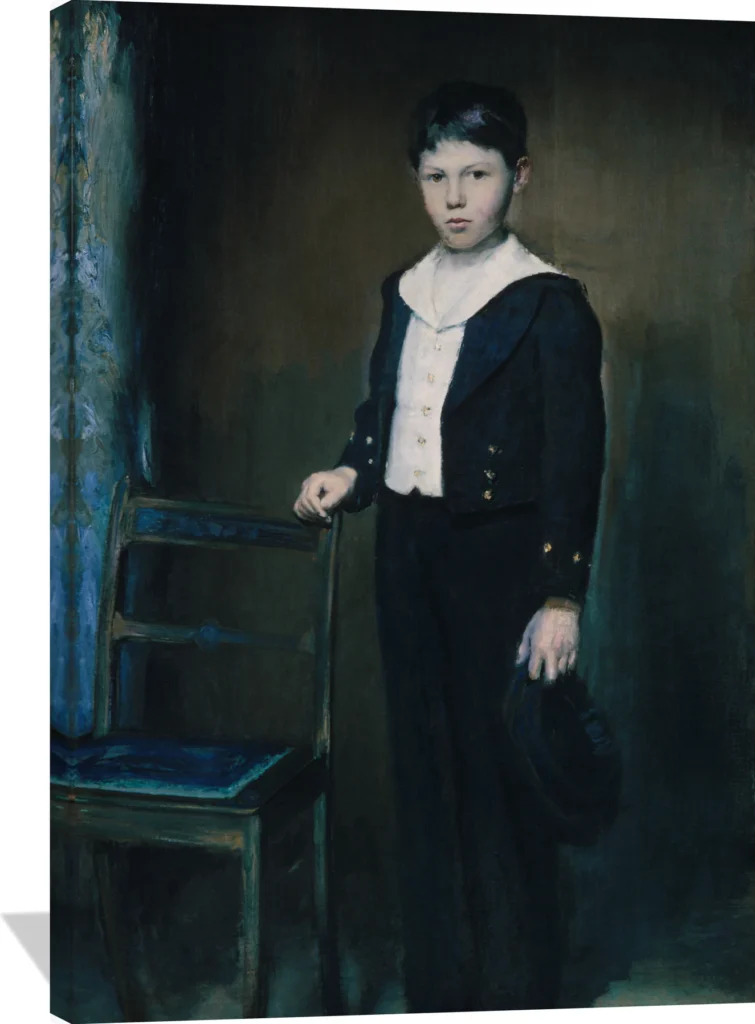
The Alfred Q. Collins Alexander Stewart Wetherill canvas captures a poised young figure rendered in deep navy, soft ivory, and muted brown tones. Collins’ refined brushwork and balanced composition evoke quiet confidence and timeless grace, making this portrait a striking statement piece for any interior.
This elegant wall art brings a sense of heritage and sophistication to your living room, study, or entryway. The Alexander Stewart Wetherill canvas print embodies 19th-century artistry with a modern sensibility—perfect for collectors who appreciate classic portraiture with enduring charm.
Alfred Q. Collins (1855–1903) was a late‑19th‑century American painter whose work reflects the period’s growing interest in natural light, atmospheric subtlety, and intimate depictions of daily life. Though less widely documented than some of his contemporaries, Collins earned recognition in his era for his refined handling of color and his sensitive approach to pictorial storytelling.
Artistic Style
Collins’s style blends the tonal delicacy of American Impressionism with the quiet realism characteristic of post‑Civil War art. His brushwork often suggests movement without sacrificing clarity, creating scenes that feel both carefully observed and gently idealized. A focus on nuanced lighting became one of his signature qualities, allowing his compositions to evoke mood as much as place.
Subjects and Themes
His paintings frequently portray landscapes, riverbanks, and rural settings, as well as domestic interior scenes that highlight the subtle rhythms of everyday life. Collins favored seasonal transitions, capturing misty mornings, golden afternoons, and dusky horizons with equal attentiveness. When painting figures, he emphasized gesture and posture over explicit narrative, giving works such as Woman at the Window or Autumn by the Marsh a contemplative, almost poetic sensibility.
Historical Significance
Working during a period of rapid industrial expansion, Collins contributed to a broader cultural desire to preserve the serenity and simplicity of the American landscape. His paintings reflect a moment when artists sought to balance realism with emotional resonance, bridging traditional academic approaches with emerging modern sensibilities. Although not widely publicized today, his work offers insight into the quieter currents of 19th‑century American art.
Legacy
Collectors value Collins’s paintings for their atmospheric depth, warm natural palette, and evocative sense of place. His ability to transform ordinary scenes into reflective visual experiences remains one of his most enduring accomplishments, making his work a timeless presence in American art history.
Trust & policies
- 🚚 Free tracked shipping to 45+ countries. Local import duties or taxes may apply in some destinations.
- 🎨 Made-to-order, printed close to your delivery location
- 🛡️ If damaged, defective, or misprinted: free replacement or refund
- 🌍 Printed in US/CA/EU/UK/AU based on delivery location
- 💎 Acid-free, fade-resistant canvas with solid wood stretcher bars
- 🖼️ Optional pine floating frames in white, black, or brown
- 🪝 Ready to hang — hardware pre-installed