
Flora and Zephyr
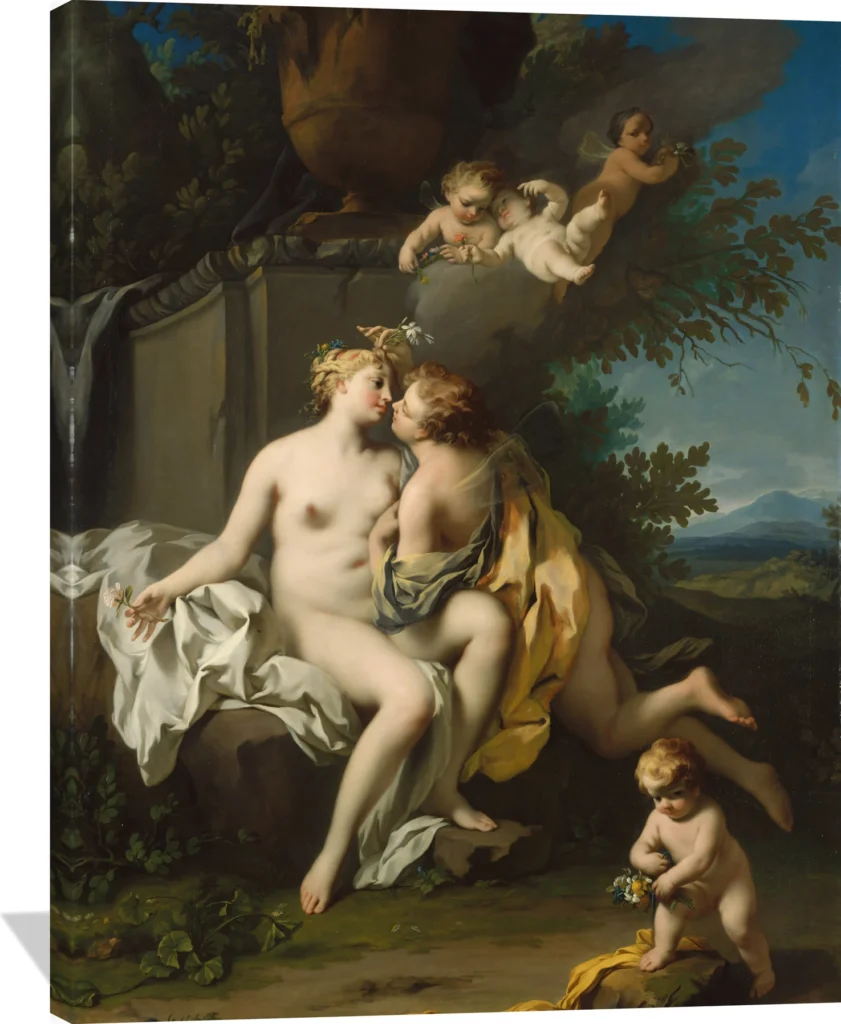
The Jacopo Amigoni Flora and Zephyr canvas captures a tender mythological embrace bathed in soft light and surrounded by cherubic figures. Amigoni’s Venetian mastery shines through in luminous tones of ivory, gold, sky blue, and verdant green, evoking a sense of grace and romantic serenity. The composition’s flowing drapery and gentle movement create a timeless elegance that draws the viewer into its dreamlike atmosphere.
This exquisite canvas print brings classical sophistication to any interior. Perfect for a living room, study, or entryway, the Flora and Zephyr wall art infuses your space with the refined beauty and poetic warmth of 18th-century Italian artistry.
Jacopo Amigoni (Italian, Venice 1682–1752 Madrid) was a distinguished Rococo painter whose graceful compositions and refined palette helped shape the artistic culture of 18th‑century Europe. Active across Venice, London, Paris, and finally Madrid, he became known for his elegant fusion of Venetian colorism with the lightness and charm characteristic of the international Rococo movement.
Artistic Style
Amigoni’s work is defined by luminous color, fluid brushwork, and an effortless sense of movement. His scenes often feature soft atmospheric effects and harmonious tonal transitions, giving his figures a distinctive warmth and vitality. This uniquely lyrical approach, paired with his mastery of decorative composition, made him a sought‑after painter for both private patrons and royal courts.
Subjects and Themes
He excelled in mythological and allegorical narratives, creating intimate yet theatrical depictions of classical subjects. His portraits, another hallmark of his career, reveal his sensitivity to character and his talent for rendering sumptuous fabrics and delicate expressions. Whether portraying deities or members of European aristocracy, Amigoni imbued each work with a refined elegance that became a signature of his oeuvre.
Legacy and Significance
Through his travels and court appointments, Amigoni served as an important conduit for the spread of Rococo aesthetics across Europe. His ability to blend Venetian tradition with contemporary tastes contributed to the development of a more cosmopolitan visual language. Celebrated for his graceful compositions and distinctive color sensibility, he remains an influential figure in the evolution of 18th‑century painting.
Trust & policies
- 🚚 Free tracked shipping to 45+ countries. Local import duties or taxes may apply in some destinations.
- 🎨 Made-to-order, printed close to your delivery location
- 🛡️ If damaged, defective, or misprinted: free replacement or refund
- 🌍 Printed in US/CA/EU/UK/AU based on delivery location
- 💎 Acid-free, fade-resistant canvas with solid wood stretcher bars
- 🖼️ Optional pine floating frames in white, black, or brown
- 🪝 Ready to hang — hardware pre-installed