
Arrangement in Black: Girl Reading
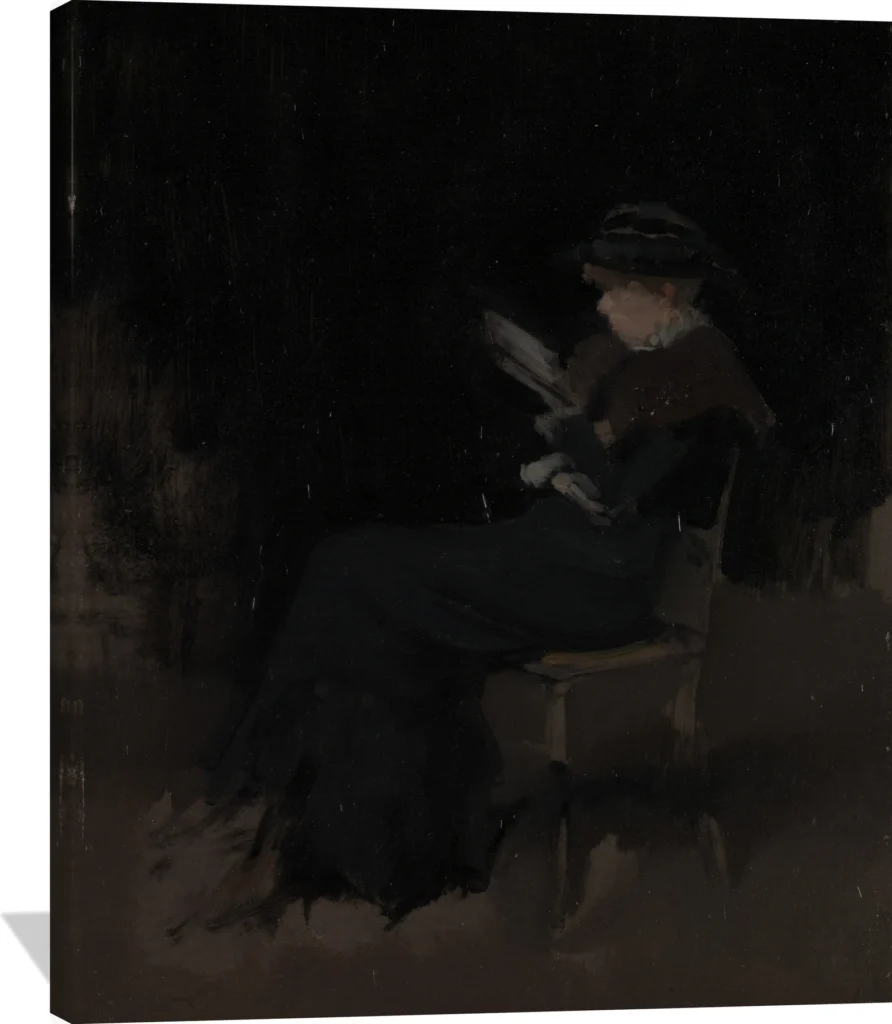
The James McNeill Whistler Arrangement in Black: Girl Reading canvas captures quiet introspection through delicate tonal harmony and shadow. A seated figure, softly illuminated against a deep, velvety backdrop of black, brown, and muted gray, evokes Whistler’s mastery of mood and restraint. The subtle interplay of light and texture draws the viewer into a moment of stillness and contemplation.
This elegant wall art brings timeless sophistication to any living room, study, or entryway. A refined choice for collectors and design enthusiasts alike, this canvas print embodies Whistler’s poetic approach to simplicity and form, offering a serene focal point for modern and classic interiors.
James McNeill Whistler (American, Lowell, Massachusetts 1834–1903 London) was a pioneering figure whose refined aesthetic reshaped modern painting. Though American-born, he built his career in Europe, becoming one of the most influential artistic voices in Victorian London and a catalyst for the Aesthetic Movement.
Artistic Style and Approach
Whistler championed the idea that art should stand apart from moral or narrative purpose, emphasizing harmony, subtlety, and mood. His paintings are distinguished by their atmospheric tonal arrangements, delicate brushwork, and a focus on creating visual balance. This pursuit of beauty for its own sake became one of his most enduring contributions and a defining principle of the era’s evolving modernism.
Subjects and Notable Work
He is best known for serene portraits, intimate interiors, and evocative nocturnes cityscapes rendered in soft, misty light. Works such as Arrangement in Grey and Black No. 1 reflect his mastery of tonal harmony, while his celebrated series of Nocturnes transformed views of the Thames into poetic meditations. These paintings demonstrated his ability to distill atmosphere into a near-musical composition, an approach that set him apart from his contemporaries.
Cultural and Historical Significance
Whistler played an essential role in advancing a more modern, cosmopolitan vision of art. His insistence on artistic autonomy, combined with his elegant, economical style, influenced generations of painters across Europe and the United States. Today, he is remembered as a pivotal figure who bridged traditional techniques with emerging modernist ideals, leaving a legacy defined by subtle beauty, innovation, and a commitment to the principles of the Aesthetic Movement.
Trust & policies
- 🚚 Free tracked shipping to 45+ countries. Local import duties or taxes may apply in some destinations.
- 🎨 Made-to-order, printed close to your delivery location
- 🛡️ If damaged, defective, or misprinted: free replacement or refund
- 🌍 Printed in US/CA/EU/UK/AU based on delivery location
- 💎 Acid-free, fade-resistant canvas with solid wood stretcher bars
- 🖼️ Optional pine floating frames in white, black, or brown
- 🪝 Ready to hang — hardware pre-installed