
Cloud Study (Distant Storm)
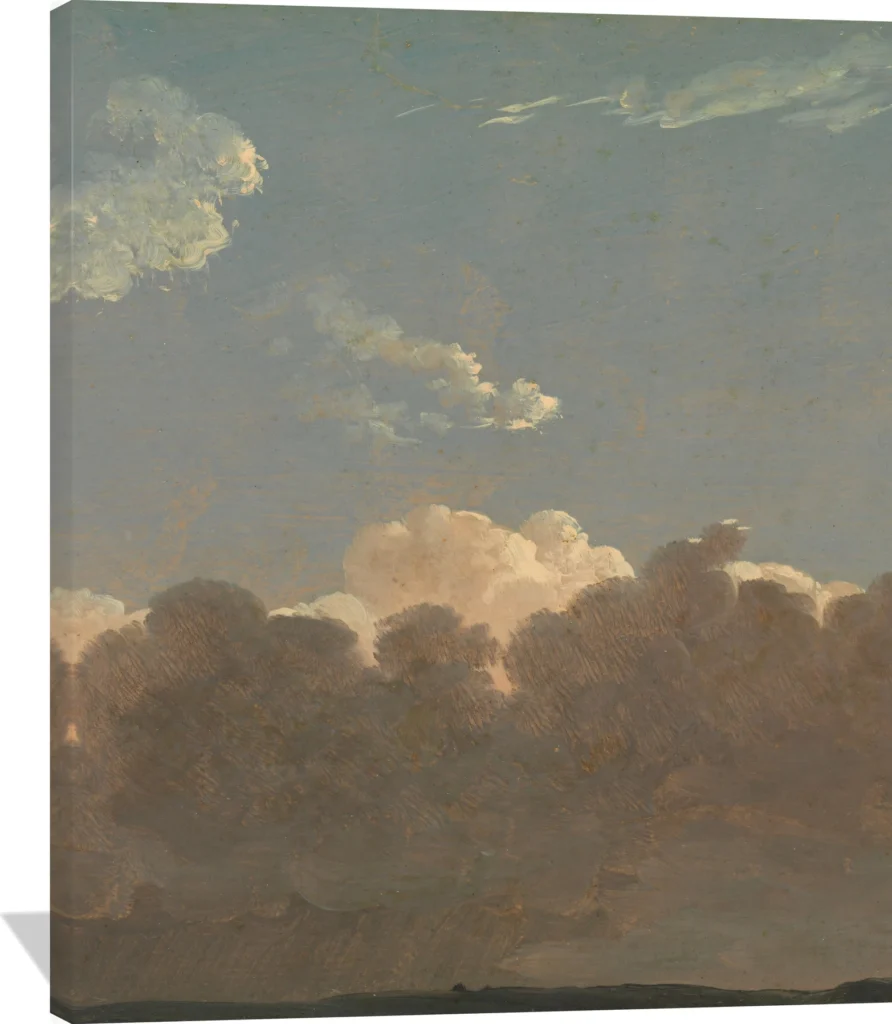
The Simon Denis Cloud Study (Distant Storm) canvas captures the fleeting drama of light and atmosphere with poetic precision. Billowing clouds in warm grays, blush pinks, and soft blues rise above a tranquil horizon, evoking the calm before a summer storm. The artist’s delicate brushwork and luminous palette create a sense of depth and serenity that draws the eye upward.
This timeless wall art brings a refined natural beauty to any space—perfect for a living room, study, or entryway. A canvas print that celebrates the elegance of the sky and the mastery of a Flemish painter whose vision transcends centuries.
Simon Denis (1755–1813) was a Flemish painter from Antwerp whose career flourished in Italy, particularly in Rome and Naples. Known for his expressive mastery of light and atmospheric effects, he became one of the key figures in the evolution of late 18th‑ and early 19th‑century landscape painting.
Artistic Style
Denis developed a distinctive approach rooted in plein‑air observation, capturing fleeting climatic changes with remarkable immediacy. His rapid oil sketches and finished landscapes reveal a refined sensitivity to color, shifting skies, and natural luminosity. He balanced the clarity of Flemish tradition with the poetic mood of Italian landscape art, creating works that feel both spontaneous and carefully composed.
Notable Contributions
Among the earliest artists to consistently produce oil studies outdoors, Denis became known for his pioneering methods that prefigured later developments in naturalistic landscape painting. His ability to render dramatic skies, volcanic vistas, and coastal horizons influenced contemporaries and contributed significantly to the growing appreciation of direct study from nature. His time near Mount Vesuvius yielded some of his most compelling works, where he captured eruptions and atmospheric effects with vivid immediacy and a strong sense of place.
Typical Subjects
Denis favored expansive views of the Roman countryside, Neapolitan coasts, and Southern Italian terrain. He frequently depicted sweeping panoramas, twilight scenes, stormy weather, and the luminous transitions of dawn and dusk. Whether painting serene pastoral settings or the volatile drama of volcanic landscapes, he brought a perceptive eye to the grandeur and subtleties of the natural world.
Cultural and Historical Significance
Working at a moment when European artists were increasingly drawn to the truthfulness of direct observation, Denis emerged as a bridge between classical landscape traditions and the more naturalistic approaches that would follow. His work held particular resonance for travelers on the Grand Tour and for connoisseurs seeking an authentic vision of the Italian landscape. Today, he is recognized as a significant precursor to later landscape innovators, celebrated for his atmospheric mastery and his role in elevating open‑air painting as a serious artistic practice.
Trust & policies
- 🚚 Free tracked shipping to 45+ countries. Local import duties or taxes may apply in some destinations.
- 🎨 Made-to-order, printed close to your delivery location
- 🛡️ If damaged, defective, or misprinted: free replacement or refund
- 🌍 Printed in US/CA/EU/UK/AU based on delivery location
- 💎 Acid-free, fade-resistant canvas with solid wood stretcher bars
- 🖼️ Optional pine floating frames in white, black, or brown
- 🪝 Ready to hang — hardware pre-installed