
William Edward Dighton (1822–1853) in Middle Eastern Dress
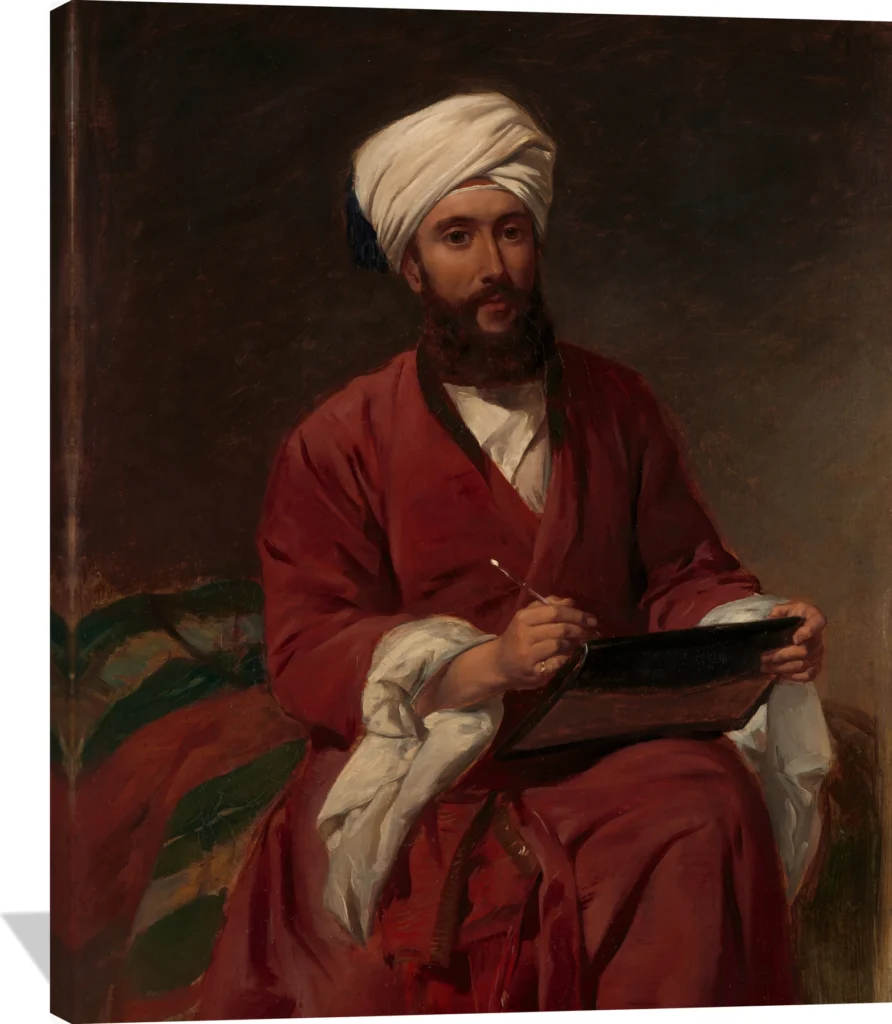
The Frederick Goodall William Edward Dighton (1822–1853) in Middle Eastern Dress canvas captures a contemplative portrait bathed in warm, earthy tones of crimson, ivory, and deep brown. The sitter’s poised expression and flowing robes evoke a quiet dignity, set against a softly shadowed background that enhances the painting’s depth and intimacy.
This refined wall art brings a touch of 19th-century Orientalist elegance to any interior. Ideal for a study, library, or sophisticated living space, this canvas print celebrates Goodall’s masterful use of light and texture while adding timeless character to modern decor.
Frederick Goodall (1822–1904) was a British painter renowned for his evocative scenes inspired by travel, faith, and cultural discovery. Born and based in London, he built a distinguished career during the Victorian era, earning recognition for his meticulous technique and immersive atmospheres.
Artistic Style
Goodall’s work is defined by finely rendered detail, a warm and radiant palette, and a deep appreciation for the interplay of light and shadow. His paintings often balance naturalistic observation with a subtly romantic sensibility, creating compositions that feel both intimate and expansive. This distinctive approach allowed him to capture distant landscapes and everyday moments with remarkable clarity and emotional resonance.
Subjects and Themes
Although trained within a British academic tradition, Goodall is best known for his richly textured Orientalist paintings. After traveling to Egypt in the 1850s, he developed a lifelong fascination with the region’s landscapes, architectural forms, and cultural rhythms. His works frequently depict desert vistas, Nile river scenes, and carefully observed representations of local life. Goodall’s sensitivity to environment and context gives these subjects an enduring appeal, offering viewers a glimpse into settings that are simultaneously historical and timeless.
Legacy and Significance
During his lifetime, Goodall enjoyed substantial acclaim and contributed meaningfully to the Victorian art world. His paintings were celebrated for their authenticity and atmospheric depth, qualities that helped shape British audiences’ visual understanding of Middle Eastern cultures. Today, he is remembered as a skilled storyteller and a leading figure within nineteenth-century Orientalist art. His enduring influence lies in his ability to transform real-world encounters into scenes of quiet grandeur and compelling visual narrative.
Trust & policies
- 🚚 Free tracked shipping to 45+ countries. Local import duties or taxes may apply in some destinations.
- 🎨 Made-to-order, printed close to your delivery location
- 🛡️ If damaged, defective, or misprinted: free replacement or refund
- 🌍 Printed in US/CA/EU/UK/AU based on delivery location
- 💎 Acid-free, fade-resistant canvas with solid wood stretcher bars
- 🖼️ Optional pine floating frames in white, black, or brown
- 🪝 Ready to hang — hardware pre-installed