
Auguste Rodin
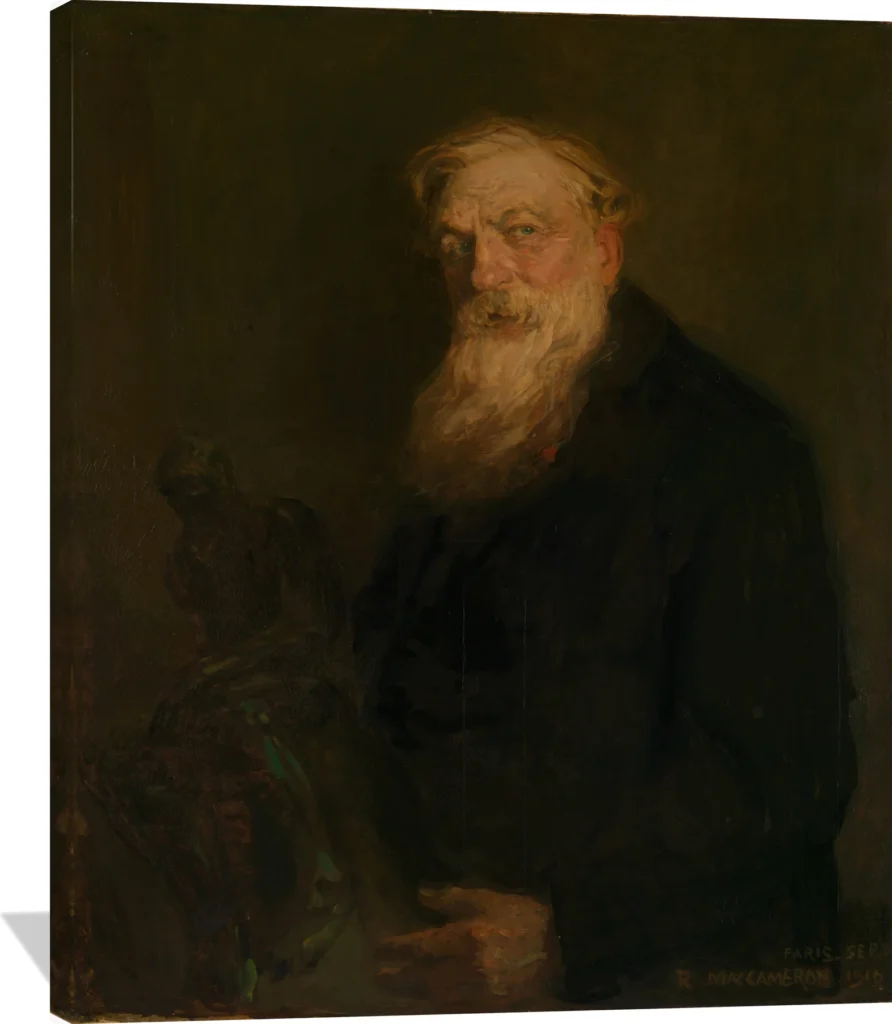
The Robert MacCameron Auguste Rodin canvas captures the quiet intensity of the legendary sculptor through rich, earthy tones of deep olive, umber, and gold. MacCameron’s painterly brushwork and dramatic lighting evoke a timeless sense of intellect and creative power, making this portrait a compelling focal point for any refined interior.
This premium wall art brings museum-quality sophistication to your living room, study, or entryway. The Auguste Rodin canvas print embodies both history and artistry, offering a contemplative presence that complements classic and modern décor alike.
Robert MacCameron (1866–1912) was a late‑nineteenth‑century painter recognized for his refined handling of atmosphere and his attentive portrayals of everyday life. Working during a period of rapid artistic change, he developed a quietly expressive style that merged traditional academic training with emerging modern sensibilities.
Artistic Style
MacCameron’s work is distinguished by its balanced compositions and subtle tonal harmonies. He favored a naturalistic approach, yet his brushwork often reveals a soft, luminous quality associated with turn‑of‑the‑century realism. His ability to capture shifting light and delicate textures lent his paintings a gentle, contemplative mood, making his surfaces resonate with a sense of lived experience.
Subjects and Themes
Although his subjects varied, MacCameron frequently depicted quiet landscapes, domestic interiors, and intimate figurative scenes. He gravitated toward moments of stillness rural paths, shaded gardens, and solitary figures at rest rendering them with an emotional depth that feels both personal and universal. His sensitivity to setting and atmosphere allowed him to transform modest subjects into evocative visual narratives.
Notable Contributions
Working within an era shaped by shifting aesthetics, MacCameron contributed to the period’s evolving dialogue between tradition and innovation. His paintings reveal an artist committed to observation, yet receptive to the evocative potential of color and light. This blend of fidelity and subtle experimentation positioned his work as part of a broader transition toward more expressive realism.
Cultural Significance
Though his career was relatively brief, MacCameron’s art reflects the broader artistic currents of the late nineteenth and early twentieth centuries. His work offers a window into the quiet beauty of everyday life at a moment when modernity was reshaping artistic priorities. Today, his paintings are valued for their atmospheric depth and their enduring sense of tranquility, qualities that continue to resonate with contemporary audiences.
Trust & policies
- 🚚 Free tracked shipping to 45+ countries. Local import duties or taxes may apply in some destinations.
- 🎨 Made-to-order, printed close to your delivery location
- 🛡️ If damaged, defective, or misprinted: free replacement or refund
- 🌍 Printed in US/CA/EU/UK/AU based on delivery location
- 💎 Acid-free, fade-resistant canvas with solid wood stretcher bars
- 🖼️ Optional pine floating frames in white, black, or brown
- 🪝 Ready to hang — hardware pre-installed