
View of the Bay and City of New York from Weehawken
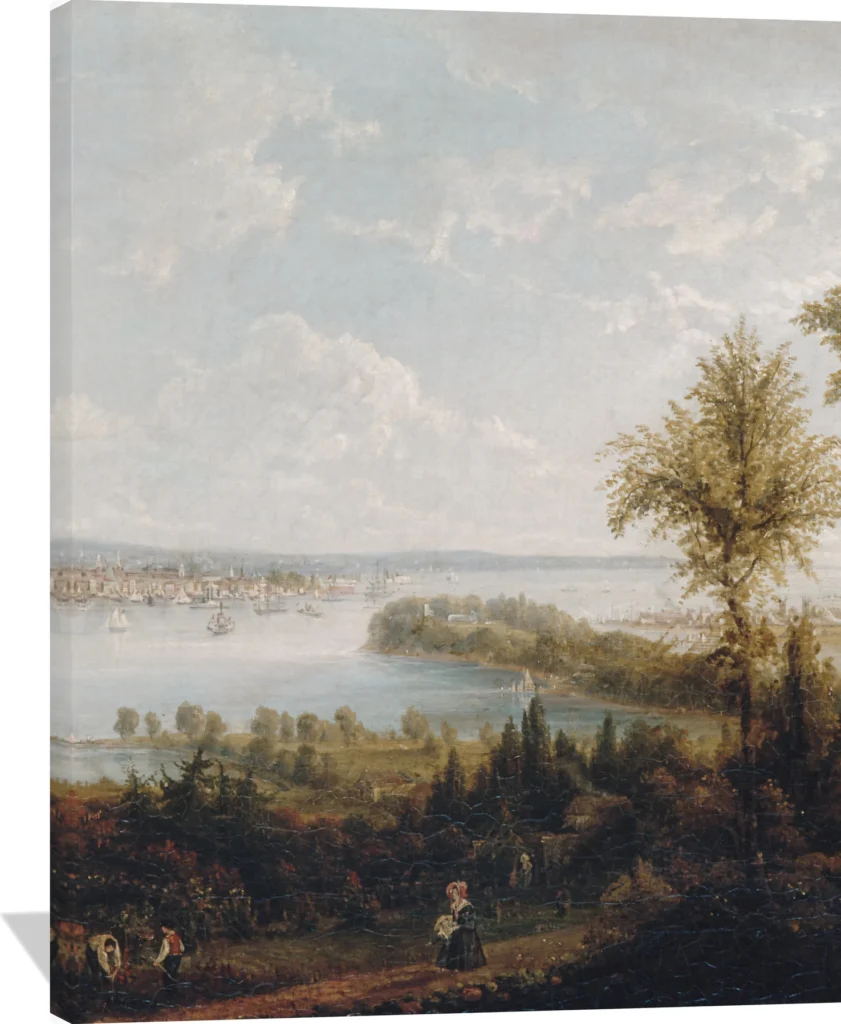
The Robert Havell Jr. View of the Bay and City of New York from Weehawken canvas captures a serene 19th-century panorama of New York Harbor bathed in soft light. Gentle blues, warm ochres, and lush greens evoke a tranquil balance between nature and the growing city, rendered with Havell’s refined precision and atmospheric depth.
This timeless wall art brings a sense of calm grandeur to any interior. Ideal for a living room, study, or entryway, this exquisite canvas print invites viewers to pause and appreciate the harmony of land, water, and sky that defined early American landscapes.
Robert Havell Jr. (1793–1878) was an American artist and master engraver, born in Reading, England, who later settled in Tarrytown, New York. Renowned for his collaboration with John James Audubon, he played a pivotal role in shaping the visual identity of early American natural history.
Artistic Style and Technique
Havell’s work is distinguished by its precision, clarity, and refined engraving technique. Trained in the British mezzotint and aquatint traditions, he brought a disciplined yet expressive touch to natural subjects. His engravings demonstrate a remarkable ability to translate delicate textures, subtle tonal shifts, and lifelike anatomical detail, resulting in imagery that is both scientifically accurate and visually captivating.
Notable Contributions
Havell is best known as the principal engraver and printer of Audubon’s monumental series The Birds of America. His craftsmanship elevated the project beyond documentation, giving it an enduring artistic resonance. The combination of Audubon’s original watercolors and Havell’s masterful engraving and hand-coloring helped establish the publication as one of the most celebrated achievements in American art and natural history. His contribution to this collaboration is often regarded as a defining force behind the work’s extraordinary beauty and technical excellence.
Subjects and Themes
Although Havell produced landscapes, panoramic views, and independent prints after moving to the United States, he remained most associated with wildlife imagery. His subjects typically include birds, botanical elements, and scenes derived from the American wilderness. His ability to capture both the vitality and fragility of the natural world lends his work a sense of authenticity that continues to resonate with collectors.
Cultural and Historical Significance
Havell’s contributions extend beyond artistic merit; they played a key role in shaping early American visual culture. By helping bring American wildlife to audiences across Europe and the United States, he broadened public appreciation for the continent’s natural richness. His engravings established a benchmark for natural history illustration, influencing generations of artists, printmakers, and environmental observers.
What Makes His Work Distinctive
Havell’s legacy rests on his unmatched technical skill and his ability to balance scientific precision with aesthetic appeal. His prints possess a clarity, vibrancy, and compositional poise that remain instantly recognizable. Through meticulous engraving and a deep sensitivity to form, he transformed natural subjects into enduring works of art, ensuring his place among the most influential printmakers of the nineteenth century.
Trust & policies
- 🚚 Free tracked shipping to 45+ countries. Local import duties or taxes may apply in some destinations.
- 🎨 Made-to-order, printed close to your delivery location
- 🛡️ If damaged, defective, or misprinted: free replacement or refund
- 🌍 Printed in US/CA/EU/UK/AU based on delivery location
- 💎 Acid-free, fade-resistant canvas with solid wood stretcher bars
- 🖼️ Optional pine floating frames in white, black, or brown
- 🪝 Ready to hang — hardware pre-installed