
Marcantonio Pasqualini (1614–1691) Crowned by Apollo
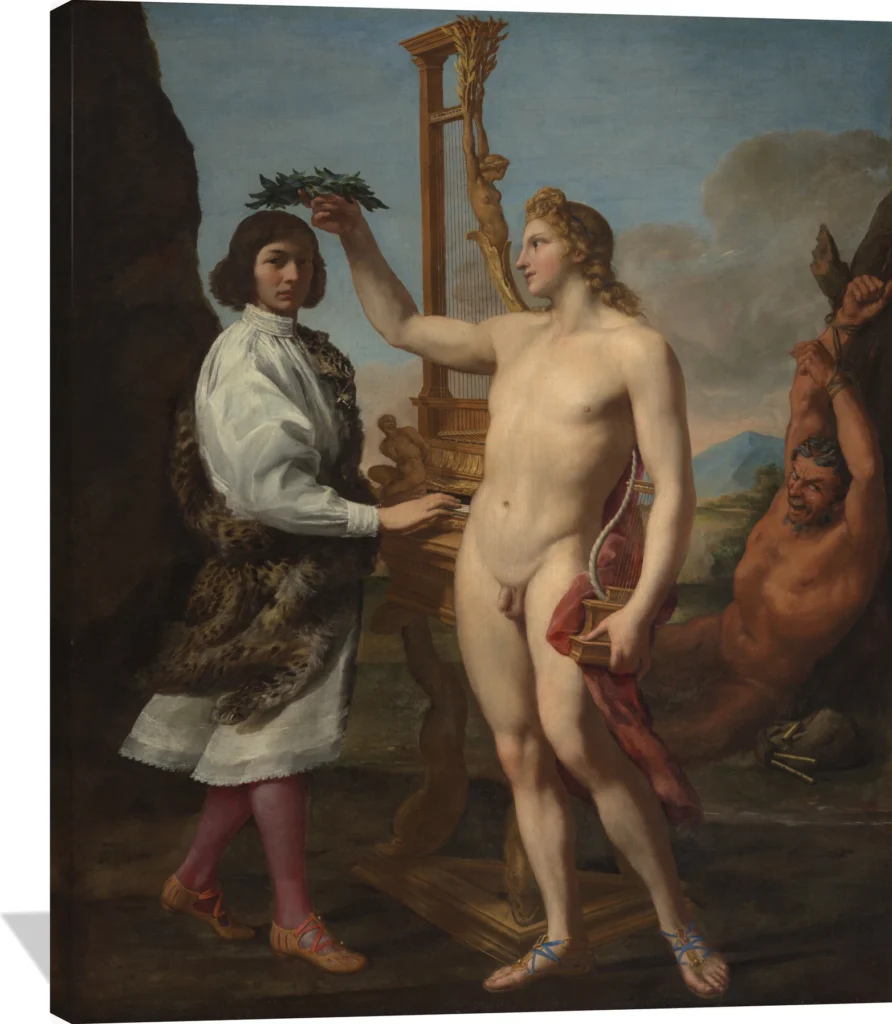
The Andrea Sacchi Marcantonio Pasqualini (1614–1691) Crowned by Apollo canvas captures a moment of divine recognition rendered in luminous tones of gold, rose, ivory, and deep brown. Apollo, radiant and poised, crowns the musician Pasqualini, symbolizing artistic triumph and celestial harmony. The balanced composition and classical serenity reflect Sacchi’s mastery of Baroque refinement.
This museum-quality wall art brings timeless grace and intellectual depth to any living room, study, or entryway. A stunning canvas print that celebrates the union of music, art, and myth—perfect for collectors and admirers of Italian classicism.
Andrea Sacchi (ca. 1599–1661) was a leading figure of the Roman Baroque whose refined approach set him apart from the more theatrical tendencies of his contemporaries. Active primarily in Rome, he developed a poetic, elevated style that emphasized clarity, balance, and the expressive power of the human figure.
Artistic Style
Sacchi championed a restrained and intellectually focused interpretation of Baroque classicism. Rather than dynamic excess, he favored compositional harmony, lucid narratives, and a controlled emotional register. His palette leaned toward luminous, softly modulated tones that enhanced the sculptural precision of his figures. This commitment to purity and order positioned him as a counterpoint to the grand, energetic manner of artists like Pietro da Cortona.
Subjects and Themes
Best known for religious and historical works, Sacchi depicted saints, allegories, and episodes from antiquity with a contemplative grace. His paintings often highlight the dignity and inner life of his subjects, creating scenes that feel both intimate and monumental. Works such as The Vision of St. Romuald exemplify his ability to convey serenity and spiritual depth through deliberate composition and refined gesture.
Legacy and Significance
Sacchi’s influence extended through his role as a teacher and his advocacy for artistic discipline during a pivotal moment in Roman art. He became a central voice in the era’s debates about the ideal number of figures in narrative painting, arguing for simplicity and intelligibility principles that left a lasting mark on seventeenth‑century aesthetics. As a result, he is remembered as a steward of Baroque classicism whose work continues to appeal to viewers drawn to elegance, precision, and intellectual clarity.
Trust & policies
- 🚚 Free tracked shipping to 45+ countries. Local import duties or taxes may apply in some destinations.
- 🎨 Made-to-order, printed close to your delivery location
- 🛡️ If damaged, defective, or misprinted: free replacement or refund
- 🌍 Printed in US/CA/EU/UK/AU based on delivery location
- 💎 Acid-free, fade-resistant canvas with solid wood stretcher bars
- 🖼️ Optional pine floating frames in white, black, or brown
- 🪝 Ready to hang — hardware pre-installed