
Judgment of Paris
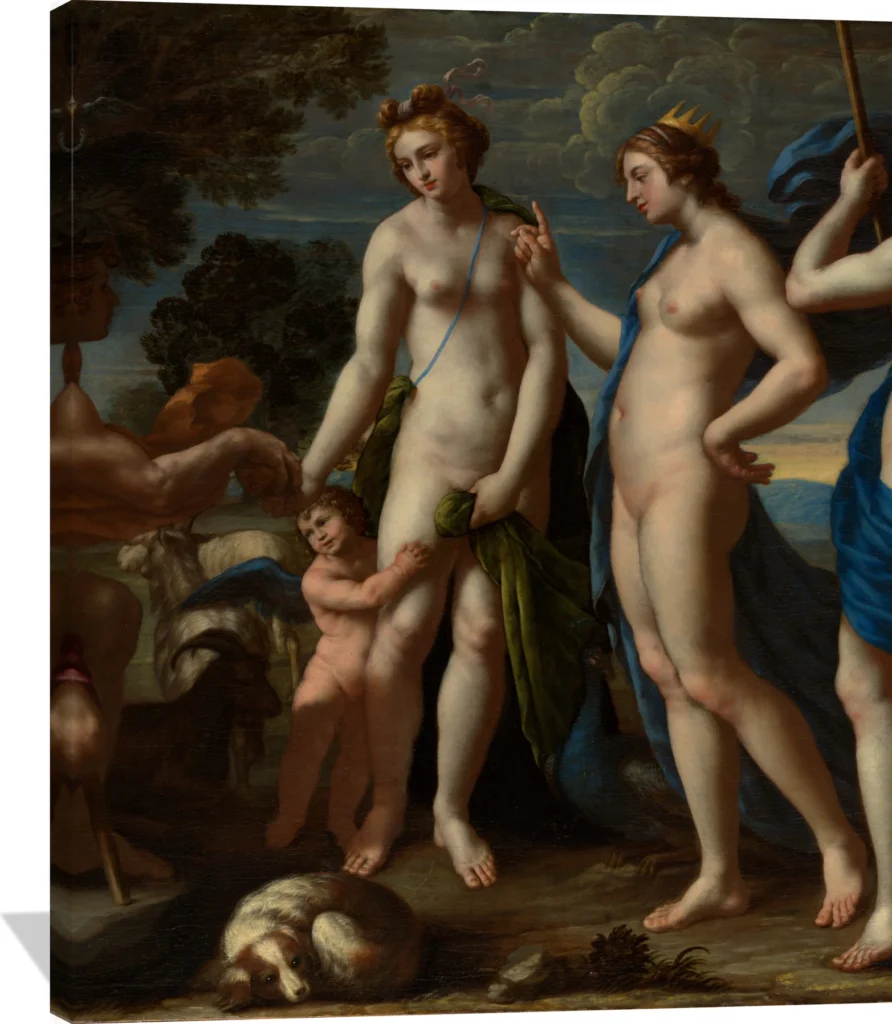
The Alessandro Turchi Judgment of Paris canvas captures a timeless mythological moment with masterful elegance. Bathed in warm earth tones, soft golds, and deep blues, this Baroque composition radiates sensuality and divine drama as the gods and goddesses gather beneath a turbulent sky. Turchi’s refined brushwork and luminous figures evoke both beauty and tension, making it a striking focal point for any art lover’s collection.
This exquisite Judgment of Paris wall art brings classical grandeur to contemporary interiors. Ideal for a living room, study, or entryway, the canvas print infuses your space with the sophistication and storytelling of 17th-century Italian artistry.
Alessandro Turchi (Verona 1578–1649 Rome) was an influential Italian painter whose elegant blend of late Mannerism and early Baroque sensibilities made him a sought‑after artistic voice in both his native Verona and later in Rome.
Artistic Style
Turchi’s work is distinguished by refined draftsmanship, luminous color harmonies, and a graceful interplay of shadow and light. His style balances the expressive drama of the Baroque with the polished subtlety of Mannerist tradition, resulting in compositions that feel both emotionally charged and meticulously controlled. His figures often carry a soft, porcelain-like modeling, contributing to the lyrical sophistication characteristic of his paintings.
Subjects and Themes
Best known for devotional imagery, Turchi frequently depicted saints, mythological scenes, and intimate religious narratives. He had a particular talent for presenting sacred subjects with gentle emotional resonance, creating works that invite contemplation rather than spectacle. His smaller cabinet paintings, often executed on slate, were especially prized for their jewel-like precision and durability.
Notable Contributions
Turchi played a significant role in the cultural exchange between Verona and Rome during a crucial period of stylistic transition. Upon moving to Rome, he worked alongside prominent contemporaries and contributed to major commissions for churches and private patrons. His ability to harmonize Veronese colorism with Roman Baroque dynamism helped establish him as a respected figure within the city’s competitive artistic circles.
Legacy
Turchi’s work remains admired for its elegant restraint and poetic expressiveness. His paintings, including celebrated examples such as The Death of Cleopatra and Saint Sebastian, continue to illustrate his mastery of atmosphere, narrative clarity, and emotional subtlety. Through his refined approach and skillful technique, Alessandro Turchi secured a lasting place within the broader history of Italian Baroque art.
Trust & policies
- 🚚 Free tracked shipping to 45+ countries. Local import duties or taxes may apply in some destinations.
- 🎨 Made-to-order, printed close to your delivery location
- 🛡️ If damaged, defective, or misprinted: free replacement or refund
- 🌍 Printed in US/CA/EU/UK/AU based on delivery location
- 💎 Acid-free, fade-resistant canvas with solid wood stretcher bars
- 🖼️ Optional pine floating frames in white, black, or brown
- 🪝 Ready to hang — hardware pre-installed