
Fruit and Flowers
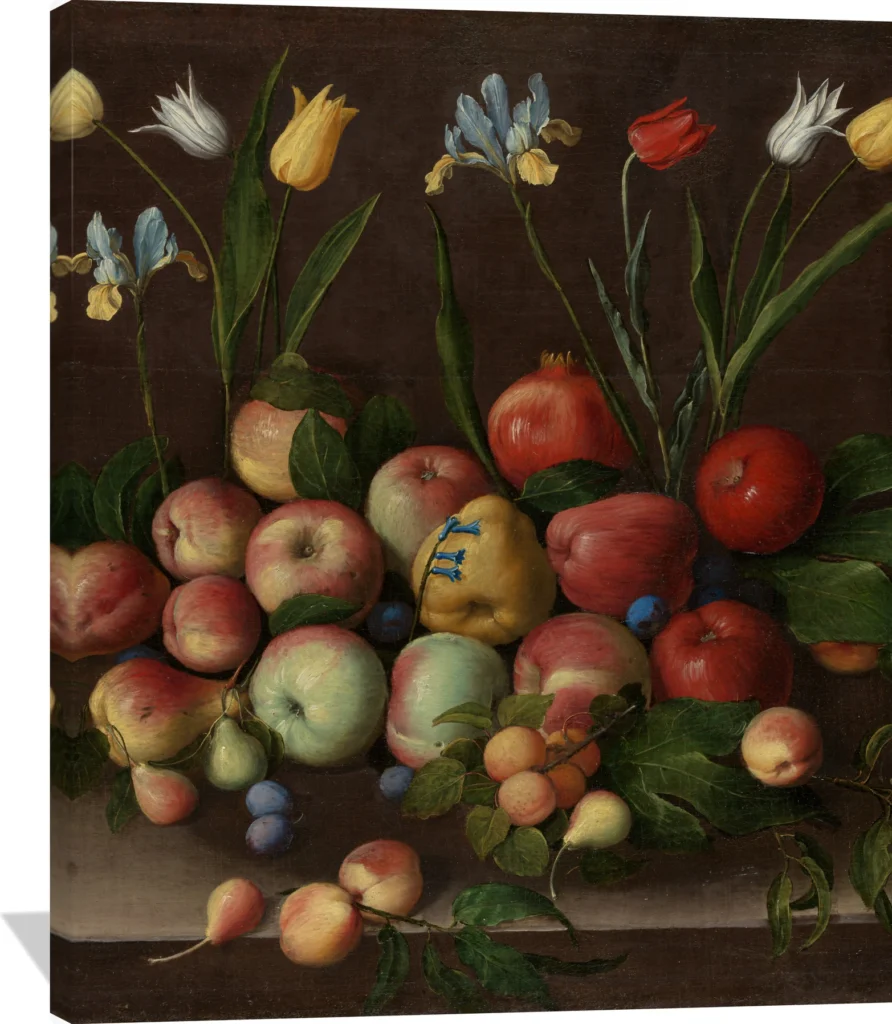
The Orsola Maddalena Caccia Fruit and Flowers canvas captures the timeless beauty of nature’s abundance with exquisite realism. Lush peaches, apples, and pears rest beside vivid tulips and irises, their colors glowing against a deep, warm background. Rich reds, soft yellows, and leafy greens create a balanced composition that feels both serene and luxurious.
This elegant wall art brings a sense of harmony and refinement to any space—perfect for a living room, dining area, or study. A masterful blend of Baroque detail and natural grace, this canvas print celebrates the artistry of one of Italy’s pioneering painters, transforming everyday fruit and flowers into a scene of enduring beauty.
Orsola Maddalena Caccia (1596–1676) was an Italian painter from Moncalvo, renowned for her refined Baroque sensibility and the singular perspective she brought as a cloistered nun-artist. Trained by her father, the Mannerist painter Guglielmo Caccia, she developed a distinctive visual language that blended devotional intensity with meticulous naturalism.
Artistic Style
Caccia’s work is characterized by serene compositions, luminous color harmonies, and an exceptionally detailed rendering of flora, fauna, and everyday objects. Her paintings often unite religious imagery with still-life arrangements, creating a contemplative atmosphere that bridges spiritual symbolism with the tangible world. This fusion positioned her as a pioneering figure in the evolution of Northern Italian still life.
Notable Subjects
While best known for her devotional scenes featuring saints, the Virgin, and monastic life, Caccia also produced richly observed still lifes that reflect an almost scientific attentiveness. Works such as Still Life with Flowers and Fruit highlight her ability to elevate humble subjects through careful composition and controlled light. Her paintings frequently feature botanical elements rendered with striking precision, a hallmark of her practice within the convent studios.
Cultural and Historical Significance
As one of the few documented women artists of the Italian Baroque, Caccia occupies a meaningful place in art history. Her dual role as a nun and a professional painter allowed her to create a sustained body of work within the supportive structure of the Ursuline convent in Moncalvo, where she also trained other sisters in artistic production. Her legacy resonates today for the clarity of her vision and her contributions to the refinement of still-life painting.
What Makes Her Work Distinctive
Caccia’s paintings stand out for their harmony of spirituality and observation, combining devotional themes with vivid natural detail. Her ability to balance contemplative serenity with painterly precision has made her a notable and enduring presence within the Baroque era. Marked by quiet intensity and exquisite detail, her works remain admired for their beauty and their rare insight into the artistic life of women in early modern Italy.
Trust & policies
- 🚚 Free tracked shipping to 45+ countries. Local import duties or taxes may apply in some destinations.
- 🎨 Made-to-order, printed close to your delivery location
- 🛡️ If damaged, defective, or misprinted: free replacement or refund
- 🌍 Printed in US/CA/EU/UK/AU based on delivery location
- 💎 Acid-free, fade-resistant canvas with solid wood stretcher bars
- 🖼️ Optional pine floating frames in white, black, or brown
- 🪝 Ready to hang — hardware pre-installed