
Bindo Altoviti (1491–1557)
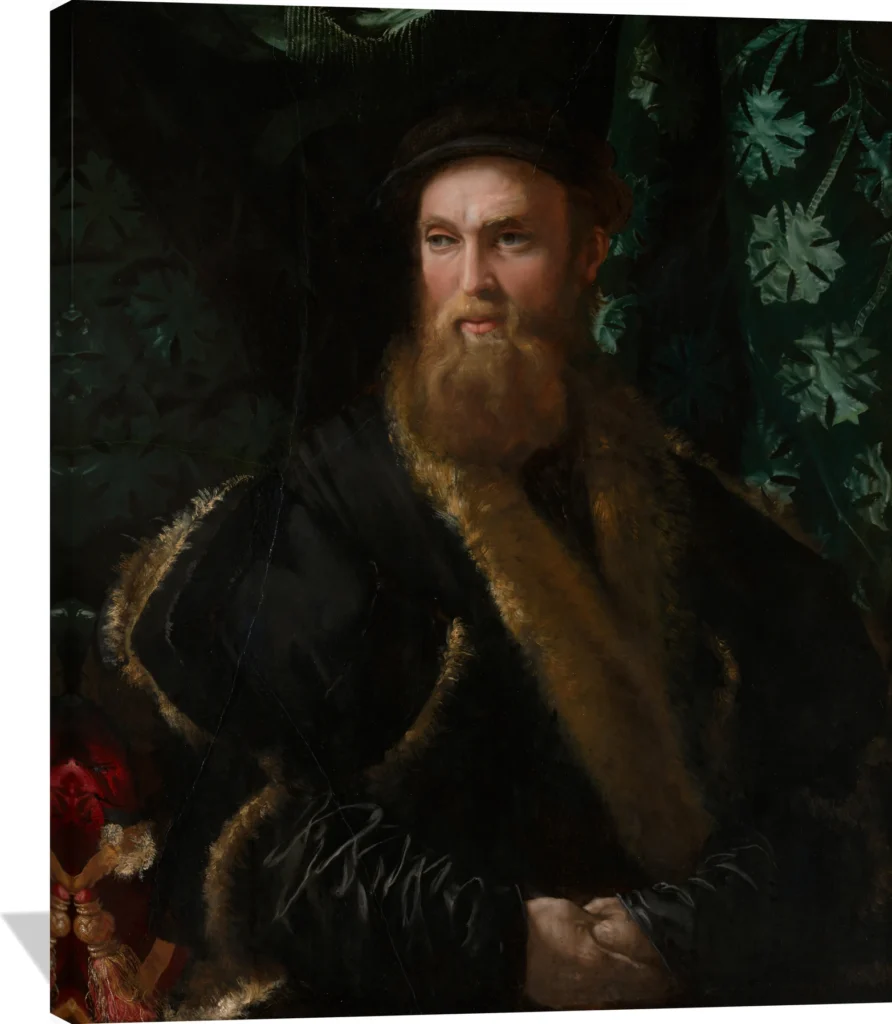
The Francesco Salviati Bindo Altoviti canvas captures the quiet authority and refined elegance of a Renaissance patron. Rich tones of deep green, gold, and black envelop the sitter, while the artist’s masterful brushwork highlights the textures of fur and fabric with luminous precision. The contemplative gaze and subtle play of light evoke timeless sophistication and depth.
This museum-quality canvas print brings classical grandeur to any interior. Ideal for a study, living room, or entryway, it adds a sense of history and poise—an exquisite statement piece for those who appreciate the artistry of Florence’s Golden Age.
Francesco Salviati, born Francesco de’ Rossi in Florence in 1510, emerged as one of the defining painters of the Italian Mannerist movement. Active in Florence, Venice, and ultimately Rome, he developed a distinctive visual language characterized by elegant elongation, refined draftsmanship, and sophisticated allegorical themes. His career reflected the artistic vitality of mid‑sixteenth‑century Italy, where innovation and classical revival flourished side by side.
Artistic Style
Salviati’s work is immediately recognizable for its fluid contours, expressive poses, and dynamic compositions. His mastery of color and anatomical precision reveals a deep understanding of High Renaissance ideals, while his inventive distortions and heightened elegance mark a clear shift toward Mannerism. This combination allowed him to create visually opulent scenes that balanced technical control with imaginative boldness.
Typical Subjects
He frequently explored religious narratives, mythological subjects, and complex allegories, bringing humanist intellect and emotional nuance to each composition. Whether depicting saints, classical deities, or courtly figures, Salviati infused his subjects with a distinctive grace that elevated both sacred and secular themes.
Contributions and Significance
Known for his fresco cycles in Rome and his influence within elite artistic circles, Salviati played a significant role in shaping the visual culture of the period. His work helped define the sophisticated, courtly aesthetic associated with Italian Mannerism, influencing contemporaries and later generations. Today, he is celebrated for his refined compositional intelligence and his ability to reinterpret classical tradition with inventive flair.
Legacy
Francesco Salviati’s artistic legacy endures through his vibrant frescoes, elegant drawings, and evocative panel paintings. His contributions stand as a testament to the creative ambition of sixteenth‑century Italy, offering a compelling blend of virtuosity, beauty, and intellectual depth.
Trust & policies
- 🚚 Free tracked shipping to 45+ countries. Local import duties or taxes may apply in some destinations.
- 🎨 Made-to-order, printed close to your delivery location
- 🛡️ If damaged, defective, or misprinted: free replacement or refund
- 🌍 Printed in US/CA/EU/UK/AU based on delivery location
- 💎 Acid-free, fade-resistant canvas with solid wood stretcher bars
- 🖼️ Optional pine floating frames in white, black, or brown
- 🪝 Ready to hang — hardware pre-installed