
The Road from Moret to Saint-Mammès
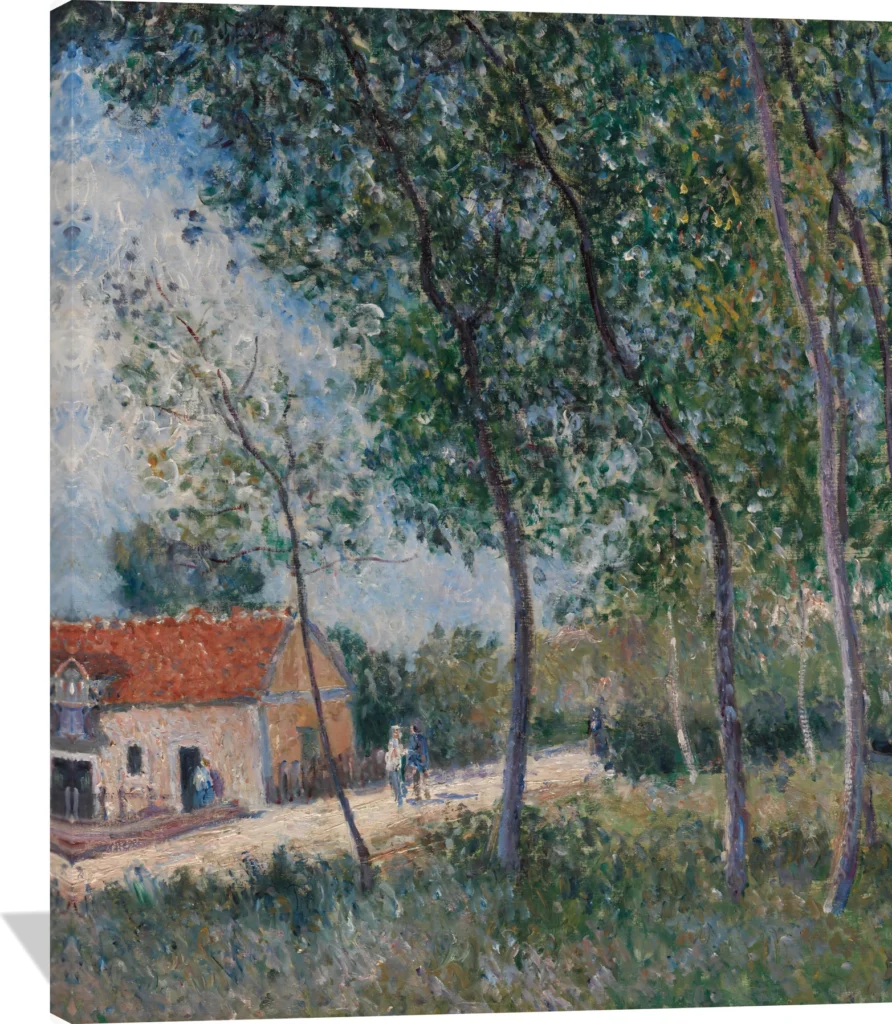
The Alfred Sisley The Road from Moret to Saint-Mammès canvas captures the serene charm of the French countryside bathed in soft, dappled light. Gentle greens, sky blues, earthy browns, and warm terracotta tones blend in Sisley’s signature Impressionist brushwork, evoking a tranquil afternoon along a sunlit path framed by slender trees.
This timeless wall art brings a sense of calm and open air to any interior, from a bright living room to a quiet study or entryway. A fine canvas print for those who appreciate natural beauty and the poetic light of 19th-century landscape painting.
Alfred Sisley (British, Paris 1839–1899 Moret-sur-Loing) was a central figure of Impressionism, celebrated for his poetic dedication to landscape painting. Although born to English parents in Paris, he became deeply embedded in the city’s avant‑garde circles, working alongside Monet, Renoir, and Pissarro as the movement took shape.
Artistic Style and Approach
Sisley’s work is distinguished by a gentle luminosity and an unwavering commitment to painting outdoors. His brushwork is fluid yet restrained, capturing subtle shifts of atmosphere, season, and time of day. Rather than dramatic vistas, he favored quiet riverbanks, village streets, and expansive skies rendered with a clarity and calm that define his signature style. His refined sense of color allowed him to create scenes that feel both naturalistic and quietly lyrical, making him one of Impressionism’s most consistent interpreters of light.
Subjects and Contributions
Sisley devoted much of his career to the landscapes around Paris and the countryside near Moret‑sur‑Loing, where he produced some of his most recognizable compositions. Works such as Flood at Port‑Marly and Snow at Louveciennes showcase his ability to convey atmosphere with remarkable sensitivity. Unlike some of his contemporaries who explored urban bustle or modern life, Sisley remained focused on pure landscape, helping to elevate the genre within the modern artistic canon.
Cultural Significance
Though less commercially successful during his lifetime, Sisley’s contributions to Impressionism are now regarded as essential. His steadfast dedication to capturing nature’s fleeting qualities shaped the movement’s visual language and influenced generations of landscape painters. Today, his paintings are admired for their serenity, balance, and the quiet mastery of light that defines his most enduring works.
Trust & policies
- 🚚 Free tracked shipping to 45+ countries. Local import duties or taxes may apply in some destinations.
- 🎨 Made-to-order, printed close to your delivery location
- 🛡️ If damaged, defective, or misprinted: free replacement or refund
- 🌍 Printed in US/CA/EU/UK/AU based on delivery location
- 💎 Acid-free, fade-resistant canvas with solid wood stretcher bars
- 🖼️ Optional pine floating frames in white, black, or brown
- 🪝 Ready to hang — hardware pre-installed