
Peasant Girl with a White Headcloth
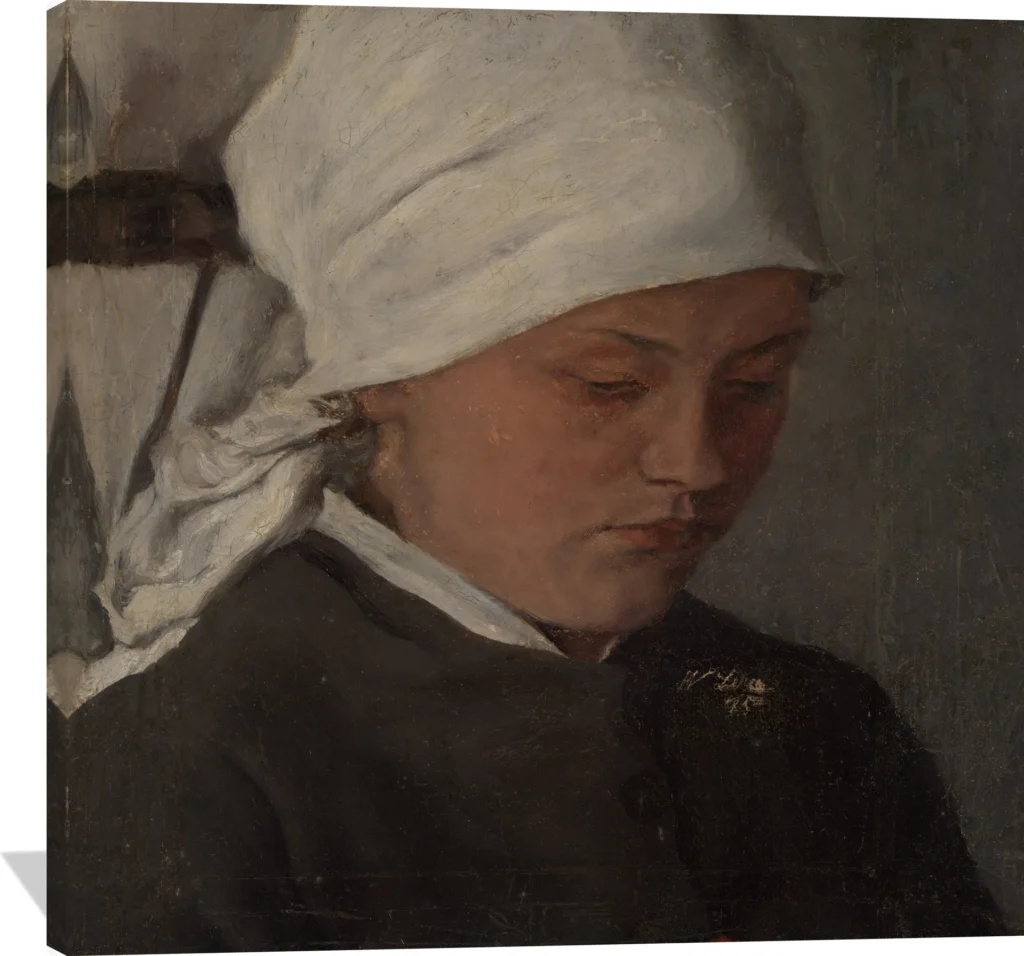
The Wilhelm Leibl Peasant Girl with a White Headcloth canvas captures quiet introspection through masterful realism. Rendered in soft earth tones, muted grays, and gentle whites, the portrait’s subdued palette and delicate lighting evoke a sense of calm dignity and timeless beauty. Leibl’s attention to texture and natural expression creates a deeply human connection that enriches any space.
This museum-quality wall art brings warmth and sophistication to your living room, study, or entryway. A canvas print of this serene composition invites reflection and adds a touch of 19th-century German artistry to contemporary interiors.
Wilhelm Leibl (1844–1900), born in Cologne and active throughout Germany, was a pivotal figure in nineteenth-century realist painting. Working during a period of profound artistic transition, he earned recognition for his uncompromising commitment to truthful visual observation and for elevating everyday life into quietly powerful works of art.
Artistic Style
Leibl is best known for his rigorous realism, marked by finely attuned draftsmanship and an unembellished, atmospheric naturalism. Influenced early in his career by the work of Gustave Courbet, he developed a style that emphasized direct, unidealized representation. His brushwork is subdued yet precise, creating surfaces that feel both tactile and deeply contemplative. This dedication to exactness, combined with a subtle emotional resonance, made him a leading figure in the movement often referred to as the Leibl Circle.
Subjects and Themes
Leibl’s paintings frequently center on rural life, capturing farmers, villagers, and domestic interiors with striking sincerity. Rather than romanticizing these subjects, he portrayed them with a quiet dignity that reflects his deep respect for the rhythms and realities of everyday existence. His figures are typically rendered with meticulous attention to posture, gesture, and facial expression, lending works such as The Three Women in Church an almost sculptural intensity.
Legacy and Significance
Throughout his career, Leibl resisted the decorative tendencies of emerging modernist movements, choosing instead to refine a vision grounded in observation and authenticity. His influence extended across Germany and beyond, inspiring contemporaries who sought to reconnect art with lived experience. Today, he is celebrated for the sensitivity of his portrayals and for his role in defining a distinctly German form of realism at the turn of the century.
Trust & policies
- 🚚 Free tracked shipping to 45+ countries. Local import duties or taxes may apply in some destinations.
- 🎨 Made-to-order, printed close to your delivery location
- 🛡️ If damaged, defective, or misprinted: free replacement or refund
- 🌍 Printed in US/CA/EU/UK/AU based on delivery location
- 💎 Acid-free, fade-resistant canvas with solid wood stretcher bars
- 🖼️ Optional pine floating frames in white, black, or brown
- 🪝 Ready to hang — hardware pre-installed