
Hermann von Wedigh III (died 1560)
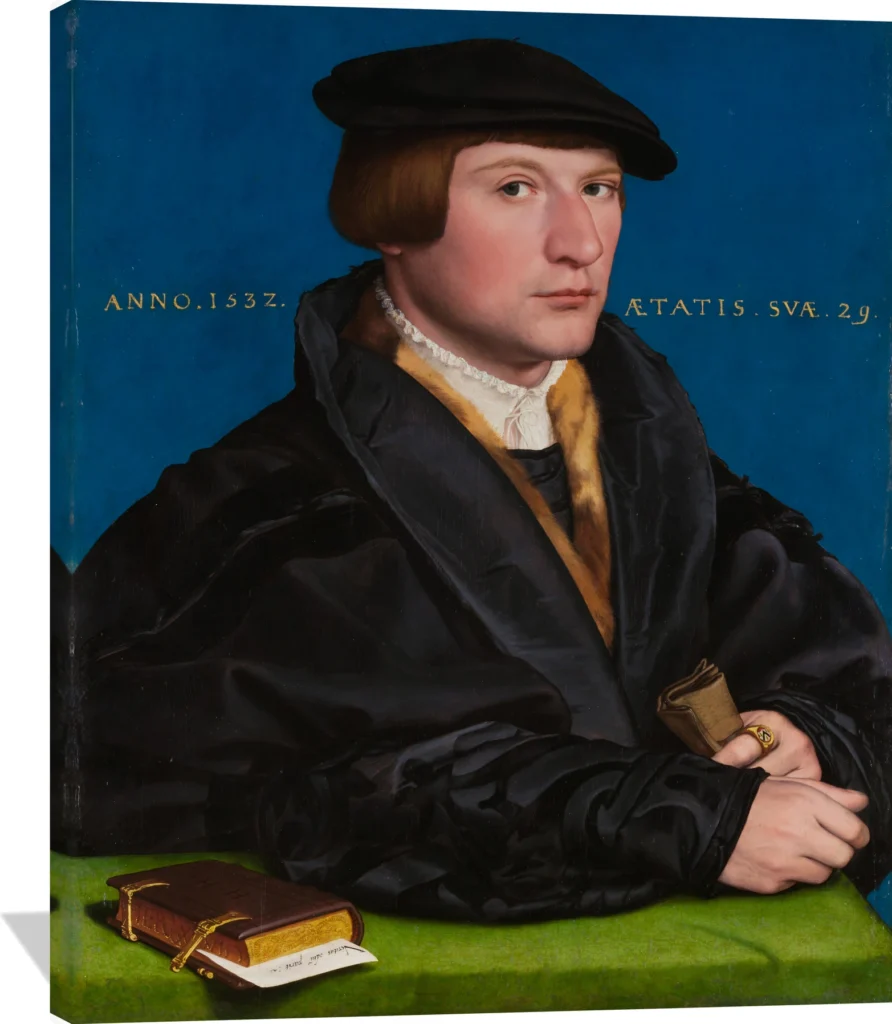
The Hans Holbein the Younger Hermann von Wedigh III (died 1560) canvas captures Renaissance refinement with striking realism. Against a vivid blue background, the sitter’s calm gaze and finely rendered black attire convey dignity and intellect, hallmarks of Holbein’s mastery. Subtle contrasts of emerald green, deep black, warm flesh tones, and gold accents create a timeless visual harmony.
This museum-quality wall art brings sophistication and historical depth to any interior. Ideal for a study, library, or elegant living space, this canvas print celebrates the precision and poise of one of the 16th century’s greatest portraitists.
Hans Holbein the Younger (German, Augsburg 1497/98–1543 London) was one of the most influential painters of the Northern Renaissance, celebrated for his unmatched precision, psychological insight, and elegant visual clarity.
Artistic Style
Holbein’s work is defined by extraordinary draftsmanship, refined linear control, and a cool, meticulous realism. His portraits balance lifelike detail with a powerful sense of presence, revealing the character of his sitters through subtle expression and richly rendered textures. His ability to fuse Northern naturalism with Renaissance compositional harmony distinguishes him as a master of early modern portraiture.
Notable Contributions
Active in both Basel and the Tudor court in London, Holbein helped shape the visual identity of the 16th century. His incisive portraits of European humanists and English nobility including the iconic image of Henry VIII set a new standard for political and personal representation. His designs for printed works, religious imagery, and decorative arts further expanded his impact across media.
Typical Subjects
Holbein is best known for his penetrating portraits of scholars, diplomats, merchants, and royalty, often captured with remarkable clarity and restrained elegance. He also produced religious scenes, allegorical compositions, and book illustrations, including the influential Dance of Death series.
Cultural and Historical Significance
As a central figure of the Northern Renaissance, Holbein brought intellectual depth and visual sophistication to an era of profound cultural change. His portraits remain essential historical documents, and his mastery of realistic representation continues to influence artists today. A true innovator, Holbein stands as a defining force in the evolution of European portraiture and a key interpreter of the political and humanist currents of his time.
Trust & policies
- 🚚 Free tracked shipping to 45+ countries. Local import duties or taxes may apply in some destinations.
- 🎨 Made-to-order, printed close to your delivery location
- 🛡️ If damaged, defective, or misprinted: free replacement or refund
- 🌍 Printed in US/CA/EU/UK/AU based on delivery location
- 💎 Acid-free, fade-resistant canvas with solid wood stretcher bars
- 🖼️ Optional pine floating frames in white, black, or brown
- 🪝 Ready to hang — hardware pre-installed