
View of Toledo
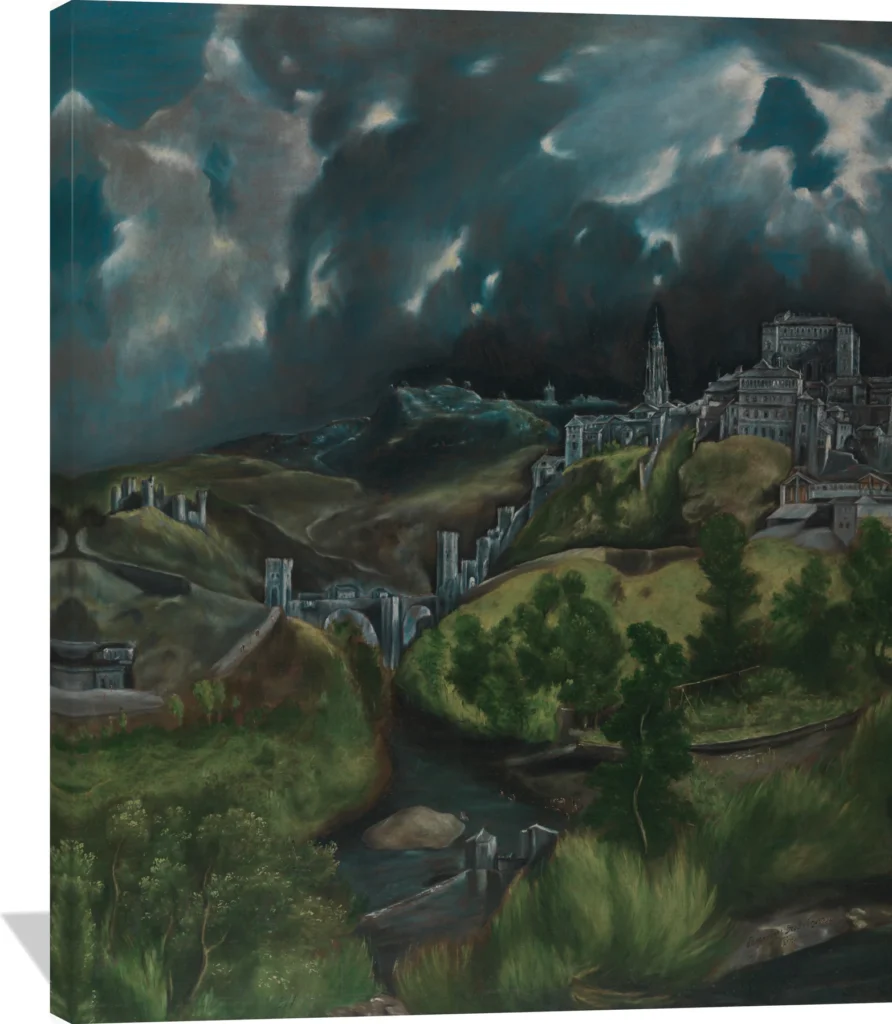
The El Greco View of Toledo canvas captures the dramatic skyline of the Spanish city under a stormy, luminous sky. Deep greens, moody blues, and silvery grays swirl together in expressive brushwork that evokes both mystery and grandeur. This masterful landscape reflects El Greco’s visionary style—where nature and architecture merge in spiritual intensity.
Perfect as a statement wall art piece for a living room, study, or entryway, this canvas print brings timeless sophistication to any space. The View of Toledo canvas print invites contemplation and adds a touch of Old World drama to modern interiors.
El Greco (Domenikos Theotokopoulos), born in 1541 in Iráklion on the island of Crete and active until his death in Toledo in 1614, was a singular force in the evolution of Western art. Trained initially within the traditions of Byzantine icon painting, he later absorbed the innovations of Venetian masters and the expressive intensity of Roman Mannerism, ultimately forging a style that remains unmistakably his own.
Artistic Style
El Greco’s work is defined by elongated figures, dramatic contrasts of light and shadow, and bold, otherworldly color. His compositions often stretch the boundaries of naturalism, using distortion as a vehicle for emotion and spiritual intensity. This visionary approach, marked by a heightened sense of movement and atmosphere, positions him as a precursor to Expressionism and a pivotal figure in the transition toward modern sensibilities.
Subjects and Themes
His paintings gravitate toward religious narratives, portraits of Spanish nobility, and scenes infused with mystical fervor. Works such as The Burial of the Count of Orgaz or View of Toledo reveal his ability to merge earthly realism with transcendent symbolism, creating images that feel both immediate and ethereal. Whether depicting saints, apostles, or civic leaders, El Greco imbued his subjects with a striking psychological depth.
Legacy and Cultural Significance
Having spent the most influential phase of his career in Toledo, El Greco became deeply intertwined with the cultural identity of Spain’s Golden Age. His innovative visual language challenged conventional aesthetics of the period, and though misunderstood by many of his contemporaries, his work later inspired artists from the nineteenth and twentieth centuries who admired his expressive freedom. Today, he is celebrated as a master whose distinctive vision bridges Byzantine tradition, Renaissance innovation, and the emotive power of modern art.
Trust & policies
- 🚚 Free tracked shipping to 45+ countries. Local import duties or taxes may apply in some destinations.
- 🎨 Made-to-order, printed close to your delivery location
- 🛡️ If damaged, defective, or misprinted: free replacement or refund
- 🌍 Printed in US/CA/EU/UK/AU based on delivery location
- 💎 Acid-free, fade-resistant canvas with solid wood stretcher bars
- 🖼️ Optional pine floating frames in white, black, or brown
- 🪝 Ready to hang — hardware pre-installed