
A Farm in Brittany
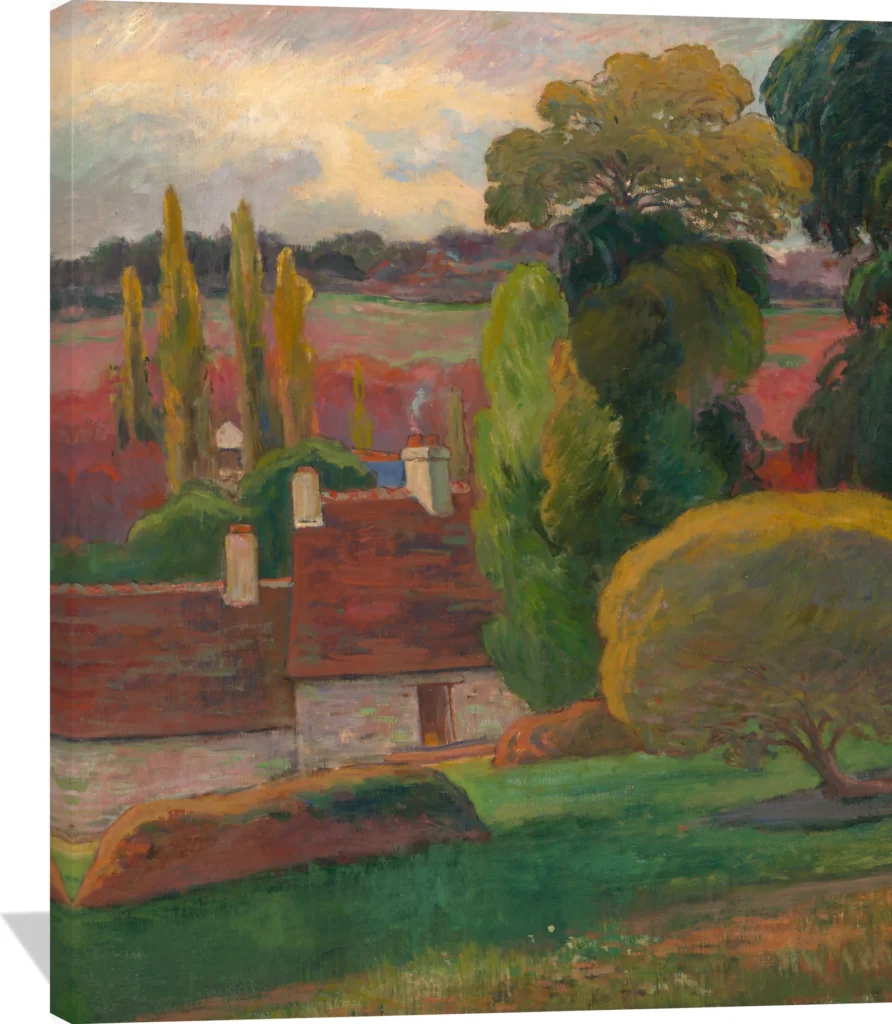
The Paul Gauguin A Farm in Brittany canvas captures the serene charm of rural France through vivid color and expressive brushwork. Soft greens, ochres, and rose tones blend harmoniously across the landscape, where cottages nestle among lush trees beneath a glowing sky. Gauguin’s distinctive style transforms a simple countryside view into a poetic study of light and mood.
This museum-quality canvas print brings timeless sophistication to any space. Ideal for a living room, study, or entryway, it evokes calm and contemplation while adding a touch of post‑Impressionist elegance to your wall art collection.
Paul Gauguin (French, Paris 1848–1903 Atuona, Hiva Oa, Marquesas Islands) was a pioneering Post‑Impressionist whose bold vision reshaped modern art. Renowned for his pursuit of emotional truth over naturalistic representation, he developed a highly personal style defined by expressive color, flattened forms, and striking compositional simplicity.
Artistic Style and Approach
Gauguin’s work embodies a deliberate break from conventional Western realism. Rejecting optical accuracy, he embraced symbolic color, rhythmic outlines, and distilled shapes to create images that conveyed inner meaning rather than surface appearance. This approach, often associated with Synthetism and Symbolism, became a foundation for many early modernist movements. His use of radiant, non-naturalistic hues and expansive areas of unmodulated color remains one of his most influential contributions.
Subjects and Themes
Drawn to places he believed offered a more elemental way of life, Gauguin spent significant periods in Brittany, Tahiti, and the Marquesas Islands. These journeys profoundly shaped his art. He depicted daily rituals, spiritual motifs, and local landscapes with a blend of observation and imagination, creating scenes that feel at once intimate and mythic. Works such as Where Do We Come From? What Are We? Where Are We Going? capture his enduring preoccupation with humanity’s existential questions.
Legacy and Cultural Significance
Gauguin’s pursuit of a new visual language made him a central figure in the transition from Impressionism to modern art. His emphasis on expressive color inspired artists from the Nabis to Fauvist painters like Matisse. His distinctive fusion of symbolism, emotional intensity, and innovative form has secured his place as a transformative force in modern painting. Today, Gauguin’s work remains celebrated for its vivid originality and its powerful exploration of belief, identity, and the human condition.
Trust & policies
- 🚚 Free tracked shipping to 45+ countries. Local import duties or taxes may apply in some destinations.
- 🎨 Made-to-order, printed close to your delivery location
- 🛡️ If damaged, defective, or misprinted: free replacement or refund
- 🌍 Printed in US/CA/EU/UK/AU based on delivery location
- 💎 Acid-free, fade-resistant canvas with solid wood stretcher bars
- 🖼️ Optional pine floating frames in white, black, or brown
- 🪝 Ready to hang — hardware pre-installed