
Portrait of a Man in Armor with Two Pages
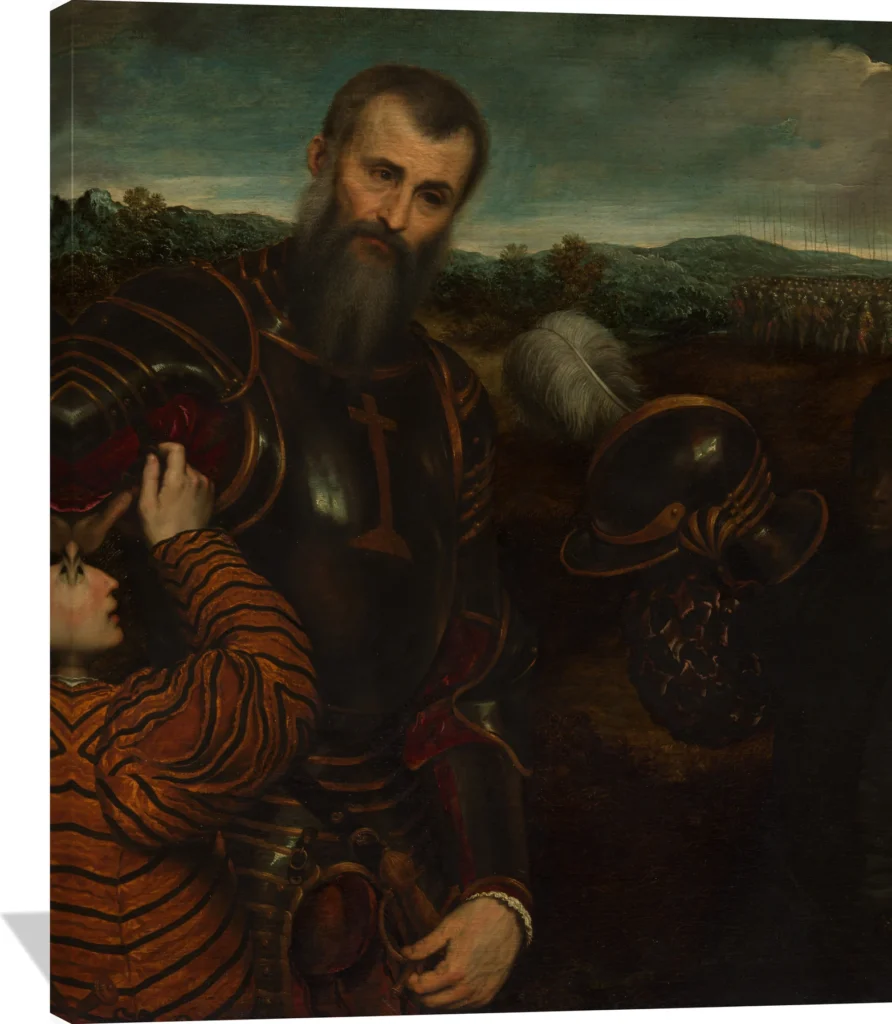
The Paris Bordon Portrait of a Man in Armor with Two Pages canvas captures the commanding presence of a noble warrior framed by two youthful attendants. Deep bronze, crimson, and golden tones contrast with a moody sky and distant landscape, creating a sense of quiet strength and Renaissance grandeur. The artist’s refined brushwork and dramatic lighting evoke both power and introspection.
This museum-quality canvas print brings timeless sophistication to any space. Ideal for a study, library, or elegant living room, this wall art adds depth and historical character while celebrating the artistry of Italian master Paris Bordon (Treviso 1500–1571 Venice).
Paris Bordon (Treviso 1500–1571 Venice) was an Italian Renaissance painter whose refined sense of color and elegant compositions positioned him among the notable successors of Titian. Active primarily within the Venetian artistic sphere, he developed a distinctive visual language that merged the opulent warmth of the Venetian palette with a graceful, often courtly sensibility.
Artistic Style
Bordon’s work is recognized for its luminous color harmonies, supple figuration, and subtle atmospheric effects. While influenced by Titian, he forged his own approach, distinguished by polished surfaces and a poised, sometimes theatrical elegance. His use of soft modeling and rich chromatic transitions supported a visual world that felt both vibrant and serene.
Subjects and Themes
His paintings range from religious scenes to mythological narratives and refined portraiture. Bordon excelled at representing figures with a natural yet idealized presence, often set against architectural or landscape backgrounds that enhanced their expressive impact. In works such as the celebrated Fisherman Presenting the Ring to the Doge, he demonstrated a confident command of storytelling and ceremonial grandeur.
Legacy and Significance
Bordon’s ability to synthesize Venetian colorism with a distinctive poetic sensibility secured his reputation among Renaissance masters. His paintings reveal the richness of sixteenth‑century Venetian culture, embodying its taste for beauty, sophistication, and visual splendor. Today, he is appreciated for his contribution to the evolution of Venetian painting and for the enduring refinement that characterizes his art.
Trust & policies
- 🚚 Free tracked shipping to 45+ countries. Local import duties or taxes may apply in some destinations.
- 🎨 Made-to-order, printed close to your delivery location
- 🛡️ If damaged, defective, or misprinted: free replacement or refund
- 🌍 Printed in US/CA/EU/UK/AU based on delivery location
- 💎 Acid-free, fade-resistant canvas with solid wood stretcher bars
- 🖼️ Optional pine floating frames in white, black, or brown
- 🪝 Ready to hang — hardware pre-installed