
Susan Walker Morse (The Muse)
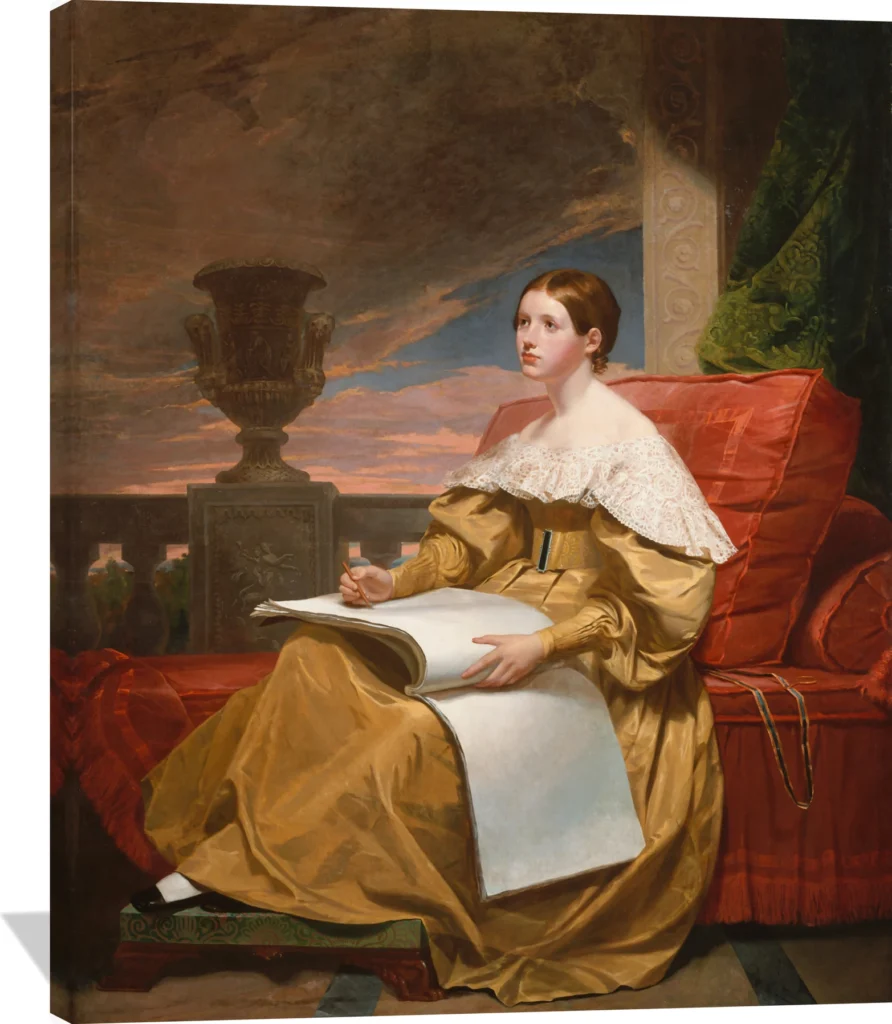
The Samuel F. B. Morse Susan Walker Morse (The Muse) canvas captures a moment of quiet introspection and grace. Bathed in warm golden tones, deep reds, and soft creams, the composition portrays a poised young woman in elegant attire, illuminated against a dramatic twilight sky. The artist’s refined brushwork and balanced composition evoke timeless sophistication and emotional depth.
This exquisite wall art brings classical refinement to any interior, from a serene study to a grand living room. A premium canvas print of Susan Walker Morse (The Muse) offers a window into 19th-century artistry and an enduring symbol of creative contemplation.
Samuel F. B. Morse (1791–1872) was an American painter and inventor whose career bridged the worlds of fine art and groundbreaking technology. Born in Charlestown, Massachusetts and later active in New York, he trained in both the United States and Europe, developing a refined academic style grounded in clarity, precision, and classical balance.
Artistic Style and Approach
Morse’s painting is marked by controlled draftsmanship, polished surfaces, and a disciplined sense of composition. Early in his career he focused on portraiture, capturing sitters with an attentive realism that reflected both technical skill and an interest in character. His later works reveal a growing ambition toward grand historical and intellectual themes, integrating complex architectural spaces and numerous carefully rendered figures.
Notable Works and Subjects
Among his most recognized paintings is Gallery of the Louvre, a vast, meticulously detailed interior that demonstrates Morse’s fascination with European masterpieces and his desire to bring their influence to American audiences. Portraits such as his depictions of John Adams, James Monroe, and the Marquis de Lafayette show his facility with likeness and his engagement with the cultural and political life of the young nation. Throughout his artistic career, Morse balanced an interest in individual identity with an aspiration to elevate American art through exposure to European traditions.
Cultural and Historical Significance
While widely known today for co-developing the telegraph and the Morse code, his legacy as a painter remains an essential part of early American art history. His efforts to promote artistic education helped shape institutions such as the National Academy of Design, and his paintings document a formative era in the country’s creative development. Though his inventive achievements eventually overshadowed his studio practice, Morse’s refined technique, academic rigor, and commitment to the cultural advancement of the United States continue to distinguish his work.
Trust & policies
- 🚚 Free tracked shipping to 45+ countries. Local import duties or taxes may apply in some destinations.
- 🎨 Made-to-order, printed close to your delivery location
- 🛡️ If damaged, defective, or misprinted: free replacement or refund
- 🌍 Printed in US/CA/EU/UK/AU based on delivery location
- 💎 Acid-free, fade-resistant canvas with solid wood stretcher bars
- 🖼️ Optional pine floating frames in white, black, or brown
- 🪝 Ready to hang — hardware pre-installed