
Madame Philippe Panon Desbassayns de Richemont (Jeanne Eglé Mourgue, 1778–1855) and Her Son, Eugène (1800–1859)
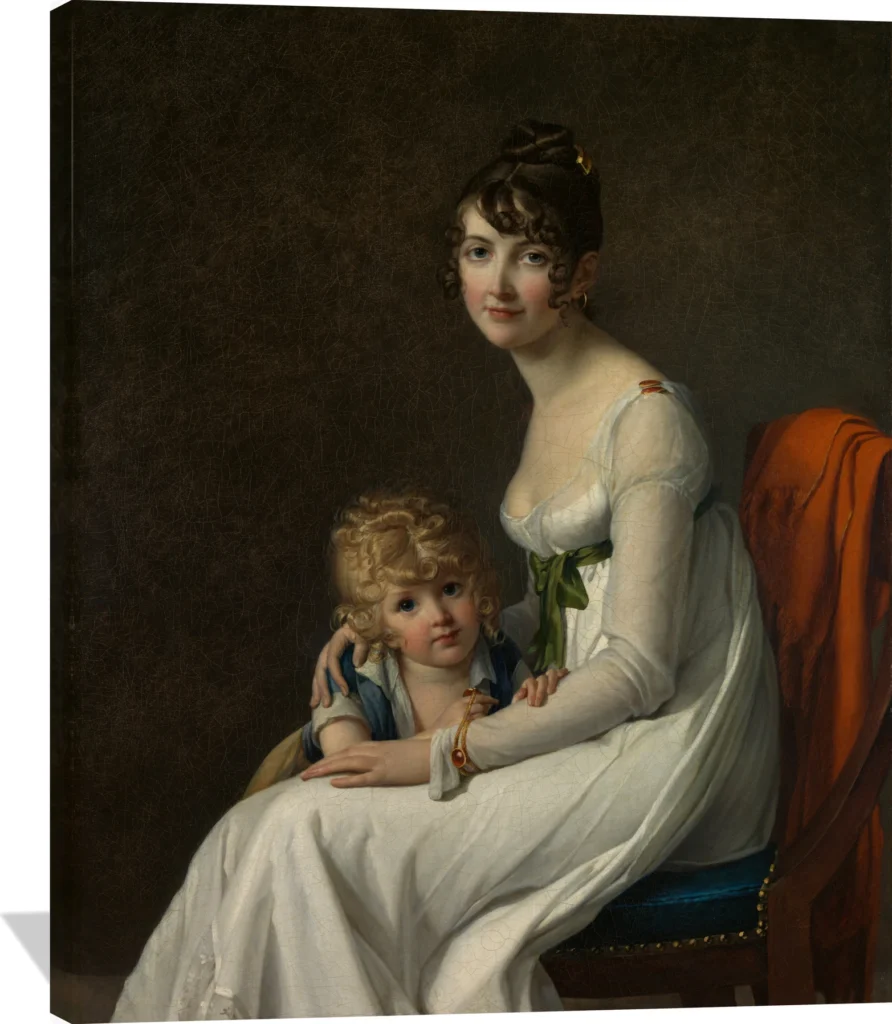
The Marie Guillemine Benoist Madame Philippe Panon Desbassayns de Richemont and Her Son, Eugène canvas captures timeless grace and maternal warmth in luminous detail. Soft ivory tones, gentle blues, and warm browns blend harmoniously, highlighting the tender bond between mother and child. Benoist’s refined neoclassical style and delicate brushwork create a serene, intimate atmosphere that enriches any space.
This exquisite wall art brings elegance and emotional depth to a living room, study, or entryway. A premium canvas print of this French masterpiece invites both sophistication and sentiment into your home, celebrating beauty, family, and artistry from the early 19th century.
Marie Guillemine Benoist (French, Paris 1768–1826 Paris) was a distinguished painter whose career bridged the late Enlightenment and the rise of French Neoclassicism. Trained under Elisabeth Vigée Le Brun and Jacques-Louis David, she developed a refined visual language that combined classical rigor with an intimate sensitivity to her subjects.
Artistic Style
Benoist’s work is marked by controlled composition, luminous color, and an elegant precision typical of Neoclassical aesthetics. Her portraits reveal a nuanced balance between idealization and psychological depth, capturing both physical presence and emotional resonance. She often employed a restrained palette and crisp contours that emphasized clarity and structure, hallmarks of the period’s academic tradition.
Subjects and Themes
Best known for her portraits, Benoist portrayed figures from the intellectual and political circles of her time. Her subjects frequently reflect the shifting social landscape of post-Revolutionary France. Works such as her iconic Portrait of a Black Woman demonstrate her ability to engage with contemporary conversations on identity and humanity while maintaining a dignified and contemplative aesthetic. Domestic interiors, fashionable attire, and expressive physiognomy appear throughout her oeuvre, underscoring her interest in individuality and social presence.
Notable Contributions
Benoist stands out as one of the few women to gain meaningful visibility in the French art world of the early nineteenth century. Exhibiting at the Salon and navigating a male-dominated academic system, she advanced the presence of women artists during a time of limited opportunity. Her paintings show mastery of the polished Neoclassical portrait, yet they also reveal a subtle departure toward more personal and empathetic representation. This blend of discipline and sensitivity is a key aspect of her enduring appeal.
Cultural and Historical Significance
Her work occupies an important position in the evolution of French portraiture. Beyond her technical skill, Benoist’s legacy lies in her ability to convey humanity with clarity and grace, offering a window into the aspirations and complexities of her era. Today, she is recognized for her contribution to the broader narrative of women in art and for the quiet but profound strength found in her refined visual voice.
Trust & policies
- 🚚 Free tracked shipping to 45+ countries. Local import duties or taxes may apply in some destinations.
- 🎨 Made-to-order, printed close to your delivery location
- 🛡️ If damaged, defective, or misprinted: free replacement or refund
- 🌍 Printed in US/CA/EU/UK/AU based on delivery location
- 💎 Acid-free, fade-resistant canvas with solid wood stretcher bars
- 🖼️ Optional pine floating frames in white, black, or brown
- 🪝 Ready to hang — hardware pre-installed