
A Lady Applying Henna to Her Foot
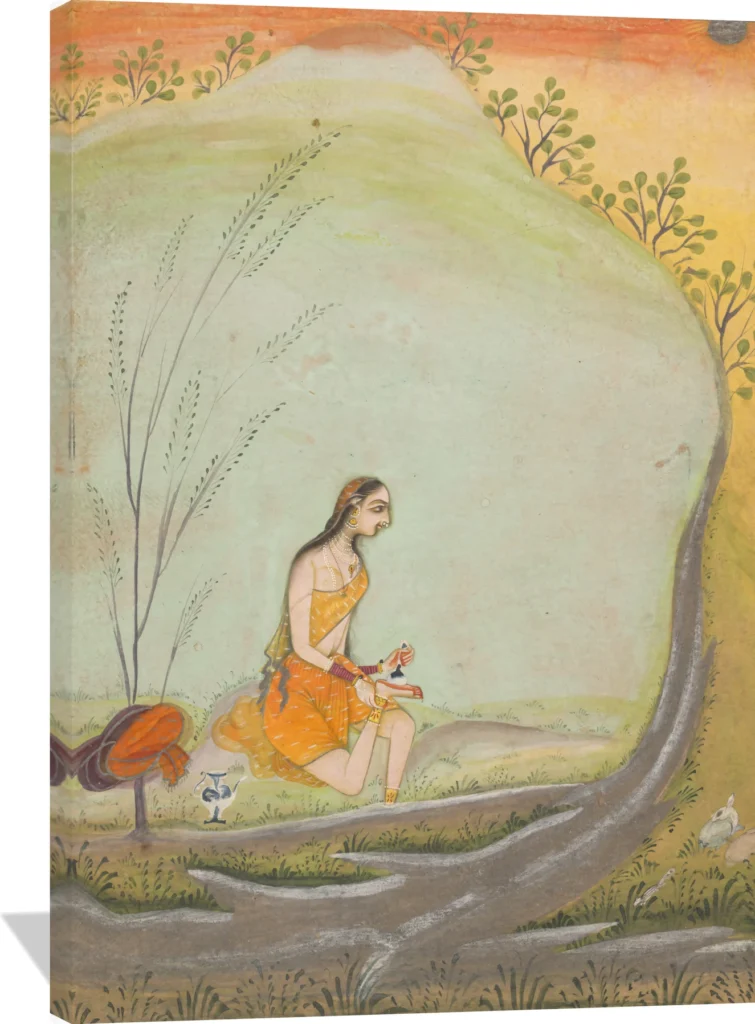
The Ustad Mohamed, son of Murad A Lady Applying Henna to Her Foot canvas captures a moment of quiet grace and feminine ritual. Rendered in warm tones of saffron, soft green, and muted gold, this elegant wall art reflects the refined detail and serenity of Mughal miniature painting. The lady’s poised gesture and the gentle landscape create a timeless atmosphere of beauty and contemplation.
This exquisite canvas print brings an aura of cultural sophistication to any space—perfect for a living room, study, or entryway. A refined choice for collectors and admirers of traditional artistry, it adds warmth, depth, and storytelling to modern interiors.
Ustad Mohamed, son of Murad, is recognized as a distinguished painter associated with the refined traditions of Mughal and Indo-Persian miniature art. Although little biographical detail survives, his work is linked to the elite atelier culture in which mastery of line, color, and delicate illumination defined an artist’s reputation.
Artistic Style
Ustad Mohamed is noted for his meticulous brushwork, clarity of contour, and nuanced layering of pigments that create depth without sacrificing the flat elegance characteristic of court painting. His compositions often balance intricate ornamental detailing with a calm, meditative atmosphere. Hallmarks of his style include precise facial modeling, jewel-like color harmonies, and sophisticated spatial organization that subtly guides the viewer’s gaze.
Subjects and Themes
His subjects typically reflect the visual culture of the Mughal era, from courtly portraits and poetic scenes to nature studies infused with quiet symbolism. Whether depicting noble figures, literary vignettes, or carefully rendered flora and fauna, Ustad Mohamed demonstrated an ability to transform everyday observation into refined visual poetry. Many works attributed to him reveal an interest in emotional subtlety small gestures, sidelong glances, and finely articulated hands elements that elevate intimate scenes into expressions of human dignity.
Cultural and Historical Significance
As the son of Murad, likely a craftsman or painter within a related artistic milieu, Ustad Mohamed inherited and advanced a lineage of disciplined workshop practice. His contribution lies in sustaining and enriching the aesthetic principles that defined Mughal painting at its height: controlled elegance, captivating detail, and a deep engagement with literary and imperial culture. Artists like Ustad Mohamed played a vital role in shaping a visual language that blended Persianate sophistication with the evolving artistic tastes of the Indian subcontinent.
Distinctive Qualities
What distinguishes Ustad Mohamed’s work is the fusion of technical precision with a quiet, contemplative beauty. His paintings display a rare understanding of color modulation and a disciplined use of line that conveys both vitality and restraint. Viewers and collectors value his art for its exquisite craftsmanship and its ability to evoke the intellectual and aesthetic richness of the Mughal court.
Today, works attributed to Ustad Mohamed, son of Murad, stand as enduring examples of miniature painting’s capacity for delicacy, narrative depth, and cultural resonance. Whether illustrating scenes of poetic imagination or capturing the radiance of royal presence, his art reflects a legacy grounded in mastery and devotion to the miniature tradition’s highest ideals.
Trust & policies
- 🚚 Free tracked shipping to 45+ countries. Local import duties or taxes may apply in some destinations.
- 🎨 Made-to-order, printed close to your delivery location
- 🛡️ If damaged, defective, or misprinted: free replacement or refund
- 🌍 Printed in US/CA/EU/UK/AU based on delivery location
- 💎 Acid-free, fade-resistant canvas with solid wood stretcher bars
- 🖼️ Optional pine floating frames in white, black, or brown
- 🪝 Ready to hang — hardware pre-installed