
Study of a Female Nude
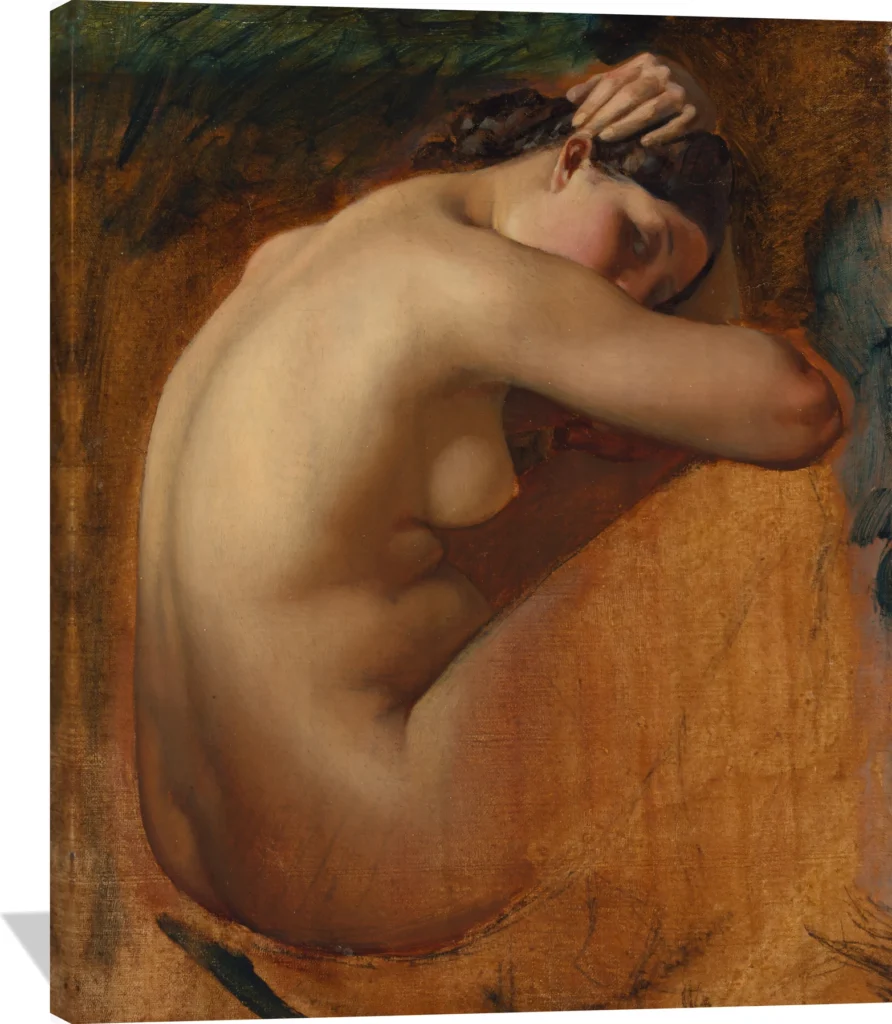
The Henri Lehmann Study of a Female Nude canvas captures the quiet grace of the human form with masterful sensitivity. Rendered in soft amber, sienna, and muted green tones, the composition radiates warmth and introspection. The artist’s delicate brushwork and subtle play of light evoke both classical beauty and emotional depth.
This refined canvas print brings timeless elegance to any interior—ideal for a living room, study, or entryway seeking a touch of serene sophistication. A tribute to Lehmann’s French artistry, this wall art invites reflection and adds a cultured, contemplative atmosphere to your space.
Henri Lehmann (French, Kiel 1814–1882 Paris) was a distinguished painter of the 19th century whose refined technique and intellectual approach placed him at the heart of French academic art. Trained under Jean-Auguste-Dominique Ingres, Lehmann embraced the ideals of clarity, harmony, and idealized form, becoming one of the era’s most respected interpreters of the classical tradition.
Artistic Style
Lehmann’s work is defined by its meticulous draftsmanship, luminous surfaces, and balanced compositions. His paintings often display the polished precision associated with the Ingres school, yet he brought to his subjects a personal lyricism that softened strict academic conventions. His control of line and color allowed him to convey both elegance and emotional depth.
Subjects and Themes
He specialized in portraits, history paintings, and allegorical scenes. Lehmann’s portraits capture sitters with calm authority and psychological nuance, while his narrative works, including depictions of classical mythology and biblical themes, reveal a devotion to the ideals of beauty and moral clarity. Works such as Marguerite Listening to Faust demonstrate his ability to blend literary inspiration with visual harmony.
Legacy and Significance
Active within Paris’s cultural circles and later a professor at the École des Beaux-Arts, Lehmann influenced a generation of young artists through his commitment to disciplined technique and expressive restraint. His oeuvre remains valued for its serenity, precision, and the enduring elegance that characterizes his contribution to 19th‑century French painting.
Trust & policies
- 🚚 Free tracked shipping to 45+ countries. Local import duties or taxes may apply in some destinations.
- 🎨 Made-to-order, printed close to your delivery location
- 🛡️ If damaged, defective, or misprinted: free replacement or refund
- 🌍 Printed in US/CA/EU/UK/AU based on delivery location
- 💎 Acid-free, fade-resistant canvas with solid wood stretcher bars
- 🖼️ Optional pine floating frames in white, black, or brown
- 🪝 Ready to hang — hardware pre-installed