
The Third Avenue Railroad Depot
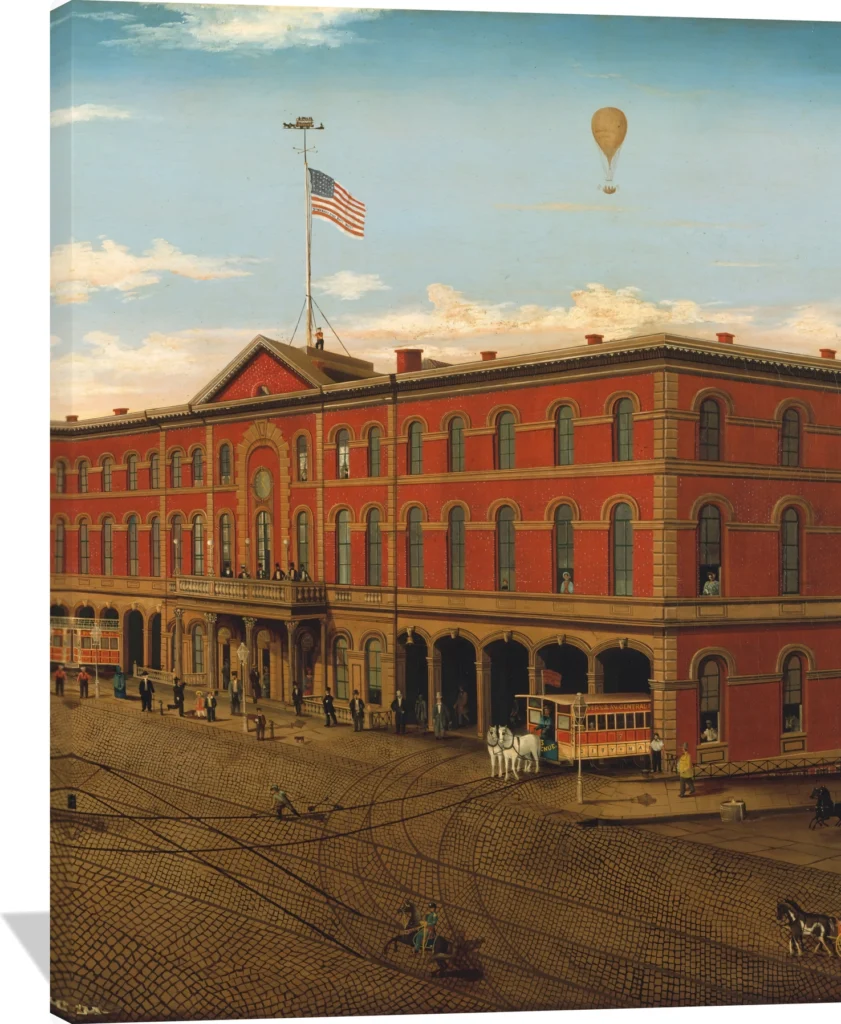
The William H. Schenck The Third Avenue Railroad Depot canvas captures a vivid moment of 19th-century urban life with striking architectural precision. The grand red-brick depot stands proudly against a soft blue and peach sky, where a hot air balloon drifts above bustling horse-drawn streetcars and elegantly dressed figures. Warm tones of brick, gold, and ochre blend with cool sky hues to create a balanced, nostalgic composition.
This finely detailed wall art brings historic charm and quiet sophistication to any space. Perfect for a study, living room, or entryway, this canvas print celebrates the artistry and craftsmanship of Schenck’s mid-century vision of progress and city life.
William H. Schenck was an American painter active from approximately 1854 to 1864, working during a transformative decade in the nation’s visual culture. Best known for his contributions to the tradition of mid‑19th‑century American portraiture, he created works that captured the era’s growing desire for personal likeness, social identity, and domestic refinement.
Artistic Style
Schenck’s style reflects the visual language of American folk and vernacular painting, characterized by clear contours, balanced compositions, and careful attention to expressive detail. His portraits often highlight the sitter’s individuality through nuanced facial modeling paired with simplified surrounding forms. This approach gives his works a distinctive presence, merging realism with the quiet charm associated with regional American art of the period.
Subjects and Themes
His primary subjects were everyday Americans families, tradespeople, and community figures rendered with a sense of dignity and immediacy. Schenck’s paintings frequently emphasize posture, attire, and personal attributes to communicate character and social position. Many works include objects or settings that speak subtly to the sitter’s aspirations, offering an intimate glimpse into mid‑century American life.
Historical Significance
Active during a time of rapid cultural change, Schenck contributed to the expanding visual record of the pre–Civil War United States. His paintings offer valuable insight into the aesthetics and social environments of the period, reflecting a shift toward more personal and accessible forms of portraiture. His work stands as part of the broader movement of regional artists whose creations now serve as important historical documents.
Distinctive Qualities
Schenck’s art is marked by a strong sense of clarity and presence, along with a refined understatement that allows the individuality of each sitter to emerge without embellishment. His portraits carry a quiet authenticity, and the directness of his gaze and the emotional restraint of his compositions give his work an enduring appeal.
Trust & policies
- 🚚 Free tracked shipping to 45+ countries. Local import duties or taxes may apply in some destinations.
- 🎨 Made-to-order, printed close to your delivery location
- 🛡️ If damaged, defective, or misprinted: free replacement or refund
- 🌍 Printed in US/CA/EU/UK/AU based on delivery location
- 💎 Acid-free, fade-resistant canvas with solid wood stretcher bars
- 🖼️ Optional pine floating frames in white, black, or brown
- 🪝 Ready to hang — hardware pre-installed